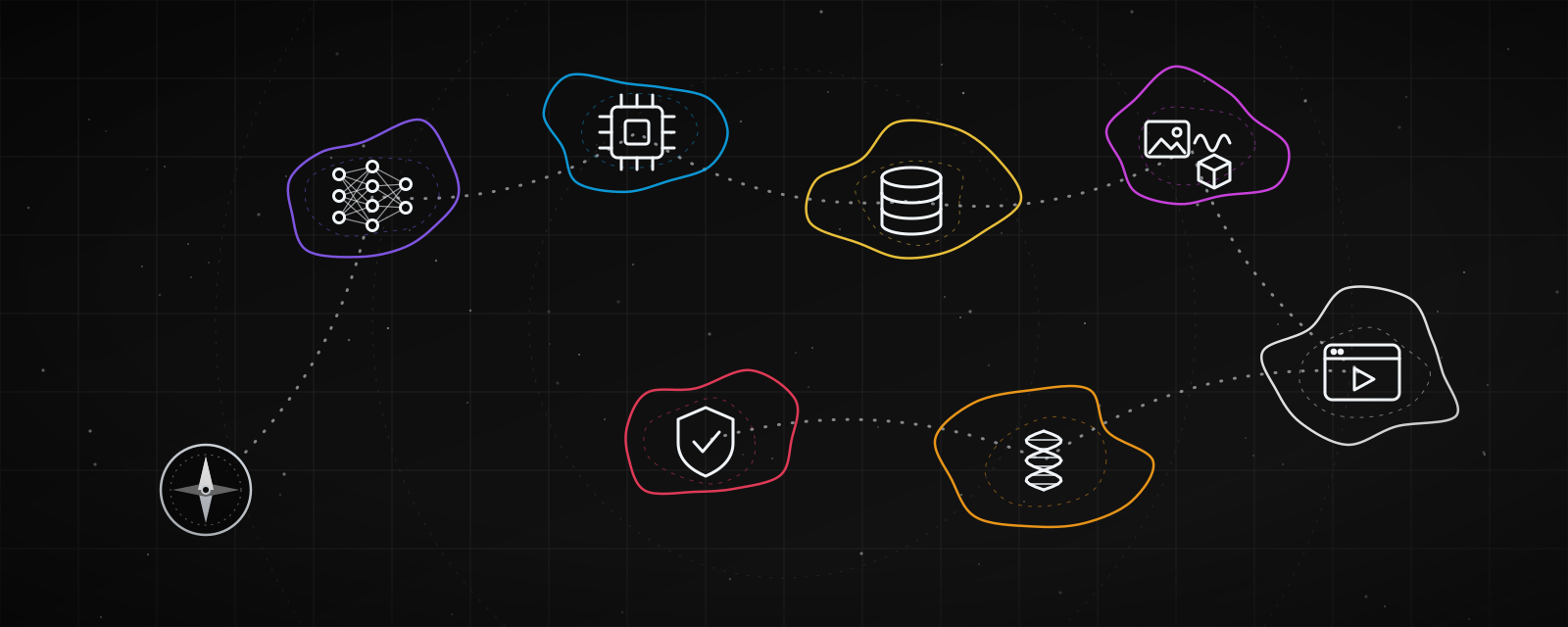
The first question anyone learning AI asks is "what should I learn?" Most roadmaps online describe a single path, or mix job titles, techniques and industries into one list.
This post tries to draw the whole map: which directions AI splits into, what each one does, what you need to learn, how hard it is to get in, and where to start.
Key Takeaways
- AI can't be split into one tree that is both complete and free of overlaps. So this post first describes any AI job from 8 angles, then groups the field into 7 families and 30 directions.
- The 7 families are: foundations and research, systems and hardware, data, data types, building products, industry domains, and trustworthy AI.
- Each direction is explained in plain language: what it does, common job titles, entry barrier, what to learn (in three levels: getting started, building real things, advanced), common tools, and a hands-on practice project.
- The two most overlooked areas are keeping AI running reliably (servers, data) and making AI trustworthy (testing, security, regulation). They are less eye-catching than video generation or robots, yet they are among the hardest roles to hire for in 2026.
- At the end there are suggested starting points for different backgrounds: software engineering, security, data analysis, embedded systems, science research, and design or product.
Why Reclassify
My original list looked like this: forward deployed engineer (FDE), AI engineer, AI agents, data analysis, model training, computer vision, animation generation, music generation, 3D generation, AI for firmware and circuits, on-device AI, robotics, AI for science, biomedicine and DNA analysis, and research skills.
Every item is a real direction, but a closer look reveals three problems.
First, the items are sorted by different angles. Some are job titles, some are techniques, some are industries:
| Angle | Question it answers | Items from the list |
|---|---|---|
| Job | What do you do at work? | FDE, AI engineer, data analysis |
| Technique | What method is used? | AI agents, model training |
| Data type | What kind of data? | Computer vision, animation, music, 3D |
| Where it runs | Where does the AI run? | On-device AI, firmware and circuits |
| Industry | Which industry? | Robotics, AI for science, biomedicine and DNA |
| Research | How is new knowledge produced? | Research skills |
Second, some items overlap. AI agents are part of an AI engineer's job; biomedicine and DNA analysis falls under AI for science; animation generation involves both video and 3D.
Third, there are big gaps. The list leans toward "making visible things" such as video, music and 3D, while understanding-type directions like speech recognition are missing. More importantly, directions that keep AI running (servers, data engineering) and make it trustworthy (testing, security, regulation) don't appear at all.
So this post starts over from the classification method itself.
How the Classification Works
Take "using AI to read X-rays" as an example. It belongs to image processing, to the healthcare industry, and to model development at the same time. Any single tree runs into the question "where does this topic go?"
Academia handles this by classifying from several angles at once. The ACM Computing Classification System lets one topic appear under several branches, and the paper archive arXiv lets one paper carry several categories. This map follows the same idea in four steps:
- Define the angles. Describe any AI job with 8 independent questions.
- Find the directions. A direction must be a real professional community with its own conferences, job titles and common tools.
- Put each direction in exactly one family. Classify it by its most important trait and treat the other traits as tags, so families never overlap.
- Check against outside standards. Compare with the arXiv and ACM categories to make sure every relevant field is covered by at least one direction.
8 independent questions
Real professional communities with conferences, job titles and tools
Classify by the main trait; other traits become tags
Compare with academic categories to make sure nothing is missing
The 8 Angles
Any AI job can be described with these 8 questions. For example, "checking products for defects with a phone camera in a factory" is: model layer, learning from labeled examples, images, recognition, runs on a phone, manufacturing, needs accuracy testing, machine learning engineer.
| Angle | Question it answers | Possible answers |
|---|---|---|
| 1 Technical layer | Which layer of the system? | Chips and hardware, server systems, data, models, applications, products and delivery |
| 2 Learning style | How does the model learn? | From labeled examples, finding patterns on its own, learning to create new content, trial and error, probability, rules and logic |
| 3 Data type | What kind of data? | Text, code, images, video, 3D, speech, music, tables, time series, relationship networks, DNA and molecules, sensor signals, machine movement |
| 4 Task | What should the AI do? | Recognize and understand, create content, predict, search and recommend, reason and plan, decide and control, design the best option |
| 5 Where it runs | Where does the AI run? | Cloud data centers, a company's own servers, phones and laptops, small chips, robots or vehicles |
| 6 Industry | Which industry? | Software, security, finance, healthcare, science, manufacturing and semiconductors, transport, media, education, law, retail, energy, agriculture, government |
| 7 Trust | How is it kept reliable? | Testing and evaluation, security, safe behavior, explainability, privacy, fairness, regulation, user experience |
| 8 Job | What is the job title? | Research scientist, research engineer, machine learning engineer, AI application engineer, forward deployed engineer, infrastructure engineer, data engineer, data analyst, AI security engineer, AI product manager, governance specialist, industry AI specialist, chip engineer |
The 7 families are cut along some of these angles:
| Family | Grouped by | Scope |
|---|---|---|
| F1 Foundations and Research | Learning style | How models learn and why it works |
| F2 Systems and Hardware | Technical layer: systems and hardware | Making AI run |
| F3 Data | Technical layer: data | Organizing data and getting answers from it |
| F4 Data Types | Data type | Understanding and creating text, images, sound and 3D |
| F5 Building Products | Technical layer: applications and delivery | Turning models into products people use |
| F6 Industry Domains | Industry | Directions that need specialist knowledge |
| F7 Trustworthy AI | Trust | Testing, security and regulation that every direction needs |
Overview of 7 Families and 30 Directions
"Entry barrier" has four levels: low, medium, high, and graduate level (usually needs a master's or PhD, or published papers). "Distance from software" is how far the direction is from a typical programming background.
| Distance / barrier | Low | Medium | High | Graduate |
|---|---|---|---|---|
| Near | 09 Data analysis18 AI apps | 08 Data engineering19 AI agents21 FDE27 AI evaluation | ||
| Medium | 23 AI UX30 Privacy and regulation | 04 Research methods05 AI infrastructure06 On-device AI10 Tables and time series11 Language models12 Computer vision14 Speech20 Search and recs22 AI product28 AI security | 03 Reinforcement learning13 Image and video gen17 Multimodal | |
| Far | 02 Model training07 Chips and firmware15 Music and sound16 3D24 Robotics | 01 ML theory25 AI for science26 Bio and genomics29 Alignment |
| # | Direction | In one sentence | Common job titles | Entry barrier | Distance from software |
|---|---|---|---|---|---|
| F1 | Foundations and Research | ||||
| 01 | ML Theory and New Algorithms | Study why models learn and invent new learning methods | Research scientist | Graduate | Far |
| 02 | Large Model Training | Train or tune large models like ChatGPT | Research engineer | High | Far |
| 03 | Reinforcement Learning | Teach AI to make decisions through trial and error | Research engineer | High | Medium |
| 04 | Research Methods | Read papers, run experiments, publish results others cite | Researcher | Medium | Medium |
| F2 | Systems and Hardware | ||||
| 05 | AI Infrastructure and Operations | Make models run fast, cheaply and reliably in the cloud | Infrastructure engineer | Medium | Medium |
| 06 | On-Device AI | Run AI directly on phones, laptops and small chips | Embedded engineer | Medium | Medium |
| 07 | AI for Chips Circuits and Firmware | Use AI to design hardware, or design chips for AI | Hardware or firmware engineer | High | Far |
| F3 | Data | ||||
| 08 | Data Engineering | Collect scattered data and make it usable | Data engineer | Medium | Near |
| 09 | Data Analysis | Find answers in data and support decisions | Data analyst | Low | Near |
| 10 | Tabular and Time Series Prediction | Predict the future and catch anomalies from tables and history | Machine learning engineer | Medium | Medium |
| F4 | Data Types | ||||
| 11 | Language Models and Text | Let AI read, organize and write text | NLP engineer | Medium | Medium |
| 12 | Computer Vision | Let AI understand images and video | Computer vision engineer | Medium | Medium |
| 13 | Image Video and Animation Generation | Create new images, videos and animation from text or pictures | Generative model engineer | High | Medium |
| 14 | Speech Recognition and Synthesis | Speech to text and text to speech | Speech engineer | Medium | Medium |
| 15 | Music and Sound Generation | Compose music and create sound effects with AI | Audio engineer | High | Far |
| 16 | 3D Reconstruction and Generation | Create 3D models and scenes from photos or text | 3D engineer | High | Far |
| 17 | Multimodal AI | One model that sees, hears and reads at once | Research engineer | High | Medium |
| F5 | Building Products | ||||
| 18 | AI Application Development | Build products with existing models | AI engineer | Low | Near |
| 19 | AI Agents | Let AI plan steps and use tools to finish tasks | AI engineer | Medium | Near |
| 20 | Search and Recommendation | Help users find what they want | Search or recommendation engineer | Medium | Medium |
| 21 | Forward Deployed Engineer | Work on site with customers to get AI systems into production | FDE, solutions architect | Medium | Near |
| 22 | AI Product Management | Decide what an AI product does and how success is measured | AI product manager | Medium | Medium |
| 23 | AI User Experience Design | Design how people and AI work together | UX designer | Low | Medium |
| F6 | Industry Domains | ||||
| 24 | Robotics | Robots that see, listen and act | Robotics engineer | High | Far |
| 25 | AI for Science | Design proteins, find new materials, forecast weather | Scientist, research engineer | Graduate | Far |
| 26 | Biomedicine and Genomics | Analyze DNA, read medical images, help develop drugs | Bioinformatics engineer | Graduate | Far |
| F7 | Trustworthy AI | ||||
| 27 | AI Testing and Evaluation | Prove with data that the AI actually got better | AI engineer, evaluation researcher | Medium | Near |
| 28 | AI Security | Stop AI from being tricked or abused, and use AI to catch attackers | AI security engineer | Medium | Medium |
| 29 | AI Alignment and Interpretability | Make AI do what people mean and understand what it is thinking | Safety researcher | Graduate | Far |
| 30 | Privacy Fairness and Regulation | Keep AI legal, fair and auditable | Governance specialist | Low | Medium |
Shared Foundations
Every direction uses these four areas. Filling them in before you pick a direction saves the most time.
| Area | What to know |
|---|---|
| Programming | Python, version control (Git), basic Linux, writing tests, and using AI coding tools while checking their output |
| Math | Matrices, probability and statistics, and the idea of a "gradient" from calculus (models improve by following gradients step by step) |
| Deep learning | Write a full training loop yourself in PyTorch; know roughly how the Transformer (the architecture behind ChatGPT-style models) works |
| Data and evaluation | Clean data, split it into training and test sets, design metrics that reflect the real goal, and study the cases the AI gets wrong |
The "common tools" under each direction are widely used software names listed to help you search later. You don't need to understand them first.
F1 Foundations and Research
How models learn and why learning works. Every AI application is built on this layer, and it has the highest entry barrier.
| Programming | Math | Deep learning | Systems and hardware | Domain and communication | |
|---|---|---|---|---|---|
| 01 ML theory | Some | Most | Most | Some | Some |
| 02 Model training | More | Most | Most | Most | Some |
| 03 Reinforcement learning | More | Most | Most | Some | Some |
| 04 Research methods | Some | More | More | Some | Most |
01 ML Theory and New Algorithms
Study why models are able to learn, how to make them learn better, and invent new learning methods. This also includes classic AI techniques such as search, planning and logical reasoning. It is the closest thing to pure research in the field.
Common job titles: research scientist Entry barrier: graduate level
- Getting started: linear algebra, probability and statistics, calculus; optimization (how a model improves step by step); classic machine learning methods such as decision trees and regression
- Building real things: understand why bigger models get stronger; describe uncertainty with probability; tell correlation from causation; get AI to plan and reason
- Advanced: design new model architectures; combine rule-based logic with neural networks; prove mathematically that a method works
- Common tools:
PyTorchJAXscikit-learn - Practice project: reproduce the experiments from a well-known paper, test one case the authors didn't, and write it up as a technical article.
02 Large Model Training
Train or tune large models like ChatGPT yourself. There are two stages: "pre-training" on huge amounts of data to build basic ability, then "post-training" with curated examples and feedback so the model follows instructions and reasons better. It needs a lot of GPUs and solid math.
Common job titles: research engineer, machine learning engineer Entry barrier: high
- Getting started: write a small language model from scratch; learn how text is split into units the model reads (tokens); train in memory-efficient ways
- Building real things: fine-tune a model on example data; improve a model with human preferences or automatic scoring (reinforcement learning); clean and filter training data; train across several GPUs; make sure test questions haven't leaked into the training data
- Advanced: study how model size, data size and quality relate; split a model across hundreds of GPUs; write your own code to speed up GPU computation
- Common tools:
PyTorchHugging FaceDeepSpeedUnsloth - Practice project: take a small open-source model and train it on a small task with clear right answers (for example, finding the cause of errors in system logs) until it clearly beats the original. Publish the training process and the failures.
03 Reinforcement Learning
AI learns to make decisions the way people learn games: by trying, seeing how it went, and adjusting. AlphaGo is the famous example, and most of today's reasoning ability in large models is trained this way. Robots, scheduling and network traffic control use it too.
Common job titles: research engineer Entry barrier: high
- Getting started: the basic framework of state, action and reward; classic trial-and-error algorithms; training an AI in ready-made game environments
- Building real things: mainstream reinforcement learning algorithms; training language models with human feedback; designing reward rules and stopping the AI from gaming them; building your own simulation environment
- Advanced: learning from past records without trying things live; multiple AIs cooperating or competing; combining search with learning
- Common tools:
GymnasiumStable-Baselines3 - Practice project: build a simulated "network bandwidth sharing" environment, train an AI to decide how to throttle traffic, and compare delays and dropped packets against fixed rules.
04 Research Methods
Whether you work in industry or academia, these skills decide whether you can keep up with new work and produce results others cite.
Common job titles: researchers, and anyone who wants to stay current Entry barrier: medium
- Getting started: read 2 to 3 papers a week; reproduce results from a paper; change only one variable per experiment
- Building real things: find problems worth studying; design fair comparisons; write technical reports; publish and maintain your code
- Advanced: submit to top international conferences; review other people's papers; build new test datasets; collaborate across fields
- Common tools:
arXiv(paper archive)Hugging Face PapersSemantic Scholar - Practice project: pick a paper related to your work, reproduce it, find a case the authors didn't test, and write it up. This can help a job search as much as a published paper.
F2 Systems and Hardware
Making AI run: cloud data centers, phones and other devices, chips and firmware.
| Programming | Math | Deep learning | Systems and hardware | Domain and communication | |
|---|---|---|---|---|---|
| 05 AI infrastructure | Most | Some | Some | Most | Some |
| 06 On-device AI | Most | More | More | Most | Some |
| 07 Chips and firmware | More | More | Some | Most | More |
Train models and serve users
Runs without the internet
Only a few hundred KB of memory
AI designs hardware; hardware designed for AI
05 AI Infrastructure and Operations
Keep models running fast, cheaply and reliably in the cloud or in a company's own data center. This covers large GPU clusters for training, services that answer users, version management and monitoring. It is often called AI infrastructure or MLOps. Recruiting firm Axe Recruiting lists it as the hardest technical role to fill in 2026, estimating that senior US engineers with 5 to 9 years of experience earn about $300,000 to $450,000 a year in the San Francisco Bay Area and about $240,000 to $360,000 in other cities.
Common job titles: AI infrastructure engineer, MLOps engineer Entry barrier: medium
- Getting started: Linux, containers (Docker), networking; cloud services (AWS, GCP); basics of GPU memory and computing
- Building real things: run a model service that stays fast when many people use it at once; monitor cost and traffic and add machines automatically; manage model versions so you can roll back immediately when something breaks
- Advanced: manage clusters of hundreds of GPUs; write your own code to speed up GPUs; shrink large models before serving them to save cost
- Common tools:
vLLMDockerKubernetesRay - Practice project: rent a cloud GPU, host an open-source model yourself, test speed and load, and write a cost comparison of "hosting it yourself vs paying for an API".
06 On-Device AI
Run AI directly on phones, laptops, cameras and small chips, without an internet connection and without sending data to the cloud. It is also called edge AI, and AI on very small chips is called TinyML. The most common technique is "quantization": lowering the precision of the numbers inside a model so it becomes smaller and faster. The hard part is that every chip maker has its own tools and limits.
Common job titles: embedded machine learning engineer Entry barrier: medium
- Getting started: model file formats and conversion; trade-offs between memory, power use and speed; C++ basics
- Building real things: quantize and compress models; convert models to run on phones or specific chips; run a local language model on a laptop; do simple recognition on a chip with only a few hundred KB of memory
- Advanced: design models for a specific chip; write low-level speed-up code yourself; keep learning on the device without uploading data
- Common tools:
ONNX RuntimeLiteRTllama.cppCore ML - Practice project: run a small model on a laptop or Raspberry Pi that judges in real time whether each outgoing network connection looks suspicious, with no data ever leaving the machine.
07 AI for Chips Circuits and Firmware
This covers two directions. The first is using AI to help design hardware: having AI draft chip design code, test code and firmware. By 2026 this is common, but it is mainly used to speed up drafts, debugging and testing; engineers still own the key design decisions. The second is designing chips for AI, such as GPUs and the AI accelerators inside phones.
Common job titles: hardware engineer, firmware engineer, chip design engineer Entry barrier: high
- Getting started: C; digital logic; basic microcontroller programming; reading schematics and datasheets
- Building real things: design circuits in a hardware description language (Verilog); verify circuits with simulators; have AI generate test code and check it yourself; design circuit boards
- Advanced: the full chip design flow; AI accelerator architecture; firmware security
- Common tools:
VerilatorcocotbKiCadZephyr - Practice project: have AI write a simple communication circuit and its tests from a spec, run them in a simulator to get a test report, and record where the AI got it wrong and how you fixed it.
F3 Data
AI is only as good as its data. This family covers the whole path from collecting and cleaning data to analyzing it, plus prediction on the tables and time series that make up most business data.
Cleaning, labeling, quality checks
Metrics, experiments, reports
Forecast and catch anomalies
Product, operations, risk control
| Programming | Math | Deep learning | Systems and hardware | Domain and communication | |
|---|---|---|---|---|---|
| 08 Data engineering | Most | Some | Some | More | More |
| 09 Data analysis | More | More | Some | Some | Most |
| 10 Tables and time series | More | More | More | Some | More |
08 Data Engineering
Collect data scattered across many systems, clean it, and keep it updated so analysts and AI can use it directly. When training large models, how data is filtered and cleaned often matters more than the model design.
Common job titles: data engineer Entry barrier: medium
- Getting started: SQL (the language for querying databases); Python; database design
- Building real things: build data pipelines that run automatically every day; handle data that arrives in real time; set up data quality checks; plan labeling work (having people mark the correct answers on data)
- Advanced: process the massive datasets used to train large models; generate training data with AI; track where each record came from; remove personal information
- Common tools:
SQLDuckDBAirflowdbt - Practice project: automatically load your to-do list, calendar and expense records into one database every day, with checks that alert you when data is missing.
09 Data Analysis
Find answers in data and help a business make decisions. The biggest change in 2026 is that you can ask AI questions in plain language, and it reads the tables and writes the queries itself. The analyst's job shifts toward designing metrics, checking whether the AI's numbers are right, and explaining the conclusions clearly.
Common job titles: data analyst, data scientist Entry barrier: low
- Getting started: SQL (most important); spreadsheets and pivot tables; basic statistics such as averages, sampling and confidence intervals; clear charts
- Building real things: design metrics that reflect real goals; split users into two groups to compare old and new versions (A/B testing); have AI query data and check its results; build dashboards; tell stories with data
- Advanced: let AI plan multi-step analyses and check itself; anomaly detection; security log analysis; data privacy
- Common tools:
SQLExcelPythonMetabase - Practice project: collect your own sleep, exercise and to-do completion records for a while, analyze how sleep relates to the next day's completion rate, and let AI answer your plain-language questions with the queries it used.
10 Tabular and Time Series Prediction
Most business data is tables and records ordered by time (daily sales, traffic per minute), not text or images. Forecasting demand, catching anomalies and detecting fraud all live here. Detecting unusual network traffic is a typical example.
Common job titles: machine learning engineer, data scientist Entry barrier: medium
- Getting started: preparing data and designing "features" (useful columns computed from raw data); decision-tree models (the most common method for tables); never peeking at future data when predicting the future
- Building real things: forecast trends; spot anomalies; analyze relationship networks between people or accounts
- Advanced: use large pre-trained time series models; large knowledge graphs; real-time detection
- Common tools:
XGBoostLightGBMscikit-learn - Practice project: collect ten days of outgoing connection records from your computer, train a model to find unusual periods, and explain why they look suspicious.
F4 Data Types
Grouped by the kind of data. Each kind has two sides: getting AI to understand it and getting AI to create it. Both are covered together here.
| Programming | Math | Deep learning | Systems and hardware | Domain and communication | |
|---|---|---|---|---|---|
| 11 Language models | More | More | Most | Some | Some |
| 12 Computer vision | More | More | Most | More | Some |
| 13 Image and video gen | More | More | Most | More | More |
| 14 Speech | More | More | Most | Some | Some |
| 15 Music and sound | More | More | Most | Some | More |
| 16 3D | More | Most | Most | More | Some |
| 17 Multimodal | More | More | Most | More | Some |
| Data type | Understand | Create |
|---|---|---|
| Text and code | 11 Language models | 11 Language models |
| Images and video | 12 Computer vision | 13 Image and video gen |
| Speech | 14 Speech | 14 Speech |
| Music and sound | 15 Music and sound | 15 Music and sound |
| 3D | 16 3D | 16 3D13 Image and video gen |
| Several at once | 17 Multimodal | 17 Multimodal |
11 Language Models and Text
Working with text and code: how language models work, how to tune and evaluate them, and text tasks such as summarizing, classifying, translating and extracting key information. The difference from "18 AI Application Development" is that this direction deals with the model itself, while 18 deals with turning models into products.
Common job titles: NLP engineer, research engineer Entry barrier: medium
- Getting started: how text is turned into numbers a model can read; roughly how the Transformer architecture works; how to judge a language model
- Building real things: fine-tune a model on your own data; summarize, classify, translate and extract information; handle very long documents; handle languages other than English
- Advanced: reasoning models; coding models; languages with little data, such as Taiwanese Hokkien and Hakka
- Common tools:
Hugging FaceCKIP(Academia Sinica's Chinese language tools)Unsloth - Practice project: fine-tune a small model to classify and summarize technical articles, and compare its accuracy and cost with a large paid model.
12 Computer Vision
Let AI understand images and video: find where objects are, trace their exact outlines, track movement, and read text. The mainstream approach in 2026 is to start from a large vision model pre-trained by a big company and adjust it with a small amount of your own data. In Roboflow's July 2026 roundup, RF-DETR is the top pick for object detection; Meta's SAM 3 traces object outlines with a click and no training; and you can also describe what to look for in words.
Common job titles: computer vision engineer Entry barrier: medium
- Getting started: basic image processing; how image classification and object detection work; how to label image data
- Building real things: train object detection on your own data; trace object outlines automatically; classify with only a few photos; find objects described in words; track moving objects in video
- Advanced: let AI answer questions about images and read documents; estimate distances in photos; run models on phones or cameras
- Common tools:
OpenCVUltralytics YOLOSAM 3Roboflow - Practice project: a workout rep counter. Film your exercise with a phone, and the AI recognizes your pose, counts reps and measures joint angles.
13 Image Video and Animation Generation
Create new images, videos and character animation from text or pictures. The core technique today is the "diffusion model": it starts from pure noise and removes it step by step until a clear image appears. What the industry lacks most are people who can plug these models into real production workflows.
Common job titles: generative model engineer, technical artist Entry barrier: high
- Getting started: basic principles of diffusion models; video basics (frame rate, smooth motion); building generation workflows in visual tools like ComfyUI
- Building real things: train a consistent character or art style from a few images; control composition with poses or depth maps; turn images into video; generate character motion from text
- Advanced: keep long videos consistent; generate faster; copyright, watermarks and fake video detection
- Common tools:
ComfyUIdiffusersWanBlender; paid services includeVeoSoraKling - Practice project: turn a technical article into a 15-second explainer video automatically: article, storyboard, images, video and voice-over in one pipeline.
14 Speech Recognition and Synthesis
Speech to text, text to speech, telling who is speaking, and voice assistants you can talk to in real time. Demand is much bigger than for music generation, and less-covered languages and accents are an opening for local teams.
Common job titles: speech engineer Entry barrier: medium
- Getting started: how sound is represented in a computer; collecting and labeling speech data
- Building real things: tune speech recognition with your own data; generate natural speech and clone a specific voice; separate each speaker in a meeting recording
- Advanced: real-time voice conversations where you can interrupt; low-resource languages; detecting fake voices
- Common tools:
WhisperpyannoteF5-TTS - Practice project: turn a meeting recording into a transcript that shows who said what, generate a summary, and add the action items to your to-do list.
15 Music and Sound Generation
Compose music, songs and sound effects with AI. In 2026, open-source music models follow two main approaches: generating sound piece by piece, the way text is written one word at a time (for example YuE), or planning the song's structure first and then "painting" the sound with a diffusion model (for example ACE-Step 1.5). Some music theory and audio processing knowledge helps.
Common job titles: audio engineer Entry barrier: high
- Getting started: basic audio signal processing; basic music theory (keys, chords, rhythm)
- Building real things: compress sound into a format models can handle; generate music; line up sung vocals with lyrics; split a song into vocals and instruments
- Advanced: generate music live while it plays; judge the quality of generated music; copyright and training data licensing
- Common tools:
YuEACE-StepMusicGenDemucs - Practice project: automatically generate background music with a different tempo for each workout type (strength, cardio, stretching), and run a blind listening test with a few friends.
16 3D Reconstruction and Generation
Create 3D objects and scenes from photos or text, including estimating depth from photos and rebuilding real spaces. The hottest technique right now is "Gaussian splatting": walk around a room filming with your phone and you get a 3D scene you can rotate and explore. The result often has to be converted into formats games or industrial design can use.
Common job titles: 3D engineer, computer graphics engineer Entry barrier: high
- Getting started: 3D coordinates and how cameras work; basic 3D model formats; using Blender
- Building real things: rebuild 3D scenes from photos; generate a 3D object from one image; clean up model surfaces and materials
- Advanced: generate whole scenes; 3D that moves, with physics; generate industrial designs that can actually be manufactured
- Common tools:
BlendernerfstudioHunyuan3DTRELLIS - Practice project: film a room by walking around it with your phone and rebuild it as a 3D scene people can rotate in a web page.
17 Multimodal AI
One model that sees images, hears sound and reads text at the same time, such as taking a photo and asking the AI about it. Going further, "world models" let AI predict what happens next. They are the shared foundation of video generation, robots and self-driving cars.
Common job titles: research engineer Entry barrier: high
- Getting started: how AI links images to words; how images are turned into numbers a model can read
- Building real things: tune models that answer questions about images; read documents and charts; search images and text together
- Advanced: world models; one model that creates text, images and sound
- Common tools:
Qwen-VLLLaVANVIDIA Cosmos - Practice project: photograph a receipt, have AI pull out the amount, store and category, and add it to your expense sheet automatically.
F5 Building Products
Turning models into products and getting them to users and customers. This family has the most jobs and is the friendliest to software engineers.
Use an API or host your own
Look up data, use tools, test quality
Plan steps and finish whole tasks
Customer rollout, product decisions, experience design
| Programming | Math | Deep learning | Systems and hardware | Domain and communication | |
|---|---|---|---|---|---|
| 18 AI apps | Most | Some | More | Some | More |
| 19 AI agents | Most | Some | More | Some | More |
| 20 Search and recs | Most | More | More | More | Some |
| 21 FDE | Most | Some | Some | More | Most |
| 22 AI product | Some | Some | Some | Some | Most |
| 23 AI UX | Some | Some | Some | Some | Most |
18 AI Application Development
Build products with existing models, for example Claude or ChatGPT through their APIs. In 2026 employers care most about three things: having AI look up a company's own data before answering (RAG), letting AI use tools, and proving with tests that the answers are good. A popular saying goes: a test set for an AI product is like unit tests for traditional software.
Common job titles: AI engineer Entry barrier: low
- Getting started: write clear instructions (prompts) and ask for output in a fixed format; understand how usage is billed; handle failed connections and usage limits
- Building real things: have AI look up data before answering (RAG); let AI call tools; prepare a standard question set that tests answer quality automatically; log each AI run so you can debug it
- Advanced: replace large models with small ones to save money; stop users from talking the AI into doing harmful things; host models yourself
- Common tools:
Claude APIOpenAI APIMCPLangGraph - Practice project: build an AI assistant that reads your habit records and writes a weekly report with suggestions. Prepare 50 test questions and prove the quality of its suggestions with numbers.
19 AI Agents
Let AI plan its own steps, use tools and finish multi-step tasks, such as writing code, operating a browser or handling a whole workflow. In 2026 the focus has moved from "how to write instructions" to "how to design the AI's working environment": which tools it gets, what it remembers, how far its permissions go, and how to check it didn't make mistakes.
Common job titles: AI engineer, agent engineer Entry barrier: medium
- Getting started: let AI call tools; the basic observe, think, act loop; retrying after errors
- Building real things: write a tool interface that lets AI use your system (MCP is today's common standard); design short- and long-term memory; have several AIs split up the work; make a person confirm key steps; measure task success rates
- Advanced: let AI operate a computer and browser directly; limit the AI's permissions so malicious content can't steer it; resume long tasks after interruptions; control cost
- Common tools:
Claude Agent SDKOpenAI Agents SDKMCPPlaywright - Practice project: write a tool interface that lets AI read and edit your to-do and habit data, add a rule that "deleting data must be confirmed by a person", and test the success rate on 30 tasks.
20 Search and Recommendation
Help users find what they want: search engines, product recommendations, video recommendations and ads. This is one of the largest-scale AI applications, and the technique that lets AI look up data in "18 AI Application Development" actually comes from this field.
Common job titles: search engineer, recommendation engineer Entry barrier: medium
- Getting started: how keyword search works; "semantic search" (finding content with similar meaning, not just the same words); how to judge search results
- Building real things: narrow a huge pool of candidates quickly and then rank the best ones carefully; combine keyword and semantic search; test changes with real users
- Advanced: recommendations powered by generative AI; systems serving hundreds of millions of users; balancing personalization and privacy
- Common tools:
ElasticsearchFAISS - Practice project: add search-by-meaning and related-article recommendations to a blog, and score the results against 50 questions you prepare yourself.
21 Forward Deployed Engineer
A forward deployed engineer (FDE) works on site with customers to get AI systems into production: half the time writing code, half the time interviewing users, managing expectations and reporting results to executives. Labor market data company Lightcast counted about 200 such job postings in 2024 and about 1,200 in 2025, and more than 5,200 in just the first seven months of 2026.
Common job titles: forward deployed engineer, solutions architect Entry barrier: medium
- Getting started: Python or TypeScript; SQL; connecting systems through APIs; cloud services
- Building real things: have AI look up a customer's internal data; let AI use the customer's systems; connect to existing databases and permissions; build test questions from customer data; ship a demo-ready version within two weeks
- Advanced: security and compliance (data must not leak, and every action is logged); controlling cost and speed; explaining return on investment to executives; turning field problems into product features
- Common tools:
Claude APIOpenAI APIMCPDocker - Practice project: pick a real workflow such as expense reports or customer support, and build a complete system that reads company data, processes it with AI, has a person confirm, and keeps a record. Include test results and a one-page impact summary for a manager.
22 AI Product Management
Decide what an AI product should and shouldn't do, and how to measure success. What makes AI products different is that the same question can get different answers, so requirements have to be defined as "test questions and a passing bar", and cost changes with usage.
Common job titles: AI product manager Entry barrier: medium
- Getting started: what AI is good and bad at; how AI is billed; user interviews
- Building real things: set success metrics for AI features; drive development with test questions; gather feedback after launch and improve; pricing
- Advanced: company AI strategy; risk and regulation decisions; platform and ecosystem design
- Common tools:
Figma, product analytics tools - Practice project: write a product spec for an AI feature that states the success metrics, what could go wrong, how it will be tested, and how it will be monitored after launch.
23 AI User Experience Design
Design how people and AI work together: when a person should confirm, how to show that the AI isn't sure, and how users can correct its results. Good interaction design often improves results more than switching to a stronger model.
Common job titles: UX designer, user researcher Entry barrier: low
- Getting started: user research methods; interface design basics; accessibility
- Building real things: design how AI answers appear (streaming word by word, editable, showing confidence); decide when a person must confirm; usability testing
- Advanced: research how people and AI collaborate best; help users trust AI the right amount; interfaces that adapt to context
- Common tools:
Figma, user interviews - Practice project: build two versions of the same AI suggestion feature, have five people try them, and compare how often they actually accept the suggestions.
F6 Industry Domains
Directions that need specialist knowledge to do well. The techniques come from the first five families; what differs is the industry's data, regulations and standards. The three largest are listed here, and other industries are covered in the mapping further down.
| Programming | Math | Deep learning | Systems and hardware | Domain and communication | |
|---|---|---|---|---|---|
| 24 Robotics | More | Most | Most | Most | Some |
| 25 AI for science | More | Most | Most | More | Most |
| 26 Bio and genomics | More | Most | Most | Some | Most |
24 Robotics
Robots that can see, understand and act. The current mainstream is the "vision-language-action model": it looks at the scene, hears an instruction, and directly decides how the arm should move. For example, NVIDIA released GR00T N1.7 in April 2026, an open humanoid robot model licensed for commercial use. Self-driving cars and drones belong here too.
Common job titles: robotics engineer, robot learning engineer Entry barrier: high
- Getting started: robot coordinates and motion; basic control theory; the Robot Operating System (ROS 2); cameras and other sensors
- Building real things: teach robots by demonstration; train movements through trial and error; control a robot remotely to collect demonstrations; train in simulation and move to a real robot
- Advanced: tune large robot models; have robots imagine outcomes before acting; dexterous finger movements and two-handed work; robot safety
- Common tools:
ROS 2MuJoCoIsaac SimLeRobot - Practice project: buy a low-cost open-source robot arm (for example the SO-101 supported by LeRobot), demonstrate "put the object in the box" 50 times, train it to do the task itself, and film its success rate.
25 AI for Science
Doing science with AI: predicting and designing proteins, finding new materials, forecasting weather and simulating physics. For example, an AI weather model can produce a 10-day forecast in minutes on a single accelerator, while traditional methods take hours on a supercomputer, with similar accuracy. What matters most here is truly understanding the science; AI is the tool.
Common job titles: scientist, research engineer Entry barrier: graduate level
- Getting started: expertise in one science (biology, chemistry, physics or earth science); scientific computing; differential equations; estimating how uncertain a prediction is
- Building real things: models that analyze molecules and atomic structures; predicting protein structures; speeding up physics simulations with AI
- Advanced: design new proteins, molecules or materials; let AI choose the next experiment; automated labs
- Common tools:
AlphaFold 3RDKitJAX - Practice project: train a small model on a public materials database to predict whether a crystal structure is stable, compare it with the database's calculated results, and state clearly when the model is unreliable.
26 Biomedicine and Genomics
Analyze DNA sequencing data, judge whether gene variants cause disease, read medical images, and help develop new drugs. Large DNA models are a 2026 highlight: the Arc Institute's Evo 2 was published in Nature in March 2026. It was trained on more than 9 trillion DNA letters and, without extra training, can predict the effect of gene mutations, such as variants in the breast cancer gene BRCA1. Regulation and privacy requirements are strict, so working with doctors or biologists is a must.
Common job titles: bioinformatics engineer, medical AI engineer Entry barrier: graduate level
- Getting started: molecular biology (DNA, RNA, proteins); how sequencing works and its data formats; biostatistics; Linux plus Python or R
- Building real things: the standard pipeline for finding gene variants in sequencing data; analyzing gene activity; predicting mutation effects with DNA models; outlining structures in medical images
- Advanced: predicting how genes are switched on and off; combining several kinds of biological data; large pathology image models; medical device regulation; genetic data privacy
- Common tools:
Evo 2GATKNextflowMONAI - Practice project: use public data (such as the ClinVar variant database) to pick a set of variants known to be harmful or harmless, score them with a DNA model, and check how well the model agrees with medical judgments. Don't upload your own or your family's genetic data to cloud services.
F7 Trustworthy AI
Every direction needs these, yet each also has its own specialists. This family is the easiest to overlook, and it is the checkpoint every company hits when it adopts AI.
Assess risk, confirm data is used legally
Prepare test questions, compare models
Simulated attacks, behavior checks
Monitor, handle incidents, keep records
| Programming | Math | Deep learning | Systems and hardware | Domain and communication | |
|---|---|---|---|---|---|
| 27 AI evaluation | More | More | More | Some | More |
| 28 AI security | More | Some | Some | More | More |
| 29 Alignment | More | Most | Most | Some | Some |
| 30 Privacy and regulation | Some | Some | Some | Some | Most |
27 AI Testing and Evaluation
Prove with data that the AI really got better, instead of "it feels better". Product teams keep a standard set of test questions and rerun it on every change; large AI companies have dedicated teams that test model abilities and potential risks.
Common job titles: AI engineer, evaluation researcher Entry barrier: medium
- Getting started: design scoring criteria; tell real differences from luck; make sure test questions haven't leaked into training data
- Building real things: build test question banks; have AI help with scoring and correct its biases; test whether AI agents finish multi-step tasks; organize human scoring
- Advanced: test AI for dangerous capabilities; evaluate long-running tasks; research evaluation methods themselves
- Common tools:
Inspectpromptfoo - Practice project: prepare 100 test tasks for an AI agent and compare three models on success rate, cost and common mistakes.
28 AI Security
This has two sides. Protecting AI means stopping people from tricking it with instructions hidden in web pages or documents (called prompt injection), limiting what AI agents are allowed to do, and checking whether third-party plugins are safe. Using AI for security means detecting attacks and analyzing large volumes of logs. Agent security is the fastest-growing new skill in 2026 security job postings. A January 2026 study collected more than 40,000 public AI agent plugins (called skills), analyzed 31,132 of them, and found that 26.1% had at least one vulnerability; the most common were quietly sending data out and grabbing too many permissions.
Common job titles: AI security engineer, red teamer (a tester who simulates attacks) Entry barrier: medium
- Getting started: OWASP's list of the top ten risks for AI applications; analyzing where a system could be attacked; network and application security basics
- Building real things: test and defend against prompt injection; simulate attacks on AI systems to find weaknesses; design permission rules for AI agents; detect data leaks; analyze security logs with AI
- Advanced: check whether models and plugins have been tampered with at the source; study inputs designed to fool AI; automated attack testing; responding to AI security incidents
- Common tools:
garakPyRITpromptfoo - Practice project: attack a tool interface you wrote for an AI: try to trick it with instructions hidden in a document into overstepping its permissions or leaking data, then publish the report and the fixes.
29 AI Alignment and Interpretability
Make AI do what people actually mean (alignment) and understand what is going on inside the model (interpretability). For example: studying why AI lies, flatters users or games the rules to get a higher score, and how to oversee it before it becomes more capable.
Common job titles: safety researcher Entry barrier: graduate level
- Getting started: how AI is trained with human feedback; common failure behaviors (gaming rules, flattery, deception)
- Building real things: take a model apart to find the pieces that represent specific concepts; test model behavior systematically; design tests that try to trigger bad behavior
- Advanced: alignment research; using AI safely without fully trusting it; assessing the risks of the most advanced models
- Common tools:
TransformerLensSAELens - Practice project: inside a small open-source model, find the internal signal that represents a concept (for example "dates"), and show how the model's answers change when you switch it off.
30 Privacy Fairness and Regulation
Keep AI legal and fair, with records you can check when something goes wrong. Taiwan passed its AI Basic Act on December 23, 2025, with the National Science and Technology Council in charge and the Ministry of Digital Affairs setting the risk classification framework. The EU AI Act is also taking effect in stages. Every company adopting AI runs into these issues.
Common job titles: AI governance specialist, compliance officer, policy researcher Entry barrier: low
- Getting started: privacy law such as the EU's GDPR; AI laws such as the EU AI Act and Taiwan's AI Basic Act; managing AI by risk level
- Building real things: write documentation for models and data; check whether AI treats different groups fairly; privacy-protecting techniques at a conceptual level; design activity logs
- Advanced: adopt the international AI management standard (ISO/IEC 42001); adopt the US NIST AI Risk Management Framework; policy research
- Common tools:
NIST AI RMF(risk management framework)ISO/IEC 42001 - Practice project: write a data protection and risk assessment document for an AI feature, following the four steps of the NIST framework: govern, map, measure and manage.
Mapping Other Industries
Finance, manufacturing, healthcare and other industries don't get their own directions, because the techniques they use all come from the 30 directions above; only the data and regulations differ. In other words, doing AI in a given industry means combining a few directions and adding knowledge of that industry.
Catch fraud, score credit, flag unusual transactions
Inspect defects, predict machine failures, raise yield
Read medical images, organize records, find new drugs
Detect attacks, analyze huge volumes of logs
Have AI write code, write tests and review code
Make videos, music, 3D scenes and game characters
Self-driving, route planning, demand forecasting
Forecast power use, balance the grid, predict weather
One-on-one AI tutors, automatic grading
Review contracts, search laws and rulings
Recommend products, automate customer service
Monitor crops, identify pests and diseases
Directions That Are Easy to Confuse
Some directions look like they overlap, but the relationship is actually "contains" or "intersects":
Agents are part of AI app development, split out because the area is big.
FDE is a way of working; the techniques match 18.
11 studies the model, 18 turns it into a product.
Biomedicine is the largest branch of AI for science, with its own regulations.
Character animation needs both video generation and 3D skeletons.
06 puts models on existing hardware, 07 designs the hardware.
28 stops people misusing AI, 29 handles AI drifting from what people mean.
- 18 AI Application Development and 19 AI Agents: agents are part of AI application development. They get their own section because the area is now big enough to have its own tools, testing methods and security issues.
- 21 Forward Deployed Engineer and 18 AI Application Development: FDE is a way of working, not a separate technique. It uses the same techniques as AI application development, plus customer communication and enterprise system integration.
- 11 Language Models and 18 AI Application Development: 11 deals with the model itself (how to train and evaluate it), while 18 deals with turning models into products.
- 26 Biomedicine and 25 AI for Science: biomedicine is the largest branch of AI for science, split out because it has its own regulations and tools.
- 13 Video Generation and 16 3D: video generation works with flat images, while character animation needs 3D skeletons and motion data, so the two meet in animation.
- 06 On-Device AI and 07 Chips: 06 puts models onto existing hardware, while 07 designs the hardware itself.
- 28 AI Security and 29 AI Alignment: 28 defends against outsiders deliberately making AI do harm, while 29 deals with AI drifting away from what people mean on its own.
How to Pick a Direction
Start from the family closest to your background, then expand into neighboring families. The numbers in the table refer to the direction numbers above.
| F1 Foundations | F2 Systems | F3 Data | F4 Data types | F5 Products | F6 Industry | F7 Trust | |
|---|---|---|---|---|---|---|---|
| Software engineering | Be aware | Next | As needed | As needed | Start | Be aware | Start |
| Security or networking | As needed | Next | Next | Be aware | Start | As needed | Start |
| Data analysis | As needed | Be aware | Start | As needed | Next | Be aware | As needed |
| Embedded or hardware | As needed | Start | As needed | Next | As needed | Next | As needed |
| Science research | Start | As needed | Next | As needed | Be aware | Start | As needed |
| Design or product | Be aware | Be aware | As needed | As needed | Start | As needed | Next |
| Your background | Start with | Next | Just be aware of |
|---|---|---|---|
| Software engineering | 18, 19, 27 | 21, 05, 28 | F1 Foundations, F6 Industry Domains |
| Security or networking | 28, 27, 19 | 10, 06, 30 | 13, 15, 16 |
| Data analysis | 09, 08 | 10, 20, 18 | 07, 24 |
| Embedded or hardware | 06, 07 | 05, 24, 12 | 13, 15 |
| Science research | 25 or 26, 04 | 01, 03, 10 | 21, 22 |
| Design or product | 23, 22 | 27, 30, 18 | 01, 02, 07 |
A few principles for choosing:
- Build a small project in F5 Building Products or F7 Trustworthy AI before deciding whether to go deeper. These two families have the lowest barriers and the fastest feedback, and they show you firsthand what AI can and can't do.
- Generative directions (13, 15, 16) are the most eye-catching, but they have fewer jobs and higher barriers. Unless you already work in film, music or games, treat them as a hobby first.
- Graduate-level directions (01, 25, 26, 29) usually need a master's or PhD, or a lab to work with. Without that, start by reproducing papers and contributing to open-source projects.
- Trustworthy AI (27, 28, 30) is the most underrated family. The last mile of AI adoption at almost every company gets stuck on testing, security and regulation.
References
Classification
- ACM Computing Classification System (2012)
- arXiv Category Taxonomy
- Artificial Intelligence: A Modern Approach, topic index
Jobs and skills
- Lightcast: What is a Forward Deployed Engineer? (September 2026)
- Hashnode: 2026 Guide to the Forward Deployed Engineer
- Unico Connect: AI Engineer Skills to Look for When Hiring
- Louis Bouchard: How I'd Learn AI Engineering in 2026
- Atlan: AI Agent Harness Tools and Frameworks 2026
- Axe Recruiting: Recruiting MLOps Engineers & AI Infrastructure Specialists 2026
- Dataquest: Data Analyst Skills 2026
- Practical DevSecOps: New AI Skills for Cybersecurity Engineers
State of each field
- Roboflow: Best Computer Vision Models in 2026
- Spheron: Open-Source AI Music Generation Guide 2026
- ACE-Step 1.5 (arXiv)
- A Survey on 3D Gaussian Splatting Applications (arXiv)
- Promwad: LLM-Aided Hardware Design in 2026
- Large Language Models for Electronic Design Automation (arXiv)
- Derek Molloy: The State of Edge AI in 2026
- Shawn Hymel: State of Edge AI on Microcontrollers in 2026
- Hugging Face: NVIDIA Isaac GR00T N1.7
- Embodied Robot Manipulation in the Era of Foundation Models (arXiv)
- Nature: Genome modelling and design across all domains of life with Evo 2
- Agent Skills in the Wild: Security Vulnerabilities at Scale (arXiv)
- Ministry of Digital Affairs (Taiwan): AI Basic Act passes third reading
- Stanford HAI: How AI is Transforming Scientific Discovery