In one line: pick the one thing that trips you up most often and try a small change for a week. Let AI help with the lists and the writing, and make the final call yourself.
Yesterday's Day 9 post was on the technical side. Today goes the other way and starts from the small things that keep tripping people up: money that runs out before the month does, too many tasks and no idea which comes first, family schedules that won't line up, people who don't reply, when you'd rather not keep chasing them.
Computers also juggle "too much to do, too little time", and engineers have found some good ways to handle it. This post puts those ways into everyday words, to borrow for daily life. You don't need to code or learn any terms. Paper and a pen, or the notes app on your phone, is enough.
The six people below are fictional: two university students, three office workers and a part-timer. Each of them has three things that come up often, and each one is written the same way: what happens, what to try, an example, and one sentence you can paste straight into an AI. You don't need to read from top to bottom. Just start with the person most like you.
"Ask AI" means pasting that sentence into a chat assistant on your phone or computer, such as ChatGPT, Gemini or Claude, and pressing send.
Each introduction below ends with a "Jump to … →" link that takes you straight to that person. Further down there is also a small encyclopedia sorted by what you want to do, for when you need it.
One note first: The parts about money, health and caring for family are general information only. They are not personal financial or medical advice. When you have a real decision to make, please ask a doctor, a pharmacist or another professional.
Meet the six people

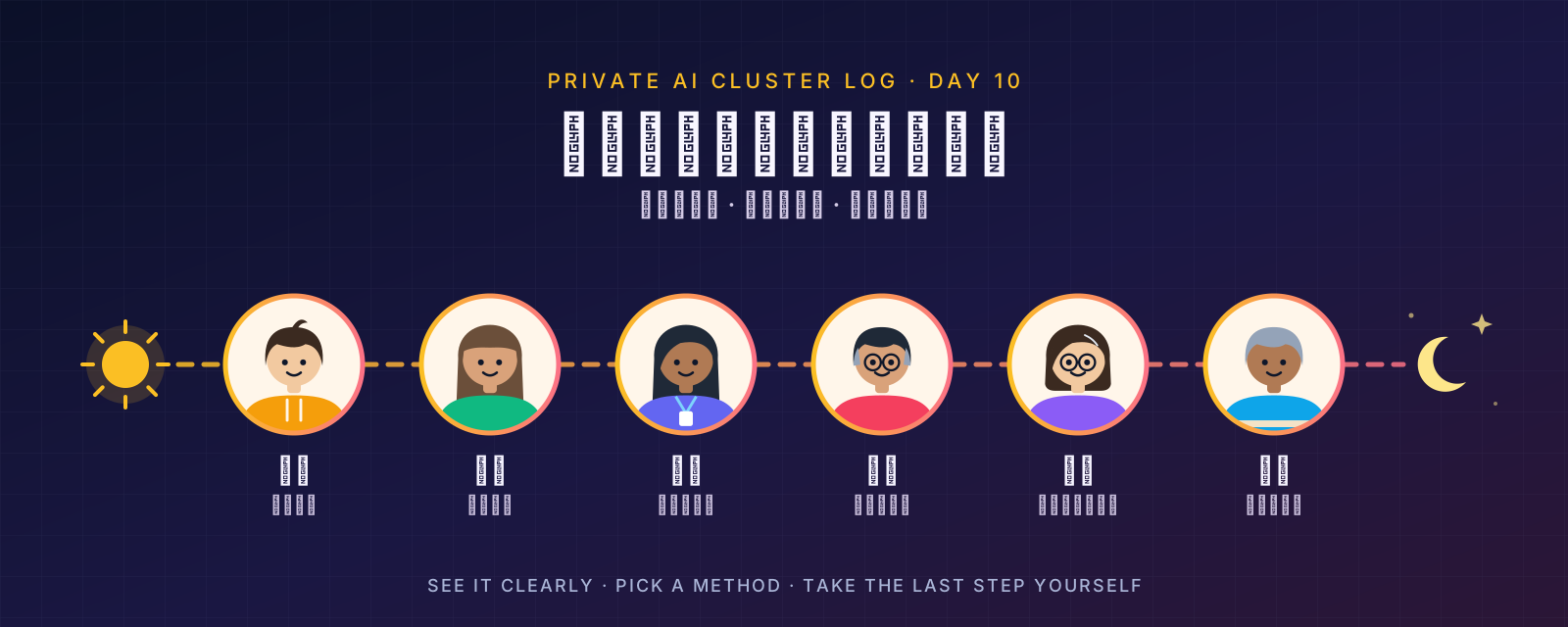
Here are the six, left to right as in the picture, and what trips each of them up most right now.
- Zhe, 20, a second-year business student. He lives in a university dorm and works weekend shifts at a bubble-tea shop. His money often runs low by mid-month, exam week lands on his work weekends, and his project group can never find a time to meet. Jump to Zhe's section →
- Ting, 21, a third-year foreign languages student who rents a small room near campus and is preparing an application for an exchange semester. There are too many exchange schools to choose from, some of her documents depend on other people, and the words she studies keep slipping away. Jump to Ting's section →
- An, 27, in her third year as a sales assistant at a trading company. She shares a flat with a friend. Clients ask her the same questions several times a day, several people want things from her at once, and some clients never reply. Jump to An's section →
- Zhihao, 46, a section manager at a logistics company. He is married with two kids, one in junior high and one in primary school, and his parents live nearby. His work list never ends, mornings when the kids suddenly can't go to school throw everything off, and he wants to make his parents' home safer. Jump to Zhihao's section →
- Meiling, 48, an accountant who lives on her own and shares the care of her mother with her younger sister. Every week the two sisters have to sort out who goes to their mother, every appointment means preparing from scratch, and at work she often worries about her mother at home alone. Jump to Meiling's section →
- Chang, 53, delivers food by day and works overnight shifts at a convenience store on Mondays, Wednesdays and Fridays. His delivery income goes up and down, he never gets enough sleep after a night shift, and customers keep interrupting his night work. Jump to Chang's section →
Five small things to try first
If you only want to try one thing first, pick from these five. You don't need to buy anything or download an app, and you can start today.
Zhe
Zhihao
Ting
Meiling
Chang
- Write down one number each night: Don't log every purchase. Before bed, write what's left in your account and wallet on that day's square of a calendar. The day it suddenly drops is the day the money went. The example is in Zhe's "Money runs out before the month ends".
- Pick three a day: Ask yourself "which three things will cause trouble tomorrow if I don't do them today", write them on a sticky note, and add the next one only when one is done. The example is in Zhihao's "The work list never ends".
- Ask early for what you wait on: A recommendation letter, a document, someone else's reply. Ask for it this week, and do your own part while you wait. The example is in Ting's "A pile of application tasks and one deadline".
- Write a checklist: Write down the things you have to rethink every time. Next time, just tick them off, and if someone else does it, they don't have to ask you again. The example is in Meiling's "Starting from scratch before every appointment with Mum".
- Leave a marker when you stop: For work that keeps getting interrupted, leave something where you stopped, such as a basket or a sticky note, and when you come back, carry on from there. The example is in Chang's "Customers keep interrupting the night work".
Zhe, a university student short of time and money

Zhe is 20, a second-year business student who lives in a university dorm and works weekend shifts at a bubble-tea shop. He has NT$9,000 a month to live on, classes on weekdays and work on weekends, so his money and time are often just enough and often a little short. These are the three things that come up most for him this semester.
Money runs out before the month ends
By the middle of the month the money is often almost gone, and when he thinks back, he can't say where it went.
Try this: Instead of logging every purchase, write down one number each night: how much you have left.
- At the start of the month, put the NT$9,000 in one account, about NT$300 a day, and keep your shift pay separate.
- Each night, write what's left in your account and wallet on that day's square of a calendar.
- If it's well below what the plan says should be left, look back for the square where it suddenly dropped.
Example: On day 10 he has NT$5,400 left; the plan says NT$6,000. Looking back, NT$900 went in one night on day 7, a club dinner. He isn't overspending every day; a week of cheaper lunches will cover it.
Ask AI:
My monthly budget is NT$9,000. It's day 10 and I have NT$5,400 left. Can you make me a simple sheet where I fill in what's left each night, and it tells me how much I can spend each day from now on?
Note: Keep one-off big costs like textbooks or a phone repair separate, outside the NT$300 a day.
Computers call this a "prefix sum". It works like a scooter's odometer: subtract two days' readings and you know how far you rode in between.
Exams and a report in the same week
Midterm week brings two exams and a report, and he still has weekend shifts. He does a little of everything, and the exam that comes first ends up the least prepared.
Try this: List every exam and deadline in date order, and give each day's longest stretch of time to whatever is due first.
- Write down everything due in the next two weeks with its date, soonest first.
- Give your longest stretch of time to the item at the top; use bus rides and breaks for light work, like vocabulary.
- For a report that needs several evenings, spend 20 minutes on an outline first, then go back to studying.
Example: Statistics exam next Monday, marketing report due Wednesday, English exam on Friday. After his Sunday shift he spends 20 minutes outlining the report, then studies statistics. He writes the report once Monday's exam is over, and reviews English vocabulary on the bus and during breaks.
| Sun | Mon | Tue | Wed | Thu | Fri | |
|---|---|---|---|---|---|---|
| Stats | Focus | Due | ||||
| Report | Quick | Focus | Focus | Due | ||
| English | Quick | Quick | Focus | Focus | Due |
Ask AI:
I have a statistics exam next Monday, a marketing report due Wednesday and an English exam on Friday. I work until 3 p.m. on Saturday and Sunday. Can you plan my week so I study for the earliest one first?
Note: If the plan shows something can't be done in time, ask your manager to swap a shift early, not the day before.
Computers call this "earliest deadline first": when jobs are waiting in line, do the one that is due soonest.
The project group never finds a time to meet
Four people, four different timetables. After three days of asking in the group chat, someone still hasn't replied and there's no meeting time.
Try this: Make one sheet everyone can edit. Each person shades the hours they're busy; whatever stays blank works for everyone.
- Make a shared spreadsheet with the hours across the top, one box per hour.
- Everyone shades their class and work hours. Set a deadline: anyone who hasn't shaded by 10 p.m. tonight counts as free.
- After the deadline, pick the longest blank stretch and post a time and place in the group chat.
Example: After everyone shades Thursday, only 12 to 1 p.m. and 4 to 6 p.m. are still blank. Lunch is too rushed, so he posts "Thursday 4:10, library", leaving 10 minutes for whoever just finished class to walk over.
| 12pm | 1pm | 2pm | 3pm | 4pm | 5pm | |
|---|---|---|---|---|---|---|
| Zhe | Busy | Busy | ||||
| A | Busy | Busy | ||||
| B | Busy | |||||
| C | Busy | |||||
| All | Free | Busy | Busy | Busy | Free | Free |
Ask AI:
Write me a short, friendly group-chat message. It should ask everyone to shade the hours they're busy on Thursday in our shared sheet by 10 p.m. tonight; anyone who doesn't counts as free.
Note: Posting a definite time works much faster than asking "when is everyone free?"
Computers call this "merging intervals": join the busy times that overlap into one block, and the gaps left over are the free time.
Try one thing this week: Tonight before bed, write down what's left in your account and wallet; do it again tomorrow night and see what one day cost.
Ting, a university student balancing classes and an exchange application

Ting is 21, a third-year foreign languages student who rents a small room near campus. She wants to apply for an exchange semester next term, so she has to choose schools and get her documents together, and there are new words to learn every day. None of it is hard; the hard part is that it all lands at the same time.
Too many exchange schools to choose from
She has read the websites of all five schools. Each one has something good, and the more she compares, the more confused she gets.
Try this: Cross off the schools that can't work or are clearly worse first, and only then take a close look at the rest.
- First cross off any school whose teaching language you can't keep up with, or whose grade or language-test requirement you don't meet.
- Compare the rest on living costs and how many courses will count toward your degree back home; if one costs more than another without counting more courses, cross it off.
- If you're still torn between the last two, flip a coin; if the result disappoints you, pick the other one.
Example: School A costs NT$32,000 a month and 6 of its courses count; School B costs NT$35,000 and only 5 count. B costs more and offers fewer courses, so it's out. That leaves three. She checks dorms and transport for those, drops one, and settles the last two with the coin.
Ask AI:
Here are the exchange schools I'm still considering, with each one's monthly living costs and how many courses would count toward my degree. Cross off any that costs more than another without offering more courses, then give me one line on the pros and cons of each one left.
Note: Go by the schools' notices and past exchange students' write-ups for living costs; numbers online are often out of date.
Computers call this "Pareto optimality": keep only the options that no other option beats on every count.
A pile of application tasks and one deadline
The application needs a recommendation letter, a transcript and a study plan, and some of them depend on other people. If she does them one by one, she may find out near the end that there isn't enough time.
Try this: Ask for the things that depend on other people first, and do your own parts while you wait.
- List everything you need to hand in.
- Circle what depends on someone else, such as a recommendation letter, an English transcript, or a language test you still have to book, and ask for or book them this week.
- While you wait, write the parts only you can write, like the study plan and the application form.
Example: The deadline is 4 weeks away. She waits 3 weeks for the letter and 1 for the transcript, and the study plan takes her 2. One after another, that's 6 weeks, too late. Started together, everything is in by week 3.
| Wk 1 | Wk 2 | Wk 3 | Wk 4 | |
|---|---|---|---|---|
| Letter | Wait | Wait | Wait | |
| Transcript | Wait | |||
| Study plan | Do | Do | ||
| Submit | Submit |
Ask AI:
Here is everything my exchange application needs, and the deadline. Pick out the items that depend on other people so I can ask for them this week, then make me a week-by-week list of what to do.
Note: Ask a teacher for a recommendation letter at least 3 weeks ahead, and give them your current grades and a few lines on why you want to go. It makes the letter easier to write.
Computers call this the "critical path": start the longest wait first and fit everything else in while you wait.
Forgetting the words she studied
Her language classes add new words every day, and a few days later half of them are gone. Going over every word from the start each day takes too long.
Try this: Go over the words you don't know yet every day and the ones you already know less often, so your effort goes to the words that haven't stuck.
- Write each word on a small card and sort the cards into three boxes: box 1 every day, box 2 on Mondays and Thursdays, box 3 on Sundays.
- Tonight, put this week's new words into box 1 and quiz yourself: a word you get right moves to the next box; a word you miss goes back to box 1.
- Once you get a word right in box 3, count it as learned and put it away.
Example: She learns 20 new words today and puts them all in box 1. The next day she gets 14 right, so those move to box 2; the 6 she missed stay in box 1 for tomorrow.
every day
Mon and Thu
Sundays
put away
Ask AI:
Please turn these 20 words into a quiz, ask me one at a time, tell me after each answer whether I got it right, and list the words I missed at the end.
Note: Don't add too many new words at once; if box 1 gets too full, you won't get through it each day.
Computers call this "spaced repetition": the better you know a word, the longer you wait before seeing it again. Flashcard apps work this way and pick the days for you.
Try one thing this week: List everything the exchange application needs, circle the items that depend on other people, and ask for them this week.
An, a young office worker juggling several things at once

An is 27. She is a sales assistant at a trading company, now in her third year, and she shares a flat with a friend. She works fast and gets on well with clients; the tiring part is that emails, colleagues and clients often all land on the same morning. Here are three things she can try without leaving her desk.
The same questions, several times a day
Clients keep asking about the same few things: quotes, delivery dates, samples, where a shipment is. Each time, An digs through her Sent folder for her last similar reply, and it takes ages to find before she can start editing.
Try this: After answering a common question once, save the reply as a template and adapt it next time.
- After answering a common question such as a quote or a delivery date, save the reply as a template; the email program's own template feature will do.
- Start with just the three most common kinds, and save others as they come up.
- For each new email, look for a template first and change only the product, quantity and date. Write from scratch only when none fits.
Example: Of the 40 emails she gets a day, about 25 are common questions. Adapting a template saves about 4 minutes per email, or 100 minutes a day.
Change the product, quantity and price
Change the date
Change the shipping address
Paste in the tracking number
About fifteen a day, still written with care
Ask AI:
I'm a sales assistant at a trading company. Clients most often ask about quotes, delivery dates, samples and where their order is. Please write one reply template for each in Chinese and English, leaving blanks for me to fill in the product, quantity and date.
Note: Templates go wrong in the details, so check the price, the date and the person's name once more before sending.
Computers call this a "cache": keep the answers you use often close at hand and reuse them.
Several people want something at once
At 10 a.m. one sales rep needs a quote revised, another needs shipping documents, and her manager needs the monthly report. Each of them hopes theirs comes first, and which one she starts on often depends on who is pushing hardest.
Try this: Ask when each one is needed, do the non-urgent ones quickest first, and tell everyone roughly when theirs will be ready.
- Reply to each person with one line: "What time do you need this by?"
- Start with anything due today that might be late; then go from the quickest task to the longest.
- Once the order is set, tell each person "you'll have it around …".
Example: The quote takes 10 minutes, the shipping documents 30 minutes and the report 1 hour. The report isn't due until 5 p.m., so there is plenty of time: the quick quote goes first and is out ten minutes later. If she started with the report, the quote would wait over an hour.
Ask AI:
Three colleagues all want something from me at once. I plan to revise the quote first, then do the shipping documents, then the monthly report. Please write a short, polite reply to each one saying roughly when they'll have it, leave the time blank for me to fill in, and don't make it sound like I'm making excuses.
Note: The manager's request isn't always the most urgent; ask when it's needed, then decide the order.
Computers call this "shortest job first", like letting the person with just a bottle of water pay ahead of you.
A client who does not reply
The quote went out two days ago and there has been no word at all. Asking every day might annoy the client; not asking might let the order slip away.
Try this: If there is no reply, ask again, but wait a little longer each time, and after three tries switch to another way of reaching them.
- Note the date the quote goes out. If there is no reply after two days, send a gentle check-in.
- Still nothing? Wait longer before asking again: a few days for the second one, then about a week for the last one.
- Make the last one easy to answer, for example: "Just reply 'not for now' if the timing isn't right." After that, call, or ask the sales rep to check in.
Example: She sends the quote on the 3rd, follows up two days later, again the next week, and one last time the week after. Only three follow-ups in two weeks: the client doesn't feel pushed, and An doesn't have to keep it on her mind every day.
Day 0, note the date
A gentle check-in
Ask once more
Last one, "not for now" is fine
Call, or ask the sales rep
Ask AI:
I sent a quote to a new client and haven't heard back in two days. Please write three polite, no-pressure follow-up emails to send on day 2, day 6 and day 14, each shorter than the last, with the last one saying a simple "not for now" is fine.
Note: If the client said when they would reply, wait until that day before asking.
Computers call this "exponential backoff": when a connection fails, they wait twice as long before each retry.
Try one thing this week: After answering the next quote request, save the reply as your first template.
Zhihao, a mid-career manager busy at work and at home

Zhihao is 46. He is a section manager at a logistics company, he is married, and he has two kids, one in junior high and one in primary school. His parents live nearby. At work the jobs come one after another, and after work it's the kids' homework and his parents' errands. He has plenty of experience. What he needs is a few simple routines, so he doesn't have to work things out from scratch every time.
The work list never ends
There are 12 things on this week's list, and someone is chasing every one of them. So each one gets a little done, and none of them gets finished.
Try this: Every morning, pick the three most pressing things. Work on only those three at a time, and let the rest wait in line.
- Write everything on one list, and hand off whatever someone on your team can do.
- Ask yourself, "Which three will cause trouble tomorrow if I don't do them today?" Write them on a sticky note.
- Only when one is done do you bring in the next from the list. If something urgent drops in, take one off to make room.
Example: This morning Zhihao picks "sort out the delayed shipment", "do next week's shift schedule" and "write the budget draft". The slides for next week's meeting matter, but they aren't urgent yet, so they wait. Two days before the meeting, they will push their way into the top three on their own.
Ask AI:
Here are my 12 tasks for this week, with client and colleague names removed. Please pick the three I should do first today and tell me why.
Note: At most three in hand at a time. Squeeze in a fourth, and often none of the four gets finished.
Computers call this a "priority queue": like an emergency room, it sees the most urgent case first, not whoever arrived first.
A morning when the kids suddenly cannot go to school
The primary-school kid wakes up with a fever, or on a typhoon day schools close but offices stay open, and Zhihao and his spouse both have to work. Every time, at seven in the morning, they work out who takes the day off while checking their phones, and the longer they talk, the more stressed they get.
Try this: On an evening when nobody is rushed, agree with your spouse in advance on "if this happens, we do that", write it down and stick it on the fridge.
- Check both calendars. Whoever has no meetings or site visits takes the day off. If you're both free, take turns.
- If you both have meetings, call the grandparents nearby and ask them to watch the kid for half a day.
- If the grandparents can't either, each of you takes half a day off, one in the morning and one in the afternoon.
Example: At 6:30 one morning, the primary-school kid has a temperature of 38°C. His spouse has a meeting at nine; Zhihao has none today. The first step on the fridge settles it: Zhihao takes the day off, decided in five minutes. The junior-high kid goes to school as usual.
A fever, or schools close but offices don't
Both free? Take turns
Ask AI:
My spouse and I both work, our two kids are in junior high and primary school, and my parents live nearby. Please make me a three-step order for "who looks after the kids when they suddenly can't go to school" that I can stick on the fridge.
Note: Ask your parents first whether they're happy to be step two. If they can't, step three still covers it.
Computers call this a "decision tree": you keep asking yes-or-no questions, and when you reach the end, you know what to do.
Wanting a safer home for his parents but not knowing where to start
Zhihao's parents are in their seventies. On his last visit, he saw his mother steady herself against the wall on her way into the bathroom. There is a lot he wants to change, from the bathroom to the stairs to the lighting, and every time he starts thinking about it, he puts it off.
Try this: Break the big job into small ones, and start with the most dangerous place.
- Walk around the home with your parents and ask them where things are hardest.
- For each place, write down two or three small jobs. For the bathroom, that's a non-slip mat, a grab rail and a shower chair.
- Do the most dangerous place first. Buy the ready-to-use things in one trip, and book the jobs that need fitting one at a time.
Example: His mother has to hold the wall in the bathroom, so this weekend he buys a non-slip mat, a shower chair and two night lights in one go, and has them in place in an afternoon. Next week he'll get someone to look at a bathroom grab rail.
Ask AI:
My parents are in their seventies and live in a flat near me. Please list two or three small things for the bathroom, stairs and bedroom that would make them safer, and mark which ones are ready to use and which need someone to fit them.
Note: Things your parents agree to are the things they'll actually use. Before fitting rails, call your local long-term care service (in Taiwan, the 1966 hotline) and ask about subsidies.
Computers call this "divide and conquer": cut a big problem into small ones, then solve them one by one.
Try one thing this week: Before work tomorrow, pick the three most pressing things from your list and write them on a sticky note. Leave the rest for now.
Meiling, a single accountant finding a rhythm between work and caring for her mother

Meiling is 48 and works as an accountant. She lives on her own and spends her weekends swimming and at a pottery class. She and her younger sister share the care of their mother. Her busiest week every month is the month-end close, and things at her mother's never wait for a quiet week.
Sorting out every week which sister helps Mum
Who takes Mum shopping, who goes with her to the doctor: every week the sisters ask back and forth in the family chat. The worst is month-end week, when Meiling can't get away and has to ask her sister at the last minute.
Try this: Agree a fixed order for taking turns with her sister, and plan it around the week each of them is always busy.
- Each of them names the week that never works. For Meiling, that's month-end.
- Month-end week always goes to her sister, her sister's busy week to Meiling, and the other weeks they take turns.
- Put it in a calendar they both share; if one of them needs to swap, trade one week for one week.
Example: This month her sister takes Mum to her appointment in month-end week, so Meiling can work late without worrying. In her sister's busy week, Meiling goes instead. On weekends that aren't her turn, she goes swimming as usual.
| Each month | Normal weeks | Sister's busy week | Month-end week |
|---|---|---|---|
| Before | Ask again | Ask again | Last-minute ask |
| After | Take turns | Meiling | Sister |
Ask AI:
My sister and I take turns looking after our mother. I can't do month-end week because of closing, and she has one week that doesn't work for her. Please make us a weekly rota and add one rule for swapping at short notice.
Note: It doesn't have to be exactly half each. What matters is that both of them feel it is fair and nobody has to sort it out again every week.
Computers call this "round-robin": everyone takes a place in the order and gets one turn each.
Starting from scratch before every appointment with Mum
Mum has a follow-up appointment once a month. Before each one, Meiling has to think it all through again: is the health insurance card in the bag, where are this month's blood pressure readings, what to ask the doctor. When it is her sister's turn, her sister has to phone Meiling and ask all over again.
Try this: Write what to bring, what to report and what to ask into one shared checklist, and use it every time.
- Tonight, spend 10 minutes writing a first draft from memory of the last visit; fill in the gaps after the next one.
- Split it into three parts: things to bring, how this month went, and questions for the doctor.
- Keep it where both sisters can see it, such as a note in the family chat.
Example: Getting ready used to take half an hour of thinking, and something still got forgotten; with the checklist, ticking it off takes 5 minutes. The first time her sister got ready from the checklist, she didn't need to phone Meiling at all.
Ask AI:
My sister and I take turns taking our mother to her monthly check-up. Please make a checklist we can reuse, in three parts: things to bring, how this month went, and questions for the doctor. No more than 5 items per part, and no medical advice.
Note: The checklist helps you tell the doctor things clearly; whether to change medicine or treatment is still the doctor's call.
Computers call this a "checklist": every time a computer starts up, it checks each of its parts against the same list, without skipping one.
Worrying about Mum at home on her own
Mum lives on her own. At work, Meiling often suddenly worries about Mum and calls several times a day. Her mother finds it a bit much, and Meiling still can't settle.
Try this: Agree with Mum on a fixed time each day to say she's fine, and only call if the message doesn't come.
- Pick a time, for example Mum sends a sticker to the family chat every morning before 9.
- If nothing has come by 10, Meiling or her sister calls.
- Ahead of time, ask a nearby neighbour or the building manager to swap numbers and to ring the doorbell if nobody answers.
Example: One day there was no sticker by 10. Meiling called and found that Mum had gone to the market and left her phone at home. On other days, seeing the sticker is enough to get on with work, and she calls when she wants a chat.
Ask AI:
My mother lives on her own. My sister and I want her to send a short "I'm fine" message every morning. Please write a simple plan I can post in our family chat: what time she sends it, who calls first if it doesn't come, and who to ask if nobody answers.
Note: If Mum says she feels very unwell, or doesn't sound right on the phone, call 119 (Taiwan's emergency number) straight away; don't wait for the agreed time.
Computers call this a "heartbeat check": a machine sends a short "still here" signal at regular times, and someone checks only when it goes quiet.
Try one thing this week: Write what to bring and what to ask at Mum's next appointment into one checklist, and send it to her sister.
Chang, a part-timer who delivers by day and works nights at a store

Chang is 53. He delivers food during the day, and on Monday, Wednesday and Friday nights he works the overnight shift at a convenience store. The store pays by the hour, so that money is about the same every week; delivery pays per order, so it is up one week and down the next. He knows the streets, works fast and gets on well with the regulars. What he most needs to look after is money and sleep.
Delivery income goes up and down every week
One week goes well, and the next is a lot lower. In the good weeks he spends more freely, and in the slow weeks money gets tight.
Try this: Pay rent and utilities from the store pay. With the delivery money, look at what you made per week on average over the last four weeks, and spend no more than that.
- Open the earnings page in the delivery app and copy down the last four weekly totals; every Sunday add the new week and cross out the oldest.
- The average of those four weeks is the most you can spend next week.
- If a week brings in more than the average, put the extra in an envelope; if it brings in less, top it up from the envelope.
Example: In the last four weeks delivery brought in NT$7,200, 5,600, 6,400 and 4,800. That is NT$6,000 a week on average, so next week he plans to spend NT$6,000. If next week brings in more, the extra goes into the envelope for the slow weeks.
Ask AI:
I deliver food during the day, and what I make is different every week. Here is my delivery income for the last four weeks: (paste the numbers). Please work out the average and tell me how much I can safely spend next week. Keep it simple.
Note: Pay for scooter repairs, tyres and oil changes from the envelope, never from the rent money.
Computers call this a "sliding window": like a window you keep pushing forward, it only ever shows the latest four weeks.
Never enough sleep after a night shift
His shift ends at 7 in the morning. He thinks he'll pick up a few breakfast and lunch orders on the way home, and doesn't get to bed until the afternoon. A few hours later he has to go out again, and by evening he is fighting sleep on the scooter.
Try this: Put the night shift and sleep in first, and fit deliveries into the time that's left.
- On mornings after a night shift, sleep from 8 a.m. to 2 p.m., and go out for orders after 4 p.m.
- While you sleep, go offline in the delivery app, put the phone on Do Not Disturb and close the curtains.
- On a shift day, go home after the dinner rush and sleep for two hours before heading to the store.
Example: On Tuesday he finishes at 7 a.m., eats something, has a shower, goes to sleep and gets up at 2 p.m. He misses the breakfast and lunch orders, but he still rides the dinner rush, and he is much more alert on the road.
| 8am | 10am | noon | 2pm | 4pm | |
|---|---|---|---|---|---|
| Before | Orders | Orders | Orders | Sleep | Sleep |
| Now | Sleep | Sleep | Sleep | Orders |
Ask AI:
I work at a convenience store from 11 p.m. to 7 a.m. on Monday, Wednesday and Friday nights, and I deliver food during the day. Please draw up a weekly timetable for me: put in work and sleep first, fit deliveries into the time that's left, keep one full day off a week, and give it to me as a table.
Note: If you feel sleepy on the scooter, find a safe place to stop and rest for 15 minutes or so; if it happens often, or you can never sleep well in the daytime, see a doctor.
Computers call this "most constrained first": place whatever can't move first, then fill the gaps with the rest.
Customers keep interrupting the night work
At night he restocks the shelves and checks for anything past its expiry date, and he often gets called to the register halfway through. When he comes back, he sometimes skips a shelf or checks the same one twice.
Try this: Before you go to the register, leave the basket or a sticky note on the shelf where you stopped.
- Before you stop, put the basket on the shelf you were working on.
- Back from the register, look for the basket and carry on from there.
- Before the shift ends, write one line in the store's handover book: "expiry check done up to shelf __".
Example: He is checking expiry dates on shelf 12 when a customer comes to pay, so he leaves the basket on shelf 12. Back at the shelves after the customer pays, he sees the basket and carries on, without wondering where he was.
Ask AI:
On my overnight shift I have to restock, check expiry dates, clean and take in deliveries (paste the list). Customers often interrupt me at night. Please help me put these in order: which ones to do between 2 and 5 a.m., when there are the fewest customers, and which ones are fine to stop halfway.
Note: Leaving the basket in place is more reliable than trying to remember.
Computers call this a "checkpoint": like saving in a video game, if you get cut off you carry on from where you saved.
Try one thing this week: After the next night shift, go offline in the delivery app and put the phone on Do Not Disturb as soon as you get home, then sleep until 2 p.m. before going out.
A small encyclopedia for when you get stuck
Every method the six people use above, plus a few more that come in handy, is collected here in six groups, sorted by what you want to do. Each line is one method with one example; the name in brackets is the person above who uses it or could. The computer name comes last; if it means nothing to you, just skip it. Come back whenever something has you stuck.
Numbers jump around, things get messy
Too many options, afraid to choose wrong
Too much to do, too many interruptions
Too big or messy to know where to start
Want it to last, tired of starting over
Finding a time, sharing jobs, waiting for replies
See where things stand
When the numbers jump around or things pile up into a mess.
- Write down what's left each night: Don't log every purchase; just write down what's left each night, and you'll know whether the money will last the month (Zhe). Computers call it a "prefix sum".
- Look at the last four weeks: When income goes up and down, plan next week's spending from the average of the last four weeks (Chang). Computers call it a "sliding window".
- Take the latest change seriously: After two slow weeks of orders, spend a bit less next week rather than wait for the monthly average to drop (Chang). Computers call it a "weighted moving average".
- Look at the middle one: Ask five shops what new tyres cost and take the middle price; one very pricey shop can't pull it up (Chang). Computers call it the "median".
- See which way it is heading: Weekly vocabulary quiz scores go up and down; just ask whether the whole line is rising or falling (Ting). Computers call it a "trend line".
- Circle the unusual day: Circle any day far above normal, like the day of the club dinner (Zhe). Computers call it "anomaly detection".
- Put things in order first: Sort your receipts by date, and one entered twice jumps out at you. Computers call it "sorting".
- Go down two lists together: Sort the card statement and your own notes by date, go down both side by side, and circle anything that doesn't match. Computers call it "two pointers".
- Will the queue keep growing?: If Saturday afternoon orders come in faster than they can be made, the line only grows, so call for help early (Zhe). Computers call it "queueing theory".
- Adjust when news comes in: When a client hasn't replied in two days, lower your hopes for that order a little; if they reply, raise them again (An). Computers call it "Bayesian updating".
- Like goes with like: Sort clients into regulars, occasional buyers and lapsed ones, and contact each group at its own pace (An). Computers call it "clustering".
Make a choice
When there are too many options, comparing never ends, or you are afraid of choosing wrong.
- Drop the ones that are beaten: Drop any school that costs more than another without counting more courses (Ting). Computers call it "Pareto optimality".
- Pack must-haves first: With a 23 kg suitcase, pack what you can't do without and leave what's cheap to buy there (Ting). Computers call it the "knapsack problem".
- Look enough, then decide: When flat-hunting, look at the first few without booking, then take the first one better than all of those. Computers call it "optimal stopping".
- Keep only the top three: When comparing prices, keep just the three you like best; when a better one turns up, it replaces number three. Computers call it "Top-K".
- Try something new now and then: Deliver mostly in familiar areas, with the odd day in a new one (Chang). Computers call it "explore and exploit".
- Is it worth it on average?: For a slot that looks busy, count the quiet stretches too and see what it really earns an hour (Chang). Computers call it "expected value".
- Toss a coin when it's a tie: If the last two schools can't be separated, toss a coin; if the result disappoints you, take the other one (Ting). Computers call it "random choice".
- Ask people with similar taste: Before choosing an elective, ask older students with interests like yours who have taken it (Zhe). Computers call it "collaborative filtering".
- Decide the what-ifs ahead: Agree and write down who takes the day off when a kid suddenly can't go to school, so the morning isn't a scramble (Zhihao). Computers call it a "decision tree".
- Plan for a bad month too: Work out once whether the money still lasts with a worse exchange rate and higher rent (Ting). Computers call it a "Monte Carlo simulation".
- Count the effort in the route: On the way to her mother's after work, count changes and walking too, and take the least tiring way (Meiling). Computers call it the "shortest path".
Decide what comes first
When there is too much to do and the interruptions keep coming.
- Pick three a day: Each day, pick the three most urgent things; when one is done, bring in the next, and if something urgent drops in, swap one out (Zhihao). Computers call it a "priority queue".
- Whatever is due soonest first: In exam week, give your longest stretches of time to whatever is due first (Zhe). Computers call it "earliest deadline first".
- Quickest job first: When several people want something at once and none of it is urgent, do the quickest first (An). Computers call it "shortest job first".
- Place what can't move first: After a night shift, sleep goes in first and deliveries only go into the hours left (Chang). Computers call it "most constrained first".
- Ask early for what you wait on: Ask a teacher for the recommendation letter first, and write the study plan while you wait (Ting). Computers call it "topological sorting" and the "critical path".
- Nearest stop next: With three delivery orders at once, always head to the one closest to where you are now (Chang). Computers call it "nearest neighbour".
- Drop it in the to-do box: Write down small favours colleagues ask in passing in one place and do them in order, so they don't interrupt what you're doing (An). Computers call it a "queue".
- Only at set times: Check the team chat only at 11 a.m. and 4 p.m., urgent client matters aside (An). Computers call it "batch processing".
Make a big job smaller
When something is too big or too messy, or you are not sure which way works better.
- Break a big goal down: "Get ready for the exchange" becomes choosing a school, gathering documents and learning words, then pieces small enough for this week (Ting). Computers call it a "tree breakdown".
- Split it into parts: His parents' home splits into bathroom, stairs and bedroom; start with the bathroom, the most dangerous, and buy the ready-to-use things in one go (Zhihao). Computers call it "divide and conquer".
- Rule out the impossible first: Cross off schools whose grade or language-test requirement you don't meet, then compare the rest (Ting). Computers call it "pruning".
- Halve it to find it: When the accounts don't match at month-end, check the mid-month balance first, to see which half the mistake is in. Computers call it "binary search".
- Change one small thing at a time: Try one different delivery time slot a week; keep it if things get better, switch back if they get worse (Chang). Computers call it "hill climbing".
- Step back when stuck: When small tweaks stop helping, try a way that looks slower, like going back to the basics when studying stalls. Computers call it "simulated annealing".
- Try both and compare: When you can't decide, try both, like taking each of two routes to work for a week to see which is less busy. Computers call it "A/B testing".
Make good habits stick
When you want a good way of doing things to last, without starting from scratch every time.
- Write a checklist: Write down what you'd otherwise rethink every time and tick it off, so nothing is missed and anyone can do it, like what to bring to her mother's check-ups (Meiling). Computers call it a "checklist".
- Keep what you use often close: Save replies to common questions as templates and adapt them next time (An). Computers call it a "cache".
- Remember what you worked out: The first time you find which entrance at a regular address is easy to park at, write it down (Chang). Computers call it "memoization".
- Longer gaps once you remember: Keep word cards in three boxes: checked daily, on Mondays and Thursdays, and on Sundays (Ting). Computers call it "spaced repetition".
- Leave a marker when you stop: Before going to the register, leave the basket on the shelf where you stopped (Chang). Computers call it a "checkpoint".
- Find it straight by its label: Household papers go in three folders: insurance, the kids' school and his parents' doctors (Zhihao). Computers call it a "hash table".
- When full, put away the longest unused: When the desk is crowded, notes she hasn't opened in a month go into a box (Ting). Computers call it "least recently used", or LRU.
- A small reward after: Watch an episode of a favourite show only after your walk; things that pay off are easier to keep up. Computers call it "reinforcement learning".
- Find your best stretch: A missed day is no reason to lose heart; look for this month's best run, like nine days of walking mid-month with only one missed. Computers call it "maximum subarray".
Work it out with other people
When you need to find a time, share out jobs, or wait for someone to reply.
- Stack everyone's busy times: Everyone shades the hours they can't make, and whatever is still blank works for all (Zhe). Computers call it "merging intervals".
- Take turns in order: Set an order with her sister for going with their mother, keeping her month-end week free (Meiling). Computers call it "round-robin".
- Split clashing things up: When the two kids' classes clash, each adult takes one (Zhihao). Computers call it "graph colouring".
- Give each job to whoever does it best: In a group project, research, slides and presenting each go to whoever is best at it (Zhe). Computers call it the "assignment problem".
- Rank your real choices: If exchange places go by grades and choices together, list the schools in your true order (Ting). Computers call it "stable matching".
- No reply, wait a little longer: Follow up with a client after 2, then 4, then 8 days, each wait longer than the last (An). Computers call it "exponential backoff".
- A daily all-is-well message: Her mother sends a sticker before 9 each morning, and they only phone if it doesn't come (Meiling). Computers call it a "heartbeat check".
A few more: Some ideas sound more like computer internals but still come in handy: check a bill isn't already paid before paying it ("idempotency"), check whether someone just changed a shared calendar before you edit it ("optimistic locking"), merge names that are really the same thing ("union-find"), hook a new habit onto something you already do every day ("linked list"), and when linking several places, join the nearest one each time ("minimum spanning tree").
Five things to remember before you use AI
AI is good at lists, drafts and putting numbers into a table, but it doesn't know you, and it can get sums wrong. Before you use any of the "Ask AI" sentences in this post, keep these five things in mind.
- Don't paste these: Passwords, ID card numbers, bank account or card numbers, full medical records, your company's client data. Swap names for labels such as "Mum" or "Client A".
- Spell out your limits: How much you can spend, which days you are free, what you won't accept. The more specific you are, the more useful the answer.
- Redo the important numbers yourself: AI sounds just as sure when it is wrong. For rules such as school notices, leases or insurance, go back to the original website or document.
- Take big things to a person: For a doctor's visit, medicine, a contract or a loan, let AI help you list the questions you want to ask, then take them to a doctor, a pharmacist or someone who knows.
- Press the last button yourself: Sending, paying, signing and promises to your family are yours to do. AI only helps with the draft.
If typing is tiring, use voice input, or take a photo of handwritten notes or receipts and show it to the AI. Cover any card numbers or ID numbers in the photo first.
To close
You don't need to follow all six people's tips, and you don't need to remember any names. Pick the thing most like yours and try it for a week. If it doesn't fit, try another one.
Here is the one thing each of the six people tries first this week. Each one is small. Do it as you go, then check back at the weekend.
| Who | Try one thing this week | Check at the weekend |
|---|---|---|
| Zhe | Each night before bed, write down what's left in his account and wallet | At this pace, will the money last to the end of the month? |
| Ting | List what the application needs, and ask this week for the items that depend on others | How many of those she has asked for |
| An | After the next quote request, save her reply as her first template | How many templates she saved, and which one she used most |
| Zhihao | Before work each day, write the three most pressing things on a sticky note | How many of the three got done |
| Meiling | Put what to bring and what to ask at Mum's appointment in one checklist, and send it to her sister | What her sister wants to add |
| Chang | Home from a night shift: delivery app offline, phone on Do Not Disturb, sleep until 2 p.m. | How many of the three mornings he slept enough, and whether he feels sleepy riding in the evening |
None of this asks you to change who you are. It just turns the small things you keep rethinking every week into steps you simply follow.
If you would like the more technical version, such as what these ideas look like in programming problems, go back to yesterday's Day 9 post, Bringing Algorithms and AI into Everyday Life.