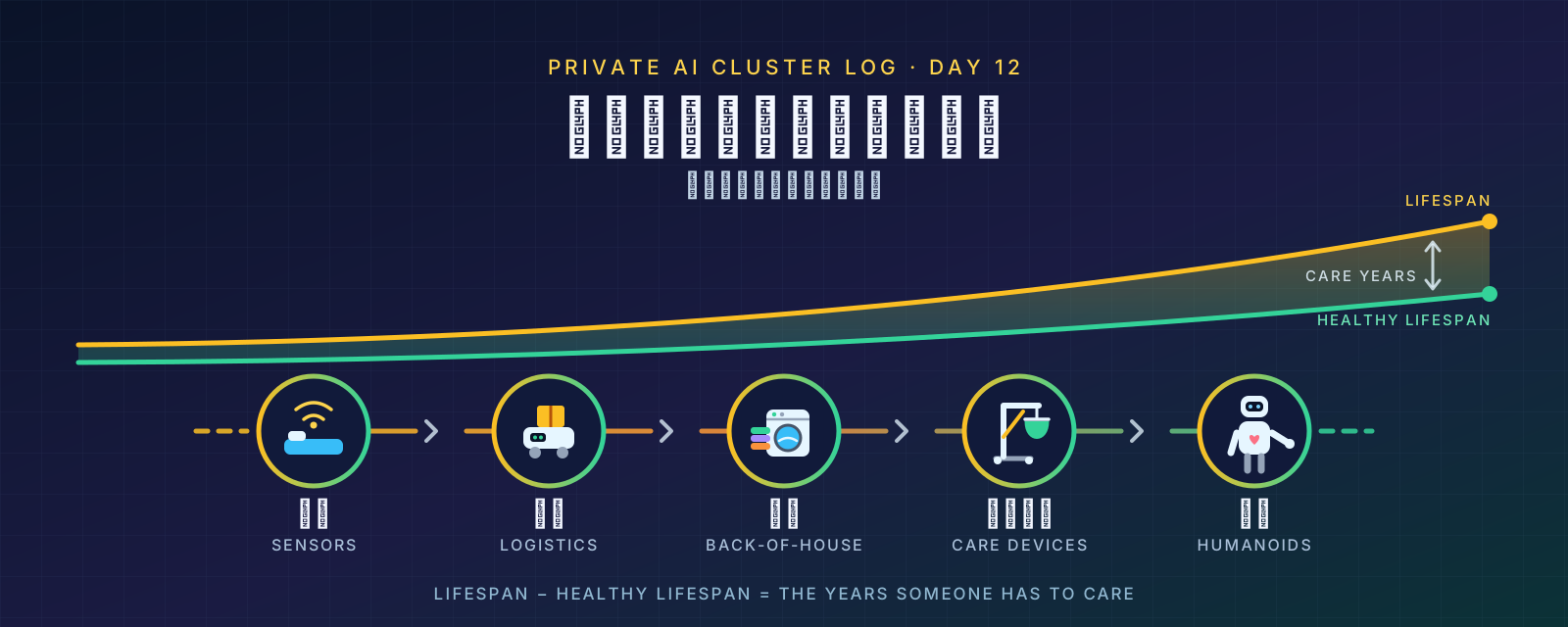
In one sentence: longevity escape velocity makes sense in principle, but so far there is no evidence for it in humans. Worldwide, lifespan and healthy lifespan are about ten years apart, and those years are the years of care. My judgement is that in the 2030s those years will still be carried by people, plus sensors and logistics robots that fetch and deliver, not by humanoid robots. The bridge that already has evidence behind it is the boring basics: blood pressure, not smoking, fitness.
Two questions kept running through my head today. First: how far away is "longevity escape velocity"? It means medicine improving so fast that each passing year adds more than one year to a person's remaining life. Second: if AI is going to help build long-term-care robots, what is the most likely path?
At first I thought these were two separate posts. After the research, they turned out to be two sides of one question. Even if lifespans keep growing, if healthy years do not keep up, someone has to provide care in the extra years. By the end of 2025 more than one in five people in Taiwan were 65 or older, and the number needing long-term care is projected to rise from just over 900,000 to 1.14–1.3 million within a decade (details in "Care Demand and Who Pays"). So I think "how long can we live" and "who provides care in those years" belong in the same conversation.
This post is for people curious about technology, for engineers, and for anyone wondering what happens when their parents grow old. A few ground rules first:
- This is research as of 2026-10-10, and the key numbers link to their sources.
- Numbers a company published itself, without independent verification, are marked "company-reported". A remote-controlled demo does not count as the robot doing it on its own.
- I keep three kinds of statements apart: established evidence; early results, animal studies, pilots and demos; predictions and opinions.
- Everything here is general information, not medical advice. Decisions about your own health belong in a conversation with your doctor.
Reading map: start with Two Curves and Ten Terms First. The first half follows the lifespan curve: what LEV means, who predicts when, real progress in labs, how much AI can speed it up and what you can do today. The second half covers care in the gap between the curves: demand and money, the scorecard of existing robots, where embodied AI stands and how AI helps build robots. It ends with the five stages, where the two roads meet and what one person can do.
Two Curves
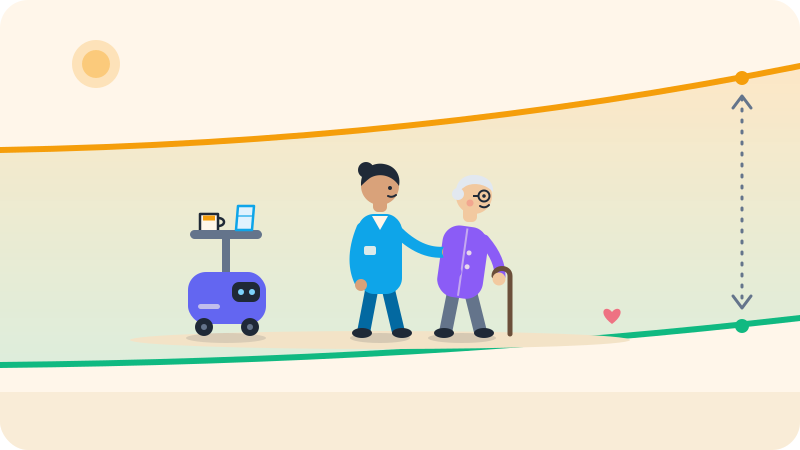
The whole post can be read through this picture. The upper line is "how long we live", the lower line is "how long we live in good health", and the gap between them is the years lived with illness or needing help from others.
According to WHO's Global Health Estimates, released on 2026-10-02 (news report), global life expectancy in 2023 was 73.3 years, almost back to the pre-COVID 73.4 of 2019; in between, 2021 dropped to 71.5. Healthy life expectancy in 2023 was 62.8 years, still 0.4 years below 2019. Subtract one from the other and the gap is about 10.5 years. The healthy line can be dragged down by a pandemic too: using its older data series, WHO calculated in 2024 that healthy life expectancy fell by 1.5 years during COVID, to 61.9.
"Healthy life expectancy" is calculated like this: take the years a person is expected to live, discount the time spent with disease or disability according to how severe it is, and what remains is the equivalent of years in "full health". In other words, a year lived with a mild limitation still counts as close to a full year, while a year lived with severe disability counts as only a fraction of one; the more severe the disability, the bigger the discount. So the 10.5 years is a global average and a discounted figure. It does not mean everyone spends their last ten years in bed; it adds up everything from mild limitations to needing round-the-clock care.
With these two lines, the rest of the post sorts itself into three:
- Longevity escape velocity wants to keep pushing the upper line up.
- Geroscience wants to push the lower line up and shrink the gap. I think this matters more than simply living longer, because if most of the extra years are unhealthy, the years of care only get longer.
- Care robots and sensors work inside the gap: they do not change how long people live, but they make those years a little better and save caregivers some walking and some heavy lifting.
Only principles and animal results so far; see the sections on what LEV is and on real progress in labs and clinics
Aims to shrink the gap; see the sections on whether AI can compress decades and on the first bridge
Makes the years of care better; see the sections from care demand and money onward
Ten Terms First
These ten terms come up again and again, so here they are in plain words once.
- Longevity escape velocity (LEV): medicine improves so that a person's "remaining life expectancy" grows by more than one year per year. Like walking up a down escalator: as long as you walk faster than it moves, you keep rising. It is not immortality; accidents and illness still happen, but the average finish line keeps moving back.
- Healthy life expectancy: the part of expected lifetime that counts as "full health" after discounting. Like the share of a car's total mileage driven smoothly, without a trip to the repair shop.
- Geroscience: studying ageing itself as the shared upstream cause of many chronic diseases, instead of tackling one disease at a time. Like fixing a leaking roof instead of putting a bucket in every room.
- Senolytics: drugs that clear out "senescent cells", cells that have stopped dividing but will not leave. Like removing the one rotten apple in the fridge that makes the fruit next to it spoil too.
- Partial reprogramming: briefly switching on a few genes that can turn cells back toward a younger state (for example three genes known together as OSK), without letting the cells revert all the way to stem cells. Like restoring a computer to a backup from a few months ago instead of wiping it clean.
- Ageing clock: a model that estimates a person's "biological age" from chemical marks on DNA or proteins in the blood. Like judging how far a car has really been driven from its tyre tread, not its year of manufacture.
- Surrogate endpoint: a measure used in a trial in place of "the outcome we really care about" (such as death or disability), on condition that changes in it reliably reflect the real benefit. Like using a mock exam in place of the real exam, provided the mock exam really predicts the result.
- VLA model: short for vision-language-action, an AI model that looks at images, listens to instructions and directly outputs robot movements. Like a kitchen apprentice who can read a recipe and cook it, but who still often fumbles in real homes.
- Teleoperation: a person far away controls a robot's arms and legs through a headset or controllers. Like someone on the ground flying a drone by remote control. A teleoperated demo does not mean the robot can do it on its own.
- ISO 13482: the international safety standard for personal care robots. Like the safety mark on a household appliance. The current version dates from 2014, and a new edition is still being drafted (see "Safety Gaps Around Frail Older People" later).
What we are chasing and how it is counted
From the lab to proof that it works
Can it do the job, who is operating it, is it safe
What Longevity Escape Velocity Actually Means
The basic idea of longevity escape velocity (LEV) was covered in "Ten Terms First" at the start: medicine gives you back more life than the time you use up. But whose "years left", and measured how? People mean different things. Let's separate three versions.
Three Versions
The first is the individual, actuarial version, and it is the original one. It looks at a person's remaining life expectancy, not life expectancy at birth. As plain arithmetic: if you are expected to have 20 years left this year, then a year later you would have not 19 but 21. Aubrey de Grey, in a 2004 PLoS Biology essay, called this "actuarial escape velocity" and put a concrete condition on it: at every age, the chance of dying within a year has to fall by about 10% every year.
The second is the population-statistics version. The forecasting site Metaculus settles its question like this: a country with more than 1 million people, whose life expectancy at age 10 is already above 85, gains on average at least 1 year per year over 5 consecutive years. That is a national average; it does not mean everyone gets the new treatments. Mathematically it is also not the same as the individual version: the population version compares "this year's 10-year-olds" with "next year's 10-year-olds", two different groups of people, while the individual version follows one person who gets a year older and asks whether their remaining years went down.
The third is the biological version. It ignores statistics and looks at the body: tissue repair outpaces the damage ageing causes. A 2022 opinion paper by Palmer calls this "biological escape velocity". It is a single author's framework with no quantified numbers, and the author holds related patents.
One person gets a year older and their remaining life expectancy goes up, not down
A country's life expectancy at 10 rises 1 year per year on average over 5 years
Tissue repair outpaces ageing damage
Not the Same as Immortality
Even if it were reached one day, people would still die from accidents, violence and infections. The optimist Ray Kurzweil stresses himself that it does not guarantee immortality. Critics summarised on Wikipedia add that it is an average: it does not remove causes of death unrelated to ageing, and it does not guarantee that everyone gets the treatment.
There is one more problem: there is no agreed way to measure it. Remaining life expectancy at what age? Measured in which group? So a claim like "we will reach it in the 2030s" is hard to prove right or wrong.
Who Named It
The idea is older than the name. According to Wikipedia, Robert Anton Wilson wrote about something similar in 1978, but I could not find the original to check. The idea is usually credited to David Gobel, co-founder of the Methuselah Foundation. Wikipedia says the term came from de Grey's 2004 essay, but that essay actually uses "actuarial escape velocity"; the words "longevity escape velocity" do not appear in it. Who first wrote the phrase is unsettled.
According to Wikipedia, in 2021 de Grey was dismissed by the SENS Research Foundation after an investigation into sexual-harassment allegations, which also found he had tried to interfere with the investigation. In 2022 he founded the LEV Foundation (LEVF), which comes up again later in "Real Progress in Labs and Clinics".
How High the Bar Is
The bar is +1 year per year. Compare it with history:
- The fastest historical record: Oeppen and Vaupel, Science 2002, found that female life expectancy in the world's longest-lived country rose almost 3 months per year for 160 years, about 0.25 years per year. Ceilings that experts announced were broken on average about 5 years after publication.
- Europe recently: a GBD study found an average gain of 0.23 years per year in 1990–2011, falling to 0.15 in 2011–2019.
- The United States: worked out from Our World in Data figures, about 0.16 years per year on average in 1950–2019, and only about 0.11 in 2000–2019. US life expectancy in 2024 was 79.0, a record high.
Put differently, reaching the bar needs about 4 times the fastest pace in history, sustained, and happening at older ages, where progress has historically been slower than overall. A rough calculation: recent "best practice" (taking the longest-lived country in the world each year) gains about 0.15–0.2 years per year, one-fifth to one-seventh of the bar. This is only a rough comparison, because all the figures above are life expectancy at birth, not the remaining life expectancy of a treated individual.
Taiwan and Japan today also show "still rising, but not fast". Taiwan's life expectancy in 2025 was 81.27 (men 77.93, women 84.75; Ministry of the Interior), up 0.50 from 2024. That looks like half a year gained in one year, but it has to be read against the pandemic years: it is still below 2020's 81.32. Women are back to their 2020 level; men are not. Japan in 2025: women 87.33, men 81.35, both still below their 2020 peaks (87.71 and 81.56). Hong Kong women, at 88.73, are higher than Japan. The global figures were covered in "Two Curves" above: by 2023 they were almost back to 2019 levels.
Slowing Camp and Straight-Line Camp
The main evidence that gains are slowing is Olshansky et al., Nature Aging 2024. They analysed the 8 longest-lived countries plus Hong Kong and the US for 1990–2019: in 30 years life expectancy rose only about 6.5 years on average, and ever more slowly. They estimate that the share reaching 100 this century is unlikely to exceed 15% for women and 5% for men, and that radical life extension this century is implausible unless ageing itself can be slowed. A PNAS 2025 study of birth cohorts in 23 high-income countries comes to a similar conclusion: for people born 1900–1938, each later birth year added about 5.5 months of life expectancy; after 1939 only 2.5–3.5 months.
The other side makes three main points:
- The record line is still straight: a 2025 preprint by Vinicius and Migliano (not peer reviewed) takes the longest-lived country each year and finds that female life expectancy rose from 84.85 to 87.75 in 2000–2020, 1.45 years per decade, slower than 2.49 in the previous two decades; for men, 1.96 years per decade, no slowdown. They project the female record reaching 100 around 2063, but agree that individual countries will struggle to keep up that pace.
- Ceilings keep breaking: Hong Kong in 2025 had men at 83.27 and women at 88.73, above the national ceilings Olshansky proposed in 1990 (about 82 for men, 88 for women).
- Different premises: de Grey argues that the paper itself assumes "no breakthrough on ageing", so its headline conclusion goes too far. Steven Austad says the paper changes nothing about his 2000 bet with Olshansky on whether someone will be alive at 150 in 2150. Matt Kaeberlein thinks that, without any intervention, individuals top out around 120–130 and population averages around 100, so ageing must be targeted directly.
The two sides actually overlap. Olshansky himself calls it "a glass ceiling, not a brick wall" and describes slowing ageing as a possible "second longevity revolution". The argument is about when, and whether, such a breakthrough happens in people, not whether it is possible in principle. My view: even taking the optimistic straight-line camp, the gain is only 0.15–0.2 years per year, far from 1. The camps argue about "gradually slowing" versus "steady progress"; neither camp's data is anywhere near escape velocity.
How Long Can a Human Live
Average lifespan and maximum lifespan are two different things. The average rises mainly because more people reach old age; the maximum record has barely moved.
The record belongs to Jeanne Calment of France, who lived 122 years and 164 days and died in 1997; it has stood for almost 30 years. In 2018 some claimed she had swapped identities with her daughter; in 2019 Robine and colleagues rebutted it, but the claimants still dispute it.
Is there a built-in limit? Dong et al., Nature 2016, argued that maximum human lifespan is about 115, with less than a 1-in-10,000 chance in any year of someone living past 125. In 2017 Nature published five rebuttals: the same data were used to both generate and test the hypothesis, the regressions had only 33 data points, and the data points were not independent. The critics concluded that either the data cannot settle it, or the limit is closer to 125. Another dispute is whether death rates stop rising after 105: Italian data suggest they do, but others argue that a small amount of age misreporting could create that illusion. It is still unresolved.
The Pearce and Raftery (2021) model says the record is very likely to fall, but mostly by a few years, not by decades. Metaculus forecasters put the median for the longest verified lifespan in 2050 at 124.5, only about two years above the current record.
How Much Does Curing One Disease Add
Intuitively, curing cancer should add many years. The calculations say otherwise, because of "competing causes": someone who does not die of cancer can still die later of heart disease, stroke or pneumonia, because the body is still ageing.
- Taiwan 2024: removing cancer raises life expectancy from 80.77 to 84.36, about +3.59 years; removing heart disease adds 1.50, removing pneumonia 1.05.
- Japan 2025: removing cancer adds 3.07 years for men and 2.66 for women; removing cancer, heart disease and cerebrovascular disease together adds 5.84 for men and 4.77 for women. At age 90, removing the same three together adds only about 1.4–1.5 years.
- United States (1999–2001 data): removing cancer adds 3.20 years; removing heart disease adds almost 4.
All of these assume other causes of death stay unchanged; they are rough estimates.
So the Target Becomes Ageing Itself
Curing one disease at a time adds only a few years. As early as 1990, Olshansky and colleagues argued that, unless ageing itself can be slowed, life expectancy at birth is unlikely to exceed about 85. This is also the consensus of geroscience (see "Ten Terms First"): rather than fighting diseases one by one, slow ageing itself so that many diseases arrive later together. A 2013 simulation by Goldman et al. found that delayed ageing would add about 2.2 years of life expectancy by 2060, mostly healthy years, versus about 1 year from separately reducing heart disease and cancer.
But "slowing ageing" is much harder than it sounds:
- In 2005, 28 biogerontologists jointly reviewed de Grey's SENS programme (a plan to repair ageing damage item by item) and judged every proposal overly optimistic given current knowledge, while agreeing that basic ageing research is underfunded.
- The twelve hallmarks of ageing listed in Cell in 2023 all affect one another. Gladyshev's "deleteriome" view holds that harmful changes are too varied to be put on one list and fixed one by one.
- As of 2026, no intervention has been proven to broadly slow human ageing, and a change in a biomarker does not mean ageing slowed; there is also no formally validated surrogate endpoint for ageing that can stand in for "how long people live".
To sum up. Established: lifespan is still rising but more slowly, at a fraction of the bar; curing a single disease adds only a few years; the maximum record has not been broken in almost 30 years. Disputed: whether gains are slowing or staying on a straight line, and whether maximum lifespan has a limit. Predictions: any "year it will happen". Going from 0.2 years per year to 1 year per year needs a technology we do not yet see in people. Who predicts when it will arrive, and what labs have actually achieved, comes next.
Who Says When
First, to be clear: this whole section is predictions and opinions, not evidence. The people making them include scientists, entrepreneurs, a company CEO, and a crowd placing forecasts on a prediction site. More telling than "who says how many years" is how the same person's date moves over time.
Aubrey de Grey: in his 2004 essay he wrote that human rejuvenation therapies would take at least 25 years and possibly 100; he also said that with about US$100 million a year of focused funding, tripling the remaining lifespan of middle-aged mice was likely within ten years. That has not happened to this day, though he always attached the condition that the money had to be there. In 2012 he gave a 50% chance within 25 years; in 2019 and 2021 a 50% chance around 2035 or 2036; in 2022 he switched to "about 15 years", adding that he used to say 25; and according to a secondary 2025 report it is now "50% within 12 to 15 years", roughly 2037–2040. The probability stays at 50%, while the target date keeps moving with the calendar.
Ray Kurzweil: in March 2024 he said that medical progress currently gives people back about 4 months a year, and that after 2029 it would give back more than a year per year. By February 2026 the year he named had become 2032; the dates he has given are not consistent. "Four months a year" is about the historical pace (the fastest historical record from the previous section, about 0.25 years per year); what has no evidence behind it is his assumption that this pace will keep accelerating past one year per year.
Dario Amodei: disclosure first: he is the CEO of Anthropic, and Claude, made by Anthropic, helped research this post. In his October 2024 essay "Machines of Loving Grace" he wrote that once powerful AI arrives, 50 to 100 years' worth of biomedical progress might be done in 5 to 10 years, the human lifespan might double to about 150, and "escape velocity" might follow. But he made "powerful AI arrives first" the premise, and said plainly that nothing is guaranteed. So he gave no calendar year. Whether AI can really speed things up that much is the subject of "Can AI Compress Decades into Years" further on.
Demis Hassabis: he talks about "disease", not ageing and not LEV. In April 2025 he said ending disease might be within reach in about ten years; in January 2026 he said 10 to 20 years.
George Church: in June 2025 he said he would not be surprised if lifespan gains exceeded one year per year by 2050, but that every estimate, his own included, should be taken with a big discount.
Bryan Johnson: in December 2025 he announced a goal of "making humans not die by 2039", while admitting his team does not yet know how to get there. This is more of a slogan-style goal than a prediction derived from data.
The Metaculus forecasting community: Metaculus is a site where many people put probabilities on future events. One question asks "in what year will a country reach LEV". It is judged by the population-statistics version described in "Three Versions" above. On 2026-10-03 the community median was around December 2052, the middle half of forecasts fell between 2038 and 2101, and 147 people took part. I converted these numbers from the page data during research, hence the "around". A range this wide means people are really quite unsure.
The same community answered two more questions: the chance that "superintelligence arrives before LEV therapies" is 95%; the chance that "LEV actually follows once effective life-extending therapies exist" is only about 48% (34 forecasters). In other words, even if the therapies get made, this group does not think LEV necessarily follows. Overall, the forecasting community is far more conservative than Kurzweil or de Grey.
Real Progress in Labs and Clinics
Predictions done, back to evidence. The conclusion first: as of 2026-10-10, no intervention has been shown in humans to slow ageing itself, let alone to extend lifespan. Below we go through them one at a time, each split into animal evidence, human evidence, and trials still running.
| Approach | Animal evidence | Human evidence | Trials running | Usable as ageing drug |
|---|---|---|---|---|
| Rapamycin | Extends life even late | PEARL missed primary endpoint | EVERLAST unpublishedNext-gen analogue | Not yet |
| Metformin | A commentator calls it mixed | Prevents diabetesNo change in mortality | TAME reportedly unfunded | Not yet |
| Senolytics | No effect alone in combo study | Liver phase 2 positiveBone trial missed | Fisetin pending | Not yet |
| GLP-1 drugs | Old female mice ~12% longer | Fewer deaths, not formally tested | None with ageing endpoint | FDA: not anti-ageing proof |
| Partial reprogramming | Restored vision in mice | Interim data, 3 people | ER-100 phase 1NewLimit 2027 | Not yet |
| Plasma exchange | Not covered here | 42 people, surrogate measureFDA warning on young plasma | No running trial found | Not yet |
Rapamycin
The animal evidence is the most solid: the US National Institute on Aging (NIA) mouse testing programme found that rapamycin extends the lifespan of genetically diverse mice even when started late in life. The best human data is PEARL: a 48-week randomised controlled trial (people are randomly split into a drug group and a placebo group, so any difference can be credited to the drug itself) analysing 114 people. Its primary endpoint (the result a trial commits in advance to judge itself by; here, visceral fat) was missed; only a few secondary measures improved, in women. The trial was led by AgelessRx, which sells the drug, and funded mainly by crowdfunding; partway through, the pharmacy-compounded version it used turned out to reach only about a third of the blood level of the commercial product, and the trial was paused because of it. EVERLAST, an NIA-funded trial of everolimus (a drug of the same class), finished in June 2026 but has not published results; ARPA-H, the US health department's agency for funding high-risk research, is also funding a next-generation analogue that blocks only part of the pathway.
Metformin and TAME
TAME is the most-mentioned "ageing trial": it wants to test whether metformin, an old diabetes drug, can delay several diseases of old age. The problem is money: the NIA put in only about US$5 million, while the whole study is estimated to need US$45–70 million, and no drug company will pay for a generic. According to secondary reports from 2026, TAME is still waiting for funding and has not enrolled anyone; it cannot be found as a registration on ClinicalTrials.gov either. NCT02570672, often cited as TAME, is actually a 141-person frailty-prevention trial. Articles online claiming to have "TAME results" deserve straightforward doubt. In another large trial, MeMeMe, metformin prevented type 2 diabetes but had no effect on cancer, cardiovascular disease or mortality.
Drugs That Clear Senescent Cells
These drugs aim to clear out senescent cells (see "Ten Terms First"), and the results are mixed. The strongest human result was published on 2026-10-01: a single-centre trial gave a drug combination (dasatinib plus quercetin, D+Q for short) to 31 patients with fatty liver disease and fibrosis; fibrosis improved in 47% versus 7% on placebo; but there were also more adverse events, 82% versus 43% (all resolved on their own). On the other side, Mayo Clinic's bone trial in postmenopausal women with the same combination missed its primary endpoint, and after its phase 2 eye-disease trial (the stage that gives a first look at the effect in a small group of patients) failed, the company Unity laid off all its staff in May 2025. Mayo's other candidate, fisetin, has trials expected to finish in November 2026.
GLP-1 Drugs
These are the weight-loss and diabetes drugs that have become so popular in recent years, such as semaglutide. The SELECT trial enrolled people who already had cardiovascular disease and higher body weight: the drug group's risk of death during the trial was about 19% lower (hazard ratio 0.81, meaning the risk was 0.81 times that of the control group). But under the testing order fixed in advance, this outcome never got its turn for a formal test, so it can only serve as a pointer. In people with diabetes and chronic kidney disease, the FLOW trial found 0.80, but it stopped early, so the effect may be overestimated. The large trial of the oral version in early Alzheimer's disease, EVOKE, failed. In animals, a September 2026 mouse study saw median lifespan extended by about 12% only in old female mice, which also ate about 24% less. An FDA reviewer put it bluntly: helping people live a bit longer through known cardiovascular effects is not proof of slowing ageing.
Partial Reprogramming
Partial reprogramming (see "Ten Terms First") has, in mice, restored damaged or aged vision. The first to enter humans is Life Biosciences' ER-100, injected into the eye to treat glaucoma and another optic nerve disease. It was cleared for human trials in January 2026, and the first participant was dosed on 9 June. On 2026-10-08 the company released interim data: 3 glaucoma patients (first dose level) followed to day 56, with no dose-limiting toxicity or serious adverse events, and visual-field improvement in 2 of the 3. Note: this is a company press release, with only 3 people, no control group, everyone knowing what they received, and the effect confined to the eye; it says nothing about whole-body rejuvenation or life extension. The risks of using it outside the eye, such as tumour growth, are still unknown. Other companies are earlier still: NewLimit raised US$435 million in June 2026 and plans a human liver trial in 2027; the drug Retro has taken into the clinic is actually a drug that boosts cells' self-cleaning, not reprogramming; and Altos Labs has not disclosed any clinical candidate.
Plasma Exchange
Replacing plasma or infusing young plasma is another frequently reported route. A 42-person trial in 2025 found that groups receiving regular plasma exchange lowered their "biological age" by 1.3 to 2.6 years on average, but this is a surrogate measure, and the trial was sponsored by a company that sells the service. As early as 2019 the FDA warned that infusions of young people's plasma have no proven benefit and carry risks.
The LEV Foundation Mouse Studies
The LEV Foundation, founded by de Grey, is testing directly whether "stacking several repair therapies together" is enough. RMR1 used 1,000 mice about 18 months old (middle-aged for a mouse) and combined four therapies. The bar for success is "both mean and maximum remaining lifespan at least doubled".
1,000 mice about 18 months old, four therapies combined
Preliminary remaining-time ratio: females 1.66, males 1.50
Effects add up, but about as much as eating fewer calories; the females' benefit came almost entirely from rapamycin
The foundation admits four therapies are not enough
At least 8 therapies, repeated dosing, about 2,000 mice, about US$5 million
The 1.66 figure is often misread: it does not mean "66% longer life". It means that, as of that moment in May 2024, the treated female mice took 1.66 times as long as the control females to die down to the same proportion. Many mice were still alive then (about 45% of the females and 65% of the males), so this was a mid-course reading, not a final lifespan ratio. The May 2025 summary called it a "qualified victory": mean lifespan went up, maximum lifespan was not greatly extended, and the effect of the one-off repair therapies faded after about a year. In December 2025 the foundation admitted four therapies were not enough; the next round, RMR2, is expected to produce results around 2028. In my view, set against de Grey's 2004 prediction of "within ten years", this is honest but slow progress.
The XPRIZE Healthspan Prize
XPRIZE Healthspan is a prize competition: on 2025-05-12 it picked 100 semifinalists from more than 600 teams in 58 countries, and on 2026-08-11 it named 20 finalists. Between 2026 and 2029 the finalists must run trials of up to one year in participants aged 50 to 90, aiming to restore muscle, cognitive and immune function by at least 10 years; the grand prize of up to US$81 million will be awarded in 2030. It targets "function" rather than lifespan, because lifespan takes too long to see.
Regulation and Ageing Clocks
In the US, ageing is not currently an FDA-recognised indication (an indication is the condition a drug is approved to treat), and no drug is marketed as "treating ageing". At a conference on 2026-10-01, the FDA's chief scientist said ageing and longevity would be added to next year's research priorities, and a reviewer outlined two possible approval paths; but these were conference remarks, not formal policy. ARPA-H, meanwhile, is putting US$144 million into 7 teams to turn "intrinsic capacity" (everyday functions such as mobility and cognition) into a trial endpoint that can be read in about three years.
So can "ageing clocks" serve as a shortcut? Not yet. Ageing clocks (see "Ten Terms First") currently have three problems:
- Imprecise: when the same sample is measured repeatedly, technical noise can make results differ by up to about 9 years; improved versions narrow this to about 1.5 years. According to an analysis not yet confirmed as peer reviewed, meals and stress also make the values swing.
- Inconsistent with each other: different clocks can move in opposite directions for the same intervention; in one small, uncontrolled pilot of D+Q plus fisetin (low-confidence evidence), first-generation clocks actually showed older ages.
- Moving is not the same as useful: a 2026 analysis of 51 human studies and 16 clocks found that 19 interventions lowered the values and 5 raised them; the authors stressed that "a clock responding" means neither that it can serve as a surrogate endpoint nor that the intervention really slowed ageing. The FDA also separates "markers that predict risk" from "endpoints that can stand in for clinical outcomes", and no clock has been accepted as the latter.
Putting this section together: there are several approaches that extend life in animals, and a few that work in humans for specific diseases, but all of them are very far from "one more year of remaining life per year". The biggest sticking point is not only the science but how to prove it: without an accepted surrogate endpoint, any life-extension claim has to rely on many years of following people.
Can AI Compress Decades into Years
Optimists who think LEV will arrive early have one main reason: AI. If AI makes biology research ten times faster, treatments that would have taken fifty years to find will show up within ten.
The most quoted version is Dario Amodei's October 2024 essay "Machines of Loving Grace" (for his claims and my disclosure, see "Who Says When" above). Notably, he lists the bottlenecks himself: the speed of hands-on lab experiments, data, biological complexity, clinical trials and regulation.
These are predictions. Below, what AI has already done and what it has not, taken separately.
What AI Has Already Done
The surest result is AlphaFold, which predicts a protein's 3D shape from its amino-acid sequence. Hassabis and John Jumper received the 2024 Nobel Prize in Chemistry for it. According to DeepMind (company-reported), it has predicted more than 200 million structures and been used by more than 3 million researchers. Its impact on basic research is established.
But "understanding proteins" is a long way from "a drug on the market". Isomorphic Labs, the drug company in the DeepMind family, moved its first-in-human target from the end of 2025 to the end of 2026, and as of September 2026 had no public record of dosing a person (source). In January 2025 Hassabis said he hoped an AI-designed drug would enter clinical trials by the end of that year; that target slipped too.
One Drug from Target to Phase 3
The furthest-along example is Insilico's rentosertib, for idiopathic pulmonary fibrosis (IPF, a disease in which lung tissue slowly stiffens and breathing gets harder). Its target protein was found by AI and the molecule was designed by generative AI (paper). Before approval a drug goes through three phases of human trials: phase 1 checks safety, phase 2 looks at dose and early effects in a small number of patients, and phase 3 uses more patients to formally prove it works.
Around mid-2019, AI picks the protein target TNIK
Candidate nominated 2021-02, about 18 months after the target search began
78 healthy volunteers, checking safety
71 patients, 12 weeks, paper published 2025-06
Announced 2026-07, 320 people, 52 weeks; first patient dosed 2026-09 per secondary reports
My estimate: approval 2028 at the earliest
The phase 2a trial (Nature Medicine, 2025-06-03) enrolled 71 patients at 21 sites in China. In the 60 mg once-daily group, forced vital capacity (FVC, how much air you can blow out forcefully after a full breath) rose by 98.4 mL on average, while the placebo group lost 20.3 mL. The numbers look good, but this was a secondary endpoint, the trial was not designed to prove efficacy, and it was small. The real test is the phase 3 announced on 2026-07-07: 320 patients, 52 weeks.
Insilico reports that going from project start to a nominated candidate takes it only 12–18 months, versus about 2.5–4 years traditionally. AI compresses the front end; the clinical trials after it did not lose a single day. Fifty-two weeks is fifty-two weeks.
One more detail: a September 2026 paper led by Insilico reanalysed 42 phase 2a patients with ageing clocks and saw a downward trend in "predicted biological age". The authors themselves admit this cannot tell whether ageing slowed or the lung disease was treated.
What AI Has Not Done Yet
- No AI-discovered drug is approved: none as of October 2026 (overview). The closest ones are in phase 3 or under review, and none of them targets ageing.
- Success rates improve only at the front: a 2024 analysis by BCG authors found that AI-discovered molecules passed phase 1 80–90% of the time, above the historical average; in phase 2 the rate was about 40%, similar to history, and the authors call this very preliminary. The hard part is still at the back end. Recursion's first AI-explored programme, REC-994, was ended in May 2025 for lack of long-term benefit.
- "Virtual cells" do not beat simple methods yet: a virtual cell is a model meant to simulate "if you change this gene, how does the cell respond". A 2025 Nature Methods study found that several single-cell foundation models did not beat a simple linear baseline.
- Ageing clocks cannot serve as a report card yet: see "Regulation and Ageing Clocks" above for why; in short, a change in the clock's number does not mean a person is really ageing more slowly.
What the Skeptics Say
- Derek Lowe, a chemist who has long written about the drug industry, points out that most drugs fail in phase 2 and 3 human trials, and no AI can reliably predict clinical results.
- A decision model by Bosley and Jack Scannell shows that, rather than screening 10 times as many drug candidates, making lab models (such as cells or mice) slightly better at predicting human results helps more. If the model itself is inaccurate, AI only delivers the wrong leads faster.
- Gary Marcus, citing Eric Topol and other researchers, pushed back on Amodei's August 2026 post on X claiming most diseases could be cured in about 5–10 years: clinical trials and regulation take time, and diseases vary enormously; cancer alone is more than 200 diseases.
- On regulation, ageing itself is not an indication a drug can be approved for. In April 2025 the FDA published a roadmap to reduce animal testing that encourages computational models. That can make trials a little cheaper, but it cannot turn 52 weeks into 52 days.
How I Read It
What follows is my opinion. AI is making the front end faster and cheaper; that is real. But proving that "people live longer" needs long human trials or a validated surrogate endpoint, and AI cannot get around either one today. As I wrote in Day 11, drafting a patch does not mean the patch is right; nominating a drug candidate does not mean it will pass human trials either. "Lifespan doubled within ten years" is speculation for now. Until then, what we can rely on is the rather boring bridge in the next section.
The First Bridge You Can Use Today
The "bridge" idea comes from Kurzweil and Grossman's 2004 book Fantastic Voyage (excerpt): bridge one is staying healthy with what we already know, long enough to reach bridge two, biotechnology, and then bridge three, nanotechnology and AI.

The three bridges are themselves a prediction. Somewhat ironically, the best-supported parts of bridge one are very ordinary, while the supplements the book spends many pages on have the weakest evidence.
To be clear: this section is general information about what research says. It is not medical advice, and it does not recommend any drug, supplement or dose. Whether and how far to treat blood pressure or cholesterol is a medical decision to discuss with a doctor.
Three terms before the numbers. A randomised controlled trial (RCT) splits people into two groups at random, so the difference between the groups can be credited to the intervention itself. An observational study follows "people who already live this way", so other factors easily mix in. A risk ratio (HR or RR) of 0.87 means 13% lower risk.
The Three Strongest Pieces of Evidence
- Blood pressure: a meta-analysis of 123 blood-pressure trials (a study that pools many studies) found that each 10 mmHg fall in systolic pressure meant 13% lower all-cause mortality (death from any cause) and 27% fewer strokes. The SPRINT trial aimed lower and saw fewer deaths, but also more side effects such as low blood pressure and acute kidney injury. How far to lower it is a doctor's judgement.
- LDL ("bad" cholesterol): each 1 mmol/L reduction meant roughly 10% lower all-cause mortality; this figure comes from a secondary summary and I could not check the original.
- Not smoking: a study of about 200,000 US adults found smokers lose more than 10 years of life; quitting before 40 avoids about 90% of the extra risk of death from smoking; quitting at 25–34 regains about 10 years, at 45–54 about 6.
Consistent but Observational Habits
The studies in this layer are large and point the same way, but they are all observational, and the numbers usually compare the best group with the worst.
- Cardiorespiratory fitness (how well heart and lungs deliver oxygen to muscles, often measured as VO2max): three meta-analyses in a 2024 review show about 41–53% lower all-cause mortality for high versus low fitness, but the certainty of that evidence is rated "very low". The popular line "being unfit is worse than smoking" is a misreading: that study compared the two extremes of fitness, while smoking was simply yes versus no, so the scales differ.
- Strength training: 16 cohort studies show strength training is associated with 10–17% lower all-cause mortality, with the largest benefit around 30–60 minutes a week; more is not necessarily better.
- Steps: a 2025 meta-analysis found 47% lower all-cause mortality at 7,000 steps a day versus 2,000. In Taiwan's MJ Health check-up cohort of more than 410,000 people, about 15 minutes of activity a day meant 14% lower risk of death than being inactive, and about 3 more years of life expectancy.
- Sleep: risk is lowest at about 7 hours (analysis); a study of more than 60,000 people found that a regular schedule predicts death better than how long people sleep: the four more regular groups had 20–48% lower all-cause mortality than the least regular group.
- Alcohol: an analysis of 107 cohorts found no significant protection even below 25 g a day, and clearly higher risk with heavier drinking; whether light drinking helps is still disputed between official reports.
- Waist and social connection: each extra 10 cm of waist meant 11% higher risk of death (72 cohorts); people with stronger social relationships had about 50% higher odds of survival (148 studies). The latter matters especially for long-term care: isolation itself is associated with higher risk of death.
How to Read These Numbers
Observational studies have three old problems: reverse causation (people who are ill already move less and lose weight), healthy-user bias (people who exercise also tend to smoke less and see doctors more), and the errors of self-reported questionnaires. Study populations are also mostly Western people or health professionals.
Generation 100 is a rare exercise RCT: 1,567 Norwegians aged 70–77 followed for 5 years showed no significant difference in deaths between the exercise and control groups, though the control group was itself quite active. A Finnish twin study found the association clearly weaker once family factors were taken into account. So "raise your VO2max and you will live longer" has not been confirmed by a large enough RCT. These effects cannot be added up either; a Harvard modelling estimate says people meeting five low-risk factors at age 50 have 12.2–14.0 more years of life expectancy than those meeting none. That is a model's output, not a sum of HRs.
What the Evidence Says About Supplements
NMN and NR do raise NAD+ in the blood (a molecule cells use to make energy), but a meta-analysis of 8 RCTs found no significant effect on blood sugar or blood lipids, and there are no data at all with death or disease as the endpoint. In mouse testing by the US National Institute on Aging (NIA), neither NR nor resveratrol extended lifespan. In September 2025 the FDA restored NMN's status as a dietary supplement (details); that is a regulatory classification, not proof that it works.
In sum, the most reliable part of bridge one is plain: lower blood pressure, lower LDL cholesterol and not smoking are linked to lower risk of death by randomised trials or strong causal evidence (whether to use medication, and what the targets are, is for a doctor to decide); activity, regular sleep, less alcohol and social connection are associations that studies keep finding. It will not get anyone to LEV, but it is the bridge with the most human evidence today.
Care Demand and Who Pays
The sections so far were about the two curves themselves: whether lifespan can keep rising, and whether healthy lifespan can keep up. From this section on, the focus is the gap between the lines, the years that need care: who carries them now, and where the money comes from.
In Day 7 I ordered care functions by risk, "no body contact → low contact → body contact", and suggested starting by cutting how much caregivers walk. That post was about the technical order. This section adds two other questions: where care time actually goes, and who will pay. Whether robots really make it into care settings often depends on these two things, not on how clever the robot is.
People Who Need Care and People Who Give It
At the end of 2025, Taiwan had 4,673,155 people aged 65+, 20.06% of the population, and officially became a super-aged society. The Ministry of Health and Welfare's approved Long-Term Care 3.0 plan projects about 910,000–920,000 people with disabilities needing long-term care in 2026, and about 1.14–1.30 million in 2035.
On the side of those giving care, there were 100,421 registered care workers (trained staff who help with bathing, feeding, turning and other daily care) in long-term-care units at the end of 2024, about four times the 2016 number; but the same plan admits that residential facilities struggle to hire for night shifts and three-shift rotas. In homes, according to media citing official statistics, there were 212,209 migrant family caregivers in June 2026. Since August 2025, people aged 80+ can hire a migrant caregiver without an assessment; the Ministry of Labor expects about 100,000 extra applications and openly says families with severe needs may find it harder to find or keep someone.
Neighbouring countries are in a similar position. Japan's care workforce fell for the first time in 2023 and stood at about 2.126 million in 2024; the Ministry of Health, Labour and Welfare (MHLW) projects demand of about 2.40 million in FY2026 and about 2.72 million in FY2040. South Korea's 65+ share reached 20.0% on 23 December 2024, making it super-aged; a projected shortage of care workers (about 76,000 short in 2027) appears only in secondary reports.
Where Care Time and Injuries Go
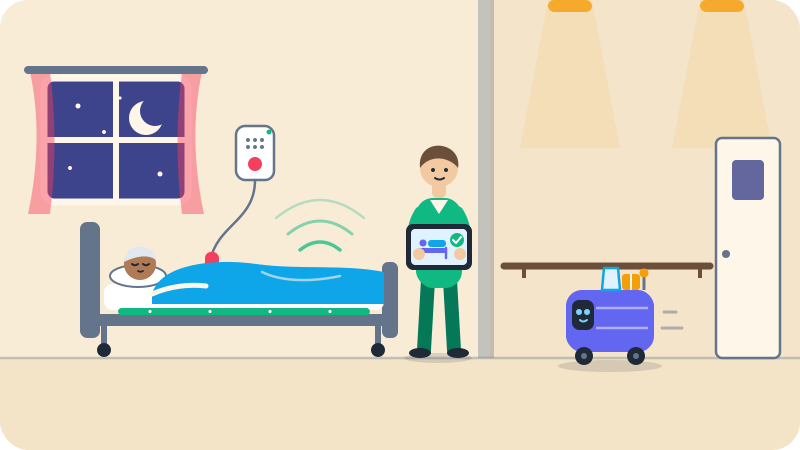
The most useful data comes from Japan. An MHLW night-shift time study from 2020 recorded 10 p.m. to 7 a.m.: care workers spent about 299 minutes on direct care plus patrols. The study also compared facilities with and without bed-monitoring sensors (sensors in or beside the mattress that detect sitting up and leaving the bed). Few facilities took part and staff filled in their own times, but it is one of the few studies that actually measured time.
This chart makes me want to correct the order I gave in Day 7 (this is my judgement). "Cut walking first" is the lowest-risk step, and hospitals already have large deployments, so it is still a reasonable first step. But the biggest use of night time is help with toileting, close to half; patrols and walking take about a fifth. Night-time toileting prediction, bed-exit detection and patrols should be worked on alongside delivery robots, not after them.
Injuries, meanwhile, cluster around moving bodies. In a small Taiwanese study, 96.5% of care workers in 176 questionnaires from 9 long-term-care facilities reported musculoskeletal injuries, most often in the lower back; the hardest tasks were transfers (moving a person from one place to another) between wheelchair and toilet, followed by help with bathing. In another survey of 341 home-care workers, 88% had discomfort in at least one body area in the past year. Taiwan has no national statistics on care workers' occupational injuries, so it is hard to work out whether buying a transfer device pays off.
Who Pays
Japan has already turned "adopting technology" into visible money, mainly through three routes:
- Relaxed staffing standards: with bed-monitoring sensors on every bed plus intercoms, the study above measured an average 25.7% cut in work time per resident. On that basis the MHLW let traditional special nursing homes relax their night-time minimum staffing by about 20%, for example from 2 to 1.6 staff for 26–60 residents; the conditions are a committee, a trial of at least 3 months, and explaining to residents or families and getting their consent first. From 2024, specified facilities that combine several technologies and reorganise tasks can move their care staffing ratio from 3:1 to 3:0.9.
- Fee add-ons (extra points in the care fee schedule): a "productivity improvement" add-on (an extra payment that rewards facilities for using technology to work more efficiently) was created in 2024, but a flash survey of 1,585 special nursing homes found 74.9% had not applied. The interim revision of June 2026 tied an extra ¥7,000 a month in care workers' pay to this add-on, making the incentive much stronger at once.
- Equipment subsidies: in FY2025, transfer and bathing equipment could get up to ¥1 million per unit, other equipment up to ¥300,000 per unit.
Taiwan's ten-year LTC 3.0 budget (2026–2035) is about NT$1.4457 trillion, of which "introducing smart care" is about NT$35.89 billion, roughly 2.5%. From 1 July 2026 a full-rental scheme for smart assistive devices was added: NT$60,000 per 3 years (including up to NT$20,000 for home accessibility changes), for people at care-need levels 2–8. The first 17 approved items are mainly sensor pads, zero-contact detection, automatic excretion processing and turning aids, plus two wearable robotic aids, an exoskeleton and a powered hip device; there are no care robots that move around or pick things up, and no humanoids. The list appears to have no transfer devices, but that is only inferred from the categories, not officially confirmed.
Residential facilities also have a quality reward of up to NT$1.01–2.40 million per facility per year; that cap covers seven indicators combined, smart technology is just one of them, and monitoring must not invade privacy. In LTC 3.0 the ministry itself admits that uptake of assistive technology is still at an early stage, with no mature adoption process, and that the new scheme's benefits are "yet to be observed and evaluated".
Prices Compared with a Live-In Caregiver
| Option | Price | What it can do | Who pays |
|---|---|---|---|
| Migrant family caregiver | About NT$23,500–26,800 a month (wage, employment-stability fee, insurance; excluding agency fees and room and board; a placement agency's estimate) | Someone present 24 hours a day | Family |
| Taiwan smart-device full rental | Up to NT$60,000 per 3 years, about NT$20,000 a year on average | Sensing, excretion processing, turning aids, wearable aids | LTC benefit |
| Hug transfer robot, Japan | About ¥1.03–1.08 million to buy; the home model can be rented through long-term-care insurance for about ¥27,040 a month, 10% paid by the user | Helps the person stand up and transfer | Care insurance + family |
| 1X NEO humanoid | US$20,000, or US$499 a month | Housework; tasks it cannot do are done by a remote expert; no confirmed consumer delivery found as of early October | Family, out of pocket |
| Moxi hospital delivery robot | About US$200,000–400,000 per hospital per year (the company filing's estimate of revenue per hospital, i.e. what the hospital pays) | Delivers items in hospitals | Hospital |
The conclusion is blunt (this is my inference): in Taiwan, nobody is currently paying for general-purpose home robots. The rental subsidy averages about NT$20,000 a year; 1X NEO rents for US$499 a month, about NT$16,000, so a single month's rent comes close to a whole year's subsidy, and tasks it cannot do still rely on a remote expert. In the short term the real buyers of care technology are facilities, and what they can afford, and get paid for, is sensors and record systems.
Scorecard of Existing Care Robots
No-Contact Tech Spread, Body-Contact Robots Did Not
A 2024 national survey by Japan's Care Work Foundation asked residential facilities which equipment they use "day to day":
The gap is obvious: seven in ten facilities use bed sensors every day, while every type of care robot is under one in ten. In the same survey about 73% of residential facilities "felt" that information and communication technology (ICT) or robots eased the workload, but that is self-assessment, not measurement.
The MHLW's combined 2020–2022 verification studies (111 facilities, five days of logged work time each, before-and-after comparison, no randomisation) give a more detailed picture:
- The more bed-monitoring sensors were installed, the less time went to direct care plus patrols.
- Transfer aids do not necessarily save time: with donning and removal counted, wearable ones slightly increased transfer work time; non-wearable ones also slightly increased it at night; both only slightly lowered the share of staff with back pain.
- Toileting-prediction devices reduced the number of "taken to the toilet but nothing happened" trips.
- Switching to smartphone records and adding care assistants (staff who take over side tasks) also saved time more clearly.
What Field Research Says
The researcher Wright spent more than 18 months from 2016 doing fieldwork in Japanese care facilities and wrote it up in the 2023 book Robots Won't Save Japan. In his MIT Technology Review article he describes the Hug transfer robot being stopped by staff after a few days, and purchased robots often being locked away in cupboards; by 2018 Japan's central government had spent well over US$300 million on care-robot R&D. A separate 2023 scoping review covering 39 systems found only 16% actually used in practice, with no proof of reduced staffing needs, and instead cases of interrupted work and tasks being shifted to nurses.
Evidence for companion robots is weak too. In an Australian trial (28 facilities, 415 people with dementia, 10 weeks, randomised by facility), the seal robot PARO beat a switched-off plush toy only on "how engaged the residents were"; once costs were counted the toy was slightly better value (extra cost per resident A$50.47 for PARO, A$37.26 for the toy). A 2026 meta-analysis pooling 34 randomised trials found an effect only on dementia-related emotional and behavioural symptoms, with low certainty and no data on care workers' workload; the authors judged it not yet suitable for routine use, only as a guided support tool.
The strongest evidence belongs to old technology. In six US nursing homes, introducing mechanical lifts together with a no-manual-lifting rule and training cut the injury-claim rate to 0.39 times its earlier level; about US$159,000 invested saved about US$55,000 a year in claims, paying back in under three years. But this was a before-and-after comparison, and another review notes that lifts are actually used in only about 21% of transfers, most often because there is "no time".
An economics study is also often cited: Lee, Iizuka and Eggleston (NBER 2024), using two survey waves from 265 Japanese facilities, found robot adoption associated with more hiring and retention and with fewer restraints and pressure ulcers, most clearly for monitoring-type devices. It is observational, and the authors themselves say causality cannot be established.
Discount the Vendor Numbers
For the items below, except where noted, the numbers are company-reported or from evaluations with company involvement; no independent audit was found:
- Moxi (hospital delivery robot): when Serve Robotics announced its acquisition, about 100 robots, 25+ hospitals and 1.25 million+ cumulative deliveries, with a claimed 575,000–600,000 hours saved. These are hospitals, not long-term-care facilities.
- ElliQ (tabletop conversational companion device): the New York State Office for the Aging programme had 834 participants by May 2025, and 94% said they felt less lonely; the report is copyrighted by the vendor and has no control group.
- Hyodol (Korean doll-shaped robot): over 10,000 units according to the company and media, not independently verified; a non-randomised study (180 people) showed improved depression at 3 months, but the effect did not last to 6 months.
- DFree (ultrasound bladder sensor that signals when it is time for the toilet): in a 3-month trial with 31 nurses at a German university hospital, its usability score was 50.9, below the commonly accepted 68, mainly because it was hard to connect to existing systems. This one is a hospital-side trial, not a company number, and the result was poor.
- Obi (feeding robot arm): a small study showed users' ability to feed themselves improved, but caregivers' time saved was not actually measured; the US insurer Anthem considers the evidence for such aids insufficient.
Pilots in Taiwan
Foxconn and Kawasaki Heavy Industries' nursing robot Nurabot has been tested on wards at Taichung Veterans General Hospital since April 2025, delivering medicines, specimens and wound-care kits. "Up to 30% less nursing workload" is Foxconn's claim, with no hospital or independent data, and during testing it ran into limited access to the hospital's data systems; it is currently in hospitals, not long-term-care facilities. A nursing home attached to the ministry's Sinying Hospital is validating, with ITRI, a patrol robot that measures breathing and heart rate at night; the report gives no quantified results. The National Science and Technology Council claims that one residential facility cut 7.5 hours of record-keeping a day after adopting an AI system, without explaining the sample or method; some facilities also self-report 1.5–2 hours a day less spent on rounds, measurements and records. A Legislative Yuan Budget Center report notes that such programmes still lack performance metrics (the page could not be opened during research; the content comes from a search snippet).
Measured, but mostly before-and-after
No time saved, or only beat a cheap alternative
No control group or independent audit
Needed, but no product or data
Putting it together (this is my summary): the unit that actually works is a whole package of "sensors plus intercoms plus records, with tasks reorganised", not a single robot. What holds things back is system integration, hidden labour such as putting devices on and pushing machines into place, and cost, not whether robots are dexterous enough.
Where Embodied AI and Humanoid Robots Stand
"Embodied AI" means AI that moves its hands and walks: a model put inside a robot body. The hottest approach of the past two years is the VLA model (see "Ten Terms First"): it looks at the scene, hears one instruction and directly outputs how the arms and legs should move. Progress is fast, but the public numbers still sit at roughly "household chores done about half the time, with a person nearby to step in".
Company Numbers and Independent Tests Are Far Apart
First, the results companies publish themselves. None has been redone by a third party:
- Figure Helix 2.5 (2026-09): in 30 homes it had never seen, tidying toys, folding towels and making beds, the whole-task completion rate was 56%. The scoring is strict: if a person has to step in for safety, it counts as a failure. The version without pre-training on human behaviour data managed only 9%.
- Gemini Robotics 2 (2026-07): a humanoid picking things up from the floor 45.7%, tying a rubbish bag 44%, sweeping into a dustpan 32%. DeepMind itself says multi-finger dexterity is still hard.
- Some numbers depend on the definition. Skild S1 claims 66% on unseen tasks, but that figure includes human interventions; it is not the robot doing the job from start to finish by itself.
Now the tests where researchers set the same tasks and score everyone the same way:
- RoboDojo (leaderboard frozen 2026-07-03): the best real-robot policy was Physical Intelligence's π0.5 at 12.8%; the same tasks under human teleoperation scored 100%. In simulation the best model's overall average was only 8.8%, against 76% for expert human teleoperation.
- OK-Robot did "pick it up and put it in a given place" in 10 real homes with a 58.5% success rate, reaching 82% in tidy settings. A slightly messier home cost more than twenty percentage points.
When caring for a frail older person, one slip can mean one fall. My judgement is that today's numbers are still far from the reliability long-term care needs (above 99%).
The Real Status of Home Humanoids
The names that keep appearing in the news, side by side (as of 2026-10-10):
| Product | Public status | Evidence of autonomy | Distance from care |
|---|---|---|---|
| 1X NEO | US$20,000 or US$499/month; production started 2026-04, internal teams first | 2025 press demo was fully teleoperated | No confirmed customer delivery found |
| Tesla Optimus | Fremont line still being installed; 1M/year is design capacity | Many interactions at the 2024 event were teleoperated by off-stage staff | No public output or autonomy figures |
| Figure | Home tests and factory deployment | The 56% above is company-reported | Former safety head sued; allegations not proven in court |
| Unitree | Big price cuts; sold mainly to research and education | A development platform, not a care product | No data on care use |
| Agility Digit 5 | Trials in H1 2027, general release end of 2027 | Separate safety controller | Aimed at factories and warehouses, not homes |
1X NEO is closest to "for the home", so it deserves a few more words. The official order page states that tasks the robot cannot do are performed remotely by 1X experts in booked time slots; the claimed weight of about 30 kg and the absence of pinch points have not yet been seen tested by any third party. 1X says its factory can make at most 10,000 units a year, but as of early October no confirmed customer delivery could be found. As for Tesla's event, Bloomberg reported that many interactions were teleoperated by off-stage staff, which was not explained on stage.
Three Roles of Teleoperation
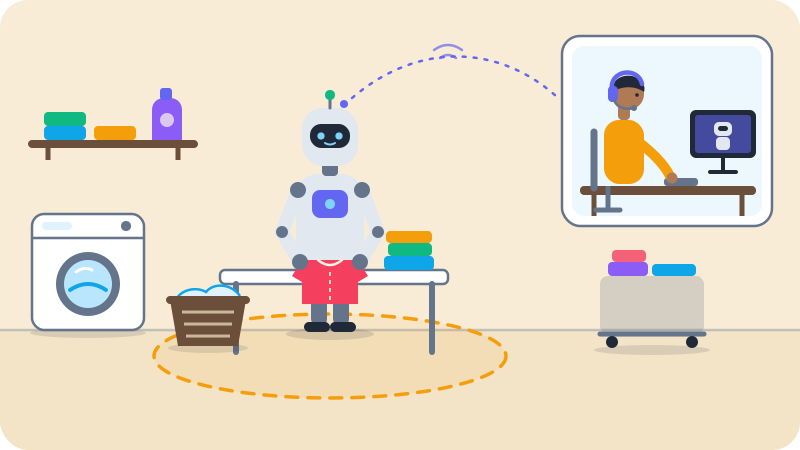
Teleoperation plays three roles in today's robot industry at once:
- Performance: a teleoperated demo is packaged to look as if the robot did it alone; the Tesla and NEO examples both fit. When watching a video, ask first: is someone controlling this?
- Product backstop: a real person takes over what the robot cannot do, such as NEO's booked remote operation. The product can launch earlier, but it also means someone can see into your home through the cameras.
- Training data: Physical Intelligence's π*0.6 feeds experts' remote corrections made mid-task straight back into training; the company claims more than double the hourly throughput on the hardest tasks and roughly half the failure rate.
In long-term care, the second role may actually make sense. Japan's Enactic has signed memoranda of understanding with more than 80 care providers: humanoids will first be teleoperated to do laundry, clear meal trays and restock, work that does not touch residents, with facility trials from summer 2026 and a test of automation around the end of the year. My view: having a "remote care worker" supervise low-contact work is more honest than pretending the robot is already autonomous. But some things must be settled first: camera privacy in residents' rooms, network latency, how many robots one operator can watch (no home-robot company had published this ratio as far as this research found), and who is responsible when something goes wrong.
Safety Gaps Around Frail Older People
Even if robots were smart enough, the safety rules are not ready:
- Standards are still being revised: the current ISO 13482 dates from 2014. The second edition is at final draft, with CEN listing publication for February 2027; critics point out that it lacks binding test methods and does not systematically include representatives of older people. ISO 25785-1, the standard for robots that must actively keep their balance, is still a committee draft, and its scope is factories.
- Power off is not safe: a traditional machine stops when power is cut, which counts as a safe state; a biped falls over when power is cut, so that logic does not hold.
- Pain limits come from healthy adults: the pain and pressure limits in ISO/TS 15066, widely used for collaborative robots (robot arms designed to work in the same space as people), are based on 100 healthy subjects aged 18 to 66. How much force an older person with fragile skin can tolerate has no matching study that could be found.
- A language model as the brain carries risks: teams from King's College London, Carnegie Mellon and others tested scenarios of helping older people at home; every model agreed to at least one instruction that could cause serious harm, and they commonly agreed to take away a user's wheelchair or cane. The authors advise against making a language model the sole controller.
- Keep your distance: roboticist Rodney Brooks advises not standing within 3 metres of a walking full-size humanoid. Long-term care, of all things, is close-contact work.
Programmes in China, Japan and Korea
- China: the elder-care robot pilot by MIIT and the Ministry of Civil Affairs (2025 to 2027) requires at least 200 households for home products and at least 20 institutions, validation of at least 6 months, and safety reports every two months. 32 projects were announced in September 2025; as of October 2026 no public results could be found. Fourier's CEO has also said that humanoids in medical and elder-care settings are still at an early stage of clinical validation.
- Japan: AIREC, from "Moonshot", the Japanese government's long-term, large-scale R&D programme, weighs about 150 kg and has shown, in the lab, turning a person over and helping them sit up; its lead researcher expects it to enter facilities around 2030 at an initial price of at least ¥10 million.
- Korea: the 2026 care-robot forum showed only specialised robots for toileting, bathing, feeding and turning. A pilot of 400 smart homes and 12 facilities comes first in 2027, and officials say humanoids will take longer, with no timeline given.
What they share: what has reached the field is sensors and specialised devices; humanoids are still in labs, demos, or pilots whose results have not been published.
How AI Helps Build the Robots
So can AI help build care robots? My conclusion after the research is that the most likely path is not AI designing a robot from scratch. Instead, AI makes software, firmware, circuit boards and simulation cheaper, while the hardware uses off-the-shelf, mass-produced, easy-to-simulate parts, such as a wheeled base with a light arm, or a small tabletop device. The bottleneck then moves from "can it be built" to reliability, field validation, certification and production quality.
Hardware Got Cheaper, but Who Is Buying
Unitree's prospectus shows the average selling price of its humanoids falling from about ¥593,000 (RMB) in 2023 to about ¥168,000 in the first three quarters of 2025, a drop of about 70%. But look at who is buying:
The market is still small. Global humanoid shipments in 2025 were about 13,000 to 16,000 units, and Morgan Stanley says about 90% came from Chinese makers; the International Federation of Robotics (IFR), counting only full-size models of 140 cm and up, puts sales at about 7,000 units. BofA forecasts the bill of materials falling from about US$35,000 in 2025 to below US$17,000 by 2030; that is a forecast. Mass production is also more than buying parts: Figure reports that every robot passes more than 80 functional tests before leaving the factory.
From Mechanisms to Firmware, How Far AI Gets
- Mechanical design: MIT used a generative model to reshape human-drafted linkages, and the jumping robot jumped about 41% higher, but it is a narrow lab demo. A benchmark of generating CAD parts (3D part design files on a computer) from text shows that beyond basic geometry it largely fails. AI suits brackets and housings, not yet joints.
- Circuit boards: Quilter claims an 8-layer board with 843 components took engineers only 38.5 hours against a manual quote of 428 hours; this is vendor-reported.
- Firmware: firmware is the code that directly controls motors and sensors. In the EmbedAgent benchmark, the best model got it right on the first try 65% of the time. Duke University's 2026 IoT-SkillsBench study, validated on real hardware, found that code which compiles without errors still fails on a real chip, for example when signal timing is off or the chip's peripheral circuits are not started up correctly; only after the model was given short skill notes written by human experts did it get close to fully correct.
Discount Simulation and Synthetic Data
Simulation means practising in a virtual world on a computer and then moving to the real robot; synthetic data is practice data generated by computer. This is the shortcut most often promoted, so read the numbers closely:
- In NVIDIA's GR00T N1 paper, adding video-generated data improved 8 real-robot tasks by only 5.8% on average; the 40% in the blog comes from a different pipeline.
- Cosmos data augmentation raised real-robot navigation success from 54% to 91%, but the number of trials was not published.
- There are solid results too: MuJoCo Playground went straight from simulation to real hardware on 6 kinds of robots.
My reading of the material: navigation, "moving to a place", is where simulation-to-reality is most mature; fine finger work still depends heavily on real data. This is one reason Day 7 suggested starting by reducing how much caregivers walk.
Open Hardware Lowers the Bar to a Few Hundred Dollars
Hugging Face's LeRobot uses the commercially usable Apache-2.0 licence, and its SmolVLA can be trained on a single graphics card. On hardware, a full XLeRobot costs about US$660, with each arm lifting 1 kg or less; the tabletop Reachy Mini sells for US$399 to 499, and the maker says more than 10,000 have shipped. The bar is low enough for one person to start, but far from care grade: no failure data could be found for these low-cost arms running 24 hours a day.
Clues from Project Fetch
A disclosure first: Project Fetch is an Anthropic study; Anthropic makes Claude, and Claude helped research this post.
In phase two (2026-06), Claude Opus 4.7 working alone finished four shared tasks in about 9.6 minutes; the human team with Claude's help took 181 minutes, and the team without AI took 361 minutes. But it could not do closed-loop control that corrects as it watches, such as "see the ball, walk over and pick it up by itself". In other words, structured integration work such as wiring sensors, object detection and navigation is already fast with AI; fine control that adjusts as it senses is not there yet.
What Still Needs a Team
Fixed steps, results easy to check
Compiled or simulated does not mean the real robot works
Mostly not solvable by a tech demo
My estimate is that, with AI's help, one engineer can build a non-contact prototype within a few months. But the work in the third group, such as raising success from about 60% to over 99%, anything that touches the body, product certification (no public figures exist for the cost and time of ISO 13482 certification) and medical claims, still needs a team and money.
My view: AI shortens the time to "build the first unit"; it does not shorten the time to "prove the thousandth unit is safe". That second stretch is what long-term care is really waiting for.
The Five Most Likely Stages
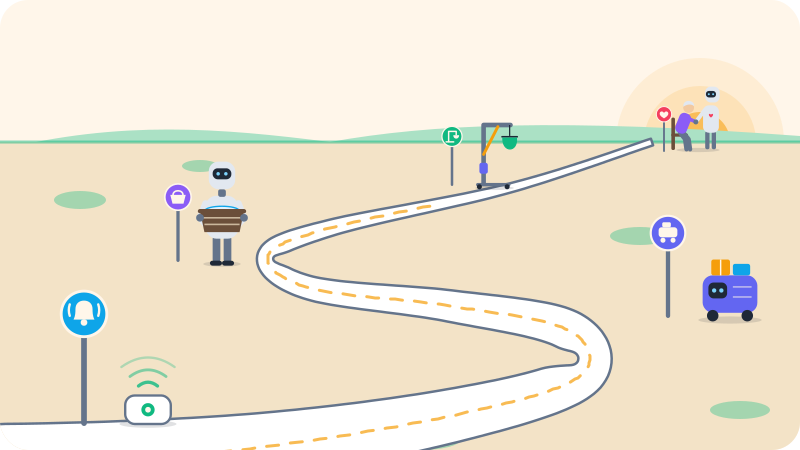
Put the earlier material side by side: the roadmaps of Japan, Korea, China and Taiwan, plus the actual adoption numbers, line up in roughly the same order. It also matches the "non-contact → low-contact → body-contact" order from Day 7. The five stages below are my inference from those roadmaps. The years are rough estimates, not prophecy. For each stage I list the gates beyond technology: who pays, when standards and rules will be ready, who is liable when something goes wrong, and whether the evidence is good enough.
S0 Sensors, records and intercoms, about 2024–2028, already spreading. Mattress or bed-exit sensors, care-record software, and an intercom for every staff member on shift. This is the only layer today that has both a payer and medium-quality evidence (numbers in "Scorecard of Existing Care Robots" above). In Taiwan's smart assistive-device rental scheme, which started in July 2026, many of the first approved items are sensing and non-contact detection products from this layer. What holds it back is not technology but changing workflows and getting residents' consent: in 2024 only 31.6% of Japanese care operators had introduced ICT or robots, short of the 36% target (MHLW administrative review).
- Payment is tied to the whole workflow: since 2024, specified facilities in Japan can use the "staffing exception" only if three things are in place together: a bed-monitoring sensor that can report bed exits in every room, an intercom device for everyone on the same shift, and record software; residents or families must also consent before installation (MHLW notice).
- The targets keep rising: the same review sets the adoption target at 43% for 2025 and 50% for 2026.
- Policy is shifting from robots to sensing: on 2024-06-28 the MHLW and METI renamed the "priority areas for using robot technology in care" to the "priority areas for using care technology", expanding them to 9 areas and 16 items (MHLW). The Japan Research Institute reads this as a shift from "robot-led" to "sensor- and AI-led" policy.
- Taiwan's privacy rules are in transition: amendments to parts of the Personal Data Protection Act were promulgated on 11 November 2025, setting up a Personal Data Protection Commission and spelling out a duty to report data incidents, but as of March 2026 the Executive Yuan had yet to set the date they take effect; medical records, treatment and health-check data are special categories with stricter limits on collection and use (law firm summary).
S1 Delivery and cleaning robots inside facilities, about 2025–2030. A wheeled base carrying things between corridors and lifts, never touching people. The closest evidence is Moxi in hospitals (company-reported, see above). The International Federation of Robotics (IFR) counted nearly 250,000 professional service robots shipped in 2025, 47% of them for transport and logistics (IFR). Japan's AI robot strategy also starts with shared tasks such as patrols, transport and cleaning, leaving work that needs finger dexterity until after 2030; a Liberal Democratic Party proposal aims to reach the "patrol and transport" level in all 18 fields before 2030.
- Money: per company filings, Moxi is projected to bring in about US$200,000–400,000 per hospital per year (company-reported), a level small care homes would struggle to pay. That is why the LDP proposes subsidising "robots as a service" (RaaS, paying by subscription).
- Buildings: lifts and door access have to be integrated with the robot.
- Standards: the second edition of ISO 13482 is renamed safety requirements for service robots and widens its scope to personal and commercial service robots, while excluding industrial and medical robots; the European standards body CEN lists its publication date as 2027-02-09 (CEN).
- EU machinery rules: the EU Machinery Regulation (EU) 2023/1230 applies from 2027-01-20 with no transition period; machines that use machine learning for safety functions need review by a notified body (a third-party testing body designated by a government), but the term has no official definition and few such bodies have been designated (DTI). The EU AI Act amendments passed in 2026 did not change this date (EUROGIP).
S2 Humanoids or mobile arms doing back-of-house chores, starting with teleoperation, about 2026–2032. Laundry, clearing meal trays, restocking, without touching residents. The Japanese Enactic pilot mentioned earlier belongs to this layer. The LDP proposal estimates that this kind of peripheral work takes about 30% of facility working hours, and recommends verifying the benefit first, then adding "humanoid or teleoperated robots that do not directly touch users" to the care priority areas.
- Operators: remote operators are themselves a labour cost. How many robots one operator can supervise: no home-robot company had published this ratio as far as this research found; one vendor's blog estimates roughly one operator per robot for live teleoperation, with one person covering several robots only in a supervision-style assist mode, none of it audited (vendor blog). My inference: if it is one operator per robot, this layer does not save labour; it only moves the person from the floor to a remote desk.
- Privacy: there are cameras in residents' rooms, and a person watching through them.
- Standards: ISO 25785-1, the standard for robots that must actively keep their balance, is still a committee draft and its scope is industrial; the IEEE humanoid standards study group published a pathway study in September 2025 focused on classification, stability (including how to handle falls) and human–robot interaction, and its chair estimates the standards are still 18–36 months from publication (The Robot Report).
- Liability: the EU's new Product Liability Directive (EU) 2024/2853 applies to products placed on the market after 2026-12-09 and treats software, including AI systems, as a product; a faulty software update or a missed safety update can create liability, and the burden of proof for complex systems shifts in the consumer's favour (Kennedys). The LDP proposal also calls for safety certification and insurance schemes to be set up quickly.
- Price: Morgan Stanley estimates a humanoid's unit price in high-income countries at about US$200,000 in 2024 and about US$150,000 in 2028.
S3 Specialised body-care devices, about 2028–2035. Transfer, turning, toileting and bathing, each handled by a purpose-built device that slowly gains AI sensing. The counter-evidence is plain: Japan has made transfer a policy priority for more than ten years, yet transfer robots are used by only 6.2% of facilities; Hug and the wearable aids in "Scorecard of Existing Care Robots" above point the same way. China's 2025–2027 elder-care robot pilots have 32 selected projects, with scenarios including transfer and walking assistance, and require at least six months of on-site validation, but no public results could be found as of October 2026; the Ministry of Civil Affairs' guidance of January 2026 also lists scenarios such as toileting care and transfer, but gives no deployment numbers.
- Medical-device classification: in Taiwan, whether a care robot counts as a medical device depends on the use it claims. Medical devices fall into three risk classes, and items not in the classification annex are in principle placed in class III, the highest-risk class; assistive products that are non-invasive, harmless and usable without a health professional can apply to be exempted from medical-device listing (Medical Devices Act).
- Reimbursement lists: Taiwan's first 17 rental items fall into four categories, mobility, bathing and toileting, home care beds, and safety monitoring, and the review looks at function, ICT and safety-certification specifications (MOHW); the list appears to have no transfer devices (inferred from the categories; see "Who Pays" above). One ready-made route already exists: FREE Bionics' FREE Walk lower-limb exoskeleton received Taiwanese class II medical-device approval and the EU CE mark in 2019, and joined the first rental list in 2026 (Business Next). Korea plans to support technologies proven effective through long-term-care equipment listing, facility payments and vouchers (Money Today).
- Acceptance: in a Swiss national telephone survey (1,211 people), 49.5% would accept a robot doing housework but only 28.8% one for companionship and chat; the strongest predictor of acceptance was "whether it eases the burden of care", though none of the respondents had actually used a robot (Innovation in Aging).
- Competition with migrant-worker policy: the health ministry is considering raising the facility migrant-caregiver quota from one per five beds to one per three beds (PTS).
S4 General-purpose humanoids doing body care, after 2035, highly uncertain. AIREC, from Japan's Moonshot R&D programme, aims to enter facilities only around 2030. Rodney Brooks predicts that deployable dexterity will still be far below the human hand after 2036, and thinks that without new mechanical designs bipedal humanoids are not safe enough to be close to people; Morgan Stanley estimates that general-purpose home humanoids need about another decade, speeding up only in the late 2030s; in Goldman Sachs' base case, 2030 shipments are almost all industrial.
- Evidence: a 2026 JMIR Aging review of 59 studies on humanoid robots in elder care found only 4 randomised controlled trials; 58% of studies had 25 participants or fewer and 55% had interventions of a week or less; the functions centred on social interaction and cognitive training, and almost none covered feeding, toileting, bathing or turning.
- Safety: pain limits come from healthy adults, and a biped falls when its power is cut; both are covered in "Safety Gaps Around Frail Older People" above.
- The regulatory timetable is still moving: the EU AI Act amendments passed in July 2026 (the Digital Omnibus) pushed back the high-risk AI obligations for AI embedded in machinery and medical devices to 2028-08-02 (AI Act Explorer).
| 2026 | 2028 | 2030 | 2032 | 2035 | 2040 | |
|---|---|---|---|---|---|---|
| S0 Sensors | Spread | Spread | Common | Common | Common | Common |
| S1 Logistics | Pilot | Pilot | Spread | Spread | Common | Common |
| S2 Teleop chores | Pilot | Pilot | Pilot | Spread | Spread | Spread |
| S3 Care devices | Pilot | Pilot | Pilot | Pilot | Spread | Spread |
| S4 Humanoids | Pilot | Pilot | Pilot | Pilot |
Payment and certification usually lag the technology by several years. Seeing which gates block each stage side by side makes this clearer:
Where the Two Roads Meet
Longevity escape velocity and care robots look like two topics, but they often fall into the same mistake: treating progress upstream as if the destination had been reached. Side by side:
| Longevity escape velocity | Care robots | |
|---|---|---|
| Where AI speeds things up | Upstream: protein structures, molecule design, nominating drug candidates | Software, firmware, circuit boards, simulation, plus cheaper hardware |
| The real bottleneck | Human trials take years; no accepted surrogate endpoint | Reliability on site, safety standards, clinical evidence, who pays |
| Typical hype | Presenting mouse results or ageing-clock changes as people living longer | Presenting teleoperated demos as robots doing it themselves |
| Optimistic timing | de Grey: 50% within 12–15 years (per a secondary report); Amodei: 5–10 years after powerful AI arrives | Home humanoids shipping from 2026 (1X's official statement; no confirmed customer delivery found as of early October) |
| Evidence-based timing | No intervention yet shown to slow ageing in humans; Metaculus community median around 2052 | Sensors and logistics dominate the 2030s; general humanoids for body care after 2035 |
(Disclosure: Dario Amodei is CEO of Anthropic, the company that makes Claude, which helped research this post.)
I take three conclusions from this table, all of them opinions:
- In the 2030s, the extra years of care will mainly be carried by people, plus sensors and logistics robots. By WHO's 2023 figures, life expectancy and healthy life expectancy are about 10.5 years apart. What those years need most is body-contact care such as transfers, toileting and bathing, which is exactly what embodied AI will be the last to do safely. What machines can lighten first is caregivers' walking, night patrols and record-keeping.
- Extending life and shortening disability are two different things. If life gets longer but the years of disability do not shrink, the years needing care only grow. Olshansky has also called slowing ageing a possible "second longevity revolution". Pushing the healthy curve up is more practical than chasing escape velocity, and it is worth doing even if escape velocity never arrives.
- Only what runs counts. In Day 3, AI said the work was done and a review found 37 problems; Day 11 concluded that only checks that actually run count. Longevity has to be judged by finished human trials, and care robots by records of getting through night shifts in real facilities. Mouse studies, demo videos and company-reported numbers are only starting points.
| Care task | Caregivers | Sensors and records | Delivery robots | Care devices | Humanoids |
|---|---|---|---|---|---|
| Night patrol | Main | Main | Not yet | ||
| Toileting | Main | Helps | Helps | Not yet | |
| Transfer and turning | Main | Helps | Not yet | ||
| Bathing | Main | Helps | Not yet | ||
| Fetching and walking | Helps | Main | |||
| Laundry and trays | Main | Helps | |||
| Records and handover | Helps | Main |
What One Person Can Do
The Personal Track
What follows is general information, not personal medical advice; see "The First Bridge You Can Use Today" above for details and caveats.
- Backed by randomised trials: lower blood pressure, lower LDL cholesterol and not smoking are causally linked to lower risk of death. Whether to use medication for blood pressure or LDL, and what the targets should be, is for a doctor to decide.
- Associations seen consistently in observational studies: people with better cardiorespiratory fitness, some weekly muscle-strengthening, more walking (about 7,000 vs 2,000 steps a day: about 47% lower risk of death), about 7 hours of regular sleep, less alcohol, a smaller waist and more social contact have lower risk of death. These are associations, not proof, and the risk numbers cannot be added together.
- Supplements: NMN and NR raise NAD+ in the blood, but there is no hard-outcome evidence on death or disease.
- For family: get to know Taiwan's LTC 3.0 services first. From July 2026, the full-rental scheme for smart assistive devices covers up to NT$60,000 every 3 years; most of the first 17 items are sensors, automatic excretion processing and turning aids, plus 2 wearable robotic aids.
The Engineering Track
If you are an engineer who wants to build something genuinely useful, I would pick a night-patrol and reminder prototype that does not touch anyone and does not record images. The reason: in Japan's night-shift study, patrols and walking took about 20% of the time and toileting help about 48%, and sensors are the one layer that has evidence today. No images, because privacy is the biggest source of resistance: Japan requires residents' or families' consent before bed-monitoring sensors are installed, and Taiwan's quality rewards for residential facilities require care technology that does not intrude on privacy.
- Measure a baseline first. With caregivers, record how many rounds a night shift makes now, how far people walk, and how many calls turn out to be false alarms. Without a baseline, any later claim about time saved does not count.
- Months 0–6: a non-contact prototype. Use open hardware to build bed-exit or in-bed reminders that only notify caregivers and never decide on their own that an older person is "fine". Let AI help write the firmware, but test every version on real hardware (for why, see "From Mechanisms to Firmware, How Far AI Gets" above), and first write down pin assignments (what each pin of the chip connects to), timing and similar knowledge as notes for the AI.
- Months 6–12: a small, supervised trial. Measure false alarms, missed events and steps saved for caregivers. To add delivery, use an open platform such as XLeRobot to put light items on a table in a known layout, never into someone's hand.
- Months 12–24: shift from features to reliability. The focus becomes logging, failure-mode analysis and long, stable runs.
AI can speed up the integration part (see the Project Fetch section above). What one person cannot do and a team must is also clear: raising success rates from about 60% to above 99%, any body contact, the certifications needed to sell a product, medical claims, and mass production.
Record one night shift's rounds, walking and false alarms with caregivers
Bed-exit or in-bed reminders that only notify people, no images
Small supervised trial, optional table-top delivery
Logging, failure-mode analysis, long runs
Body contact, product certification, medical claims, mass production
Limits to Know First
- The research date is 2026-10-10. Standards, pilots, prices and forecasts change fast and may be out of date within months.
- Many numbers come from secondary sources. For example, the number of family migrant caregivers in Taiwan is official data as quoted by the media, and the Legislative Yuan Budget Center's comment comes from a search summary; some items could not be re-checked because the search budget ran out during the research.
- Company-reported numbers are not independently verified. The figures for Moxi, Nurabot, Figure, Quilter and ER-100 all fall into this group.
- The five stages and the heatmap are my judgement, not a forecast with probabilities. Forecasts in this field have consistently run high: in 2010 NEDO, the Japanese government's industrial technology R&D agency, projected that the care and welfare robot market could reach ¥404.3 billion by 2035 (secondary source); Yano Research Institute estimates the actual market at about ¥2.2 billion in FY2021 and about ¥3.6 billion in FY2025, so it would have to grow more than a hundredfold to catch up with that forecast.
- Health content is general information only, not medical advice.
Closing
Who will care for us in the extra years? The answer from this research: at least in the 2030s, still people, only with sensors, record software and delivery machines beside them. Longevity escape velocity is possible in principle, but there is no human evidence yet; humanoid robots that can safely touch frail older people are still many years away. What can be done now is to keep up the boring basics, and to start by measuring one night shift with caregivers.
References
Population and lifespan
- WHO Global Health Estimates 2026 (Medical Xpress report), 2026-10-02
- WHO: COVID-19 eliminated a decade of progress in life expectancy, 2024-05-24
- Focus Taiwan: Taiwan's 2025 life expectancy 81.27 years, 2026-08-24
- MHLW: 2025 abridged life tables, 2026-07-24
- MHLW: international comparison of life expectancy, 2026-07-24
- MHLW: life expectancy with specific causes of death removed, 2026-07-24
- Commercial Times: Taiwan 2024 cause-elimination life table, 2025-10-25
- Oeppen & Vaupel, Science (PDF), 2002-05-10
- Our World in Data: the rise of maximum life expectancy, accessed 2026-10
- Olshansky et al., Nature Aging (ScienceDaily), 2024-10-07
- UIC: Olshansky 2024 press release, 2024-10-07
- Lifespan.io: researchers respond to Olshansky 2024, 2024-10-11
- GBD study of slowing life-expectancy gains in Europe (ScienceDaily), 2025-02-18
- Vinicius & Migliano best-practice life expectancy preprint, 2025-05-02
- Dong et al. 2016 on a limit to human lifespan (Carl Zimmer), 2016-10-05
- University of Groningen: five rebuttals in Nature, 2017, 2017-06-28
- Pearce & Raftery, Demographic Research, 2021-06-30
- The Local: verification of Jeanne Calment's age, 2019-09-17
- US NCHS cause-elimination life tables, 2013-05-31
- WHO: 2026 Global Health Estimates news release, 2026-10-02
- US NCHS: record US life expectancy in 2024, 2026-01-29
- Ministry of the Interior: 2025 abridged life table, 2026-08-24
- Fight Aging!: commentary on Olshansky 2024, 2024-10-07
- Andrade et al., PNAS 2025: birth-cohort lifespan study (Technology Networks), 2025-08-26
- Newswise: the Austad–Olshansky 2150 wager, 2000-09-15
- Barbi et al. 2018 and critics: do death rates plateau after 105 (ScienceDaily), 2018-12-20
- Metaculus 1628: longest verified lifespan in 2050, 2026-09-18
- Olshansky et al. 1990, Science: limits to life expectancy, 1990-11-02
- Goldman et al. 2013, Health Affairs: simulation of delayed ageing (ScienceDaily), 2013-10-07
- López-Otín et al., Cell: twelve hallmarks of ageing, 2023-01-19
- Gladyshev: the deleteriome view, 2016-08-01
- Medical News Today: what can and cannot slow ageing, 2026-09-05
Definition of and predictions about longevity escape velocity
- de Grey, PLoS Biology, "Escape Velocity", 2004-06-15
- Wikipedia: Longevity escape velocity, accessed 2026-10-10
- Fight Aging!: the three bridges of Fantastic Voyage, 2004-11
- 80,000 Hours: interview with de Grey, 2012-04
- Longevity.Technology: de Grey's 2035 prediction, 2021-01-01
- Arjun Khemani: de Grey's 2025 estimate (secondary report), 2026-10-01
- Report on Kurzweil's 2024 interviews (Yahoo), 2024-03
- Boston Magazine: interview with Kurzweil, 2026-02-11
- Dario Amodei: Machines of Loving Grace, 2024-10
- Fortune: Hassabis on AI and disease, 2026-01-22
- Gary Marcus: rebuttal of Amodei's 5–10 year claim, 2026-08-17
- Metaculus 6592: when will a country reach longevity escape velocity, accessed 2026-10-03
- Warner et al., EMBO Reports: 28 scientists on SENS, 2005-11-01
- Palmer: opinion paper on biological escape velocity, 2022-12-12
- Wikipedia: David Gobel, accessed 2026-10-10
- Wikipedia: Aubrey de Grey, accessed 2026-10-10
- Dwarkesh Patel: interview with George Church, 2025-06-26
- Fortune: Bryan Johnson's 2039 goal, 2025-12-17
- Metaculus 4788: will superintelligence precede LEV, 2026-09-23
- Metaculus 3795: will LEV follow effective therapies, 2026-09-03
Interventions and trials
- PEARL rapamycin trial, 2025-04-04
- Technology.org: TAME still waiting for funding, 2026-09-26
- D+Q phase 2 trial in MASH, Nature Metabolism, 2026-10-01
- Mayo D+Q bone trial, Nature Medicine, 2024-07
- SELECT trial, NEJM, 2023-11-11
- FLOW trial (Pharmaceutical Journal), 2024-05-24
- Life Biosciences: first participant dosed with ER-100, 2026-06-09
- Life Biosciences: first-in-human ER-100 data, 2026-10-08
- NewLimit financing (STAT), 2026-06-02
- LEVF: RMR1 update, May 2024, 2024-05-07
- LEVF: RMR1 conclusion, 31 May 2025, 2025-05-31
- LEVF: December 2025 update and RMR2, 2025-12-09
- XPRIZE Healthspan first milestone, 2025-05-12
- XPRIZE Healthspan: 20 finalist teams, 2026-08-11
- GEN: the FDA and ageing as an indication, 2026-10-02
- Lifespan.io: FDA officials at ARDD 2026, 2026-10-01
- Sehgal et al., Nature Medicine: 51 intervention studies and ageing clocks, 2026
- Moqri et al., Cell: biomarkers of ageing, 2023-08-01
- NIA ITP: mouse results for NR and other compounds, 2021
- NIA ITP, Nature: rapamycin fed late in life extends mouse lifespan, 2009-07-08
- ClinicalTrials.gov: the EVERLAST trial, 2026-09-04
- Fight Aging!: ARPA-H funding for ageing-related trials, 2026-03-04
- NPR: the TAME trial and its funding, 2024-04-22
- ClinicalTrials.gov: NCT02570672 frailty-prevention trial, 2025-08-06
- Fight Aging!: review of metformin evidence (incl. MeMeMe), 2026-08-20
- Longevity.Technology: Unity lays off staff, 2025-05
- ClinicalTrials.gov: fisetin trial, 2026
- Alzheimer Europe: EVOKE trial results, 2025-12
- Nature: a GLP-1 drug and mouse lifespan, 2026-09-02
- Lu et al., Nature: partial reprogramming restores vision in mice, 2020-12-02
- Fight Aging!: Retro's autophagy-promoter trial, 2026-01-09
- Sacra: Altos Labs company profile, 2026-09
- Buck Institute and Circulate: 42-person plasma exchange trial, 2025-05-27
- CBS News: FDA warning on young-plasma infusions, 2019-02-19
- LEVF: RMR1 study updates, 2025-05-31
- Brown University: ARPA-H ageing research programme, 2026-02-24
- Higgins-Chen et al., Nature Aging: technical noise in ageing clocks, 2022-07
AI and drug discovery
- Rentosertib phase 2a, Nature Medicine, 2025-06-03
- Insilico's TNIK target and molecule design, Nature Biotechnology, 2024-03-08
- Insilico: rentosertib phase 3 begins, 2026-07-07
- Nobel Prize in Chemistry 2024, 2024-10-09
- IntuitionLabs: AI drugs and FDA approvals, 2026
- BCG authors: clinical success rates of AI-discovered molecules, 2024
- Nature Methods: perturbation prediction did not beat linear baselines, 2025
- Derek Lowe, Chemistry World, 2025-01
- Bosley & Scannell: predictive validity model, 2016
- Google DeepMind: five years of AlphaFold impact (company-reported), 2025-11
- The Pharma Letter: Isomorphic Labs, 2026
- The Register: Hassabis's AI-drug timeline, 2025-01-22
- Insilico: rentosertib and proteomic ageing clocks, 2026-09-07
- Pharmaceutical Technology: Recursion ends programmes, 2025-05
- Morgan Lewis: FDA roadmap to reduce animal testing, 2025-04
Evidence on behaviour and lifestyle
- Ettehad et al.: blood-pressure meta-analysis (NIHR), 2016
- CTT 2010: LDL-lowering trials summary, 2010-11
- Jha et al., NEJM: smoking and quitting (PDF), 2013-01-24
- Lang et al., BJSM: cardiorespiratory fitness umbrella review, 2024-05-02
- Momma et al., BJSM: muscle-strengthening activity, 2022
- Ding et al., Lancet Public Health: daily steps, 2025-07
- Windred et al.: sleep regularity (UK Biobank), 2023-09
- Jayedi et al., BMJ: waist circumference, 2020-09-23
- Holt-Lunstad et al., PLoS Medicine: social relationships, 2010-07
- Meta-analysis of NMN randomised trials, 2024
- SPRINT trial, NEJM, 2015-11
- Mandsager et al., JAMA Network Open: fitness and mortality, 2018-10-19
- Wen et al. 2011, Lancet: physical activity in Taiwan's MJ cohort (ScienceDaily), 2011-08-16
- JAHA 2017: meta-analysis of sleep duration and all-cause mortality, 2017
- Zhao et al. 2023: alcohol meta-analysis of 107 cohorts (Healio report), 2023-03-31
- Generation 100 exercise randomised trial, 2020-10-07
- Kankaanpää et al. 2024: Finnish twin cohort study, 2024
- Li et al. 2018: five low-risk lifestyle factors (Harvard Chan School), 2018-04-30
- Venable: FDA restores NMN's dietary-supplement status, 2025-10
Long-term care demand, workforce and money
- Ministry of Health and Welfare: approved LTC 3.0 plan, 2025-12-31
- CNA: Taiwan's 65+ population reaches 20.06%, 2026-01-09
- Ministry of Health and Welfare: smart assistive-device rental scheme launched, 2026-07-01
- Cnyes: the first 17 smart assistive devices, 2026-07-01
- Number of social-welfare migrant workers in Taiwan (media citing labour ministry data), 2026
- Monthly cost of a family migrant caregiver (agency web page), 2026
- PTS: proposal to relax facility migrant-caregiver quotas, 2026
- Legislative Yuan: no performance metrics yet for smart long-term care, accessed 2026-10-10
- MHLW: night-shift time study and relaxed staffing minimums, 2020-12-09
- MHLW: verification across 111 facilities, 2023-04-27
- MHLW: notice on the productivity staffing exception, 2024-03-29
- MHLW: priority areas for care technology, 2024-06-28
- MHLW: administrative review (ICT and robot adoption rate), 2025
- Care Work Foundation: FY2024 survey of care work, 2025-07
- Korea Times: Korea becomes a super-aged society, 2024-12-24
- Money Today: Korea's welfare and care AI roadmap, 2026-10-06
- Ministry of Labor: no assessment needed for hiring a caregiver at 80+, 2025-07-28
- Japan's care workforce falls for the first time, 2025
- MHLW: projected demand for care workers, 2024-07-12
- Newsis: projected care-worker shortage in Korea (secondary report), 2023-12-21
- Small Taiwanese study: musculoskeletal injuries among care workers, accessed 2026-10-10
- Osaka Prefecture: the productivity add-on and staffing exception, 2024
- Flash survey on the productivity add-on, 2024-08
- Fukushi Shimbun: the 2026 interim fee revision, 2026-01-25
- Nagano Prefecture: FY2025 care-technology subsidies, 2025
- Liberty Times: full rental of smart assistive devices, 2026-02-06
- Japan Research Institute: the shift in care-technology policy, 2025-06-17
- Business Next: FREE Bionics' FREE Walk exoskeleton, 2019
Evidence on existing care robots
- James Wright, MIT Technology Review, 2023-01-09
- Hundt's review of Wright's Robots Won't Save Japan (2023) (arXiv), 2024-03
- PARO cluster randomised trial, Moyle 2017, 2017-09
- PARO cost-effectiveness analysis, Mervin 2018, 2018-07
- Collins et al.: ceiling lifts and a no-manual-lift policy, 2004-08
- Lee, Iizuka & Eggleston, NBER, 2024-11
- Ohneberg et al.: scoping review of care robots, 2023-03-18
- JMIR Aging: scoping review of humanoid robots in elder care, 2026-03-11
- Serve Robotics to acquire Diligent (SEC filing), 2026-01-20
- CNN: Nurabot at Taichung Veterans General Hospital, 2025-09-12
- FUJI Hug products and prices, 2026
- Yano Research: Japanese care-robot market, 2022-10-17
- NEDO 2010 market projection (secondary source), 2010
- Kim & Jeon, JMIR: meta-analysis of companion-robot randomised trials, 2026-06-30
- Review of how often patient lifts are actually used, 2024-12-12
- Serve Robotics: release on acquiring Diligent Robotics, 2026-01
- NYSOFA: ElliQ project update 2026 (vendor-copyrighted), 2026-02
- Lee et al. 2023: Hyodol non-randomised study, 2022-11-03
- Halle University Hospital: DFree usability trial, 2025
- JMIR Rehabilitation: Obi feeding-robot study, 2026
- System-access problems during Nurabot testing, 2026
- UDN: patrol robot at Sinying Hospital's nursing home, 2026-06-30
- Economic Daily News: NSTC on AI systems in care homes, 2026-07-23
- MOHW: self-reported results of smart care in facilities, 2025-03-28
- Innovation in Aging: Swiss acceptance of care robots, 2025-06-17
Embodied AI and national programmes
- Figure: Helix 2.5 in 30 homes, 2026-09-17
- Google DeepMind: Gemini Robotics 2, 2026-07-30
- RoboDojo benchmark, 2026-07
- OK-Robot, 2024
- 1X NEO order page, accessed 2026-10-10
- Road to VR: the WSJ's NEO demo, 2025-10-30
- BNN Bloomberg: Optimus robots were remotely operated at the event, 2024-10-14
- Rodney Brooks on humanoids and dexterity, 2025-09
- Rodney Brooks: 2026 predictions scorecard, 2026-01-01
- China MIIT and MCA: elder-care robot pilot notice, 2025-05-26
- The list of 32 pilot projects, 2025-09-12
- Interesting Engineering: AIREC, 2025-02
- Electronic Times: Korea's care-robot forum, 2026-09-16
- Cabinet Secretariat: outline of the AI robot strategy, 2026-03-26
- LDP robot strategy project team proposal, 2026-06-04
- JOINT Kaigo: Enactic partners with 80+ care operators, 2026-03-25
- IFR World Robotics 2026, 2026-09-30
- Morgan Stanley: the humanoid robot market, 2025-05-14
- Goldman Sachs: the humanoid robot market, 2024-02-27
- Turing Post: robotics breakthroughs, September 2026 (Skild S1), 2026-09-21
- 1X: NEO factory opens in Hayward (company release), 2026-04-30
- Botinfo: 1X NEO production and delivery status, 2026-10-05
- Physical Intelligence: π*0.6 (arXiv), 2025-11-18
- Vendor blog: operator-to-robot ratios in teleoperation, 2026
- Cailian Press: 32 elder-care robot pilot projects, 2025-09-11
- IT Home: humanoid costs and the view of Fourier's CEO, 2026-10-02
- Kathmandu Post: AIREC and care in Japan, 2025-02-28
- Xinhua: Ministry of Civil Affairs guidance on technology innovation, 2026-01-30
Safety standards, regulation and liability
- ISO 13482 second edition, 2025-07-24
- CEN FprEN ISO 13482, 2026
- ISO 25785-1, accessed 2026-10-10
- DGUV: pain-threshold study behind ISO/TS 15066, 2019-12-18
- Biped falls on power loss and functional safety (arXiv), 2026-08-03
- KCL: risks of LLM-controlled robots, 2025-11-11
- EU Machinery Regulation and AI safety functions (DTI), 2025
- IEEE humanoid standards study group, 2025-09-25
- IEEE Spectrum: critique of home-humanoid safety standards, 2026-05-19
- Summary of Taiwan's privacy-law amendments (law-firm newsletter), 2026-03
- EUROGIP: what the Digital Omnibus changes for the Machinery Regulation, 2026
- Kennedys: the EU's new product liability framework, 2025
- Laws & Regulations Database: Medical Devices Act, accessed 2026-10-10
- AI Act Explorer: the EU AI Act Digital Omnibus, 2026-07
AI-assisted design and manufacturing
- The Robot Report: analysis of Unitree's prospectus, 2026-03-25
- Quilter: Project Speedrun (vendor-reported), 2026
- EmbedAgent benchmark, 2025-06
- IoT-SkillsBench, 2026-03-20
- Anthropic: Project Fetch phase two, 2026-06-18
- GR00T N1 paper, 2025-03
- XLeRobot, 2026-03-10
- Seeed Studio: Reachy Mini, 2026-01-06
- Hugging Face LeRobot, accessed 2026-10-10
- SmolVLA, 2025-06-02
- Figure: ramping Figure 03 production, 2026-04-29
- TMTPost: Morgan Stanley on humanoid shipments, 2026-05-29
- BofA humanoid bill-of-materials forecast (as reported), 2026-03-12
- MIT News: generative AI designs a jumping robot, 2025-06-27
- Text2CAD-Bench: text-to-CAD benchmark (arXiv), 2026-05
- NVIDIA Cosmos Cookbook: X-Mobility navigation, accessed 2026-10-10
- MuJoCo Playground (arXiv), 2025-02-12