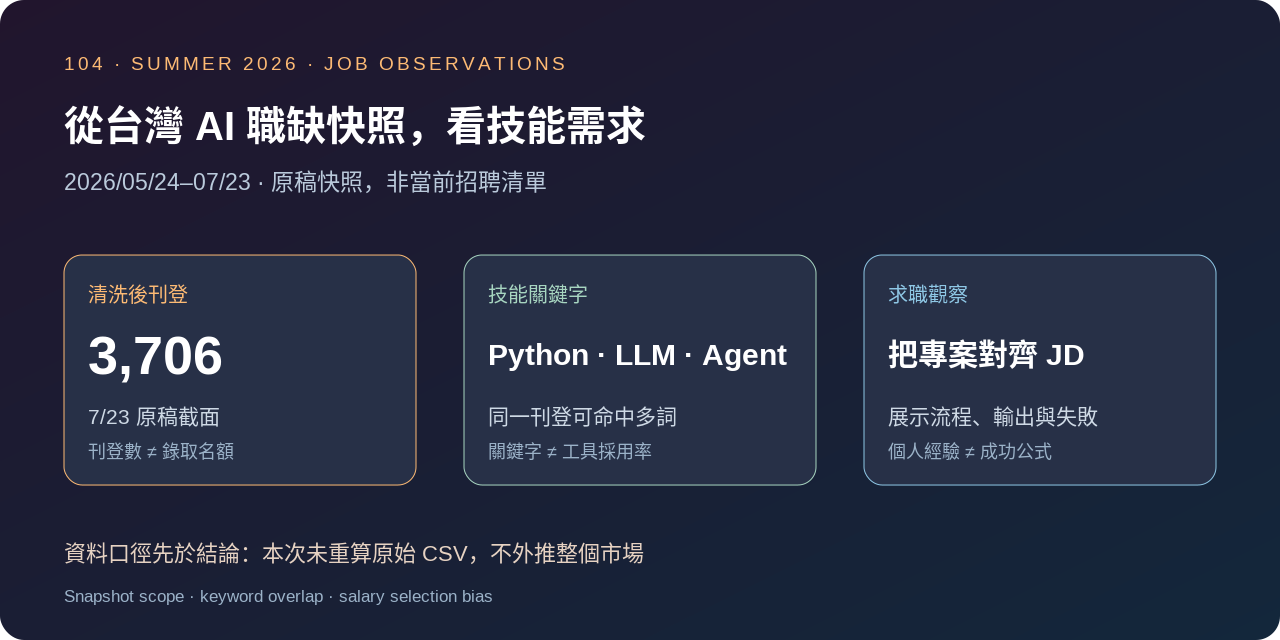
During my job search, I organized AI-related searches on 104 into daily snapshots. The most useful question eventually became: how do employers describe their needs, and which project can show that I can do the work?
This standalone article retains the job-data observations and personal application lessons. Hardware, local agents and inference measurements belong to the separate Z13 local-model and SSD-streaming experiments.
All figures below come from the existing draft. Original CSVs and cleaning scripts were not rerun for this publication. These are summer 2026 observations, not a current list of employers hiring or a newly audited market census.
Data source and boundaries
The draft records snapshots from May 24 to July 23, 2026, with July 23 used for the main cross-section. Ten AI-related keyword groups were queried across 22 regions, merged, deduplicated and filtered.
Raw searches produced roughly 24,000 rows a day, including sales, retail, support and roles merely borrowing AI terminology. The draft used titles and descriptions to identify AI, machine-learning, data-science and LLM-application postings. This is a subset defined by personal rules, not an official platform category.
| Boundary | How to interpret it |
|---|---|
| Only 104 | Other platforms and employer websites are excluded; not the entire Taiwan market |
| Counts are listings | One listing is not one hire or necessarily one unique role |
| Custom cleaning rules | Keywords and exclusions affect the subset and still deserve reconciliation |
| Summer snapshots | Not evidence that the same jobs remained open in October |
| Inherited draft statistics | Not recomputed or independently audited for this publication |
I use the figures to refine searches and project presentations, rather than claim a definitive current market size.
July 23: keep the denominator visible
| Indicator | Draft figure | Limit |
|---|---|---|
| Raw search rows | 23,907 | Includes noise; not valid unique openings |
| Strictly filtered postings | 3,706 | Listings, not hires |
| Posting companies | 1,645 | The platform and filtered subset only |
| Taipei, New Taipei, Hsinchu and Taoyuan | About 74% | Geography, not suitability for an individual |
| Explicit partial/full remote labels | 251, about 6.8% | Missing labels do not prove remote work impossible |
| Negotiable salary | About 67% | Public-pay subset has selection bias |
| Median advertised monthly salary floor | NT$50,000 | Not the median salary of the whole market |
The daily digest described another filtered subset, around 3,190 postings on July 23, rather than 3,706. Until the original files and cleaning rules are reconciled, I do not join those figures into one growth series or repeat a nine-percent increase as an established conclusion.
Likewise, the draft's 50–80 daily additions and disappearances cannot establish that half a cohort turns over in a month. That would require tracking the same IDs, reposts, missing scrape days and duplicates. Keeping a shortlist current is useful without claiming an unverified survival rate.
Location and salary suggest questions to ask
The roughly 74% northern concentration encourages considering commuting, relocation and work arrangements. Platform coverage and search terms may favor certain employers, so it does not mean other regions have no AI roles.
The 6.8% remote figure refers to explicit labels. For an interesting role, I still need to ask about office days, probation arrangements and collaboration practices; a blank field does not answer those questions.
The NT$50,000 median has two restrictions: it is an advertised floor, and it covers only postings that disclose salary. Around 67% were negotiable, and undisclosed pay may differ. This is a starting point for questions, rather than a personal pay target or whole-market median.
Technology mentions: Python leads, agents extend beyond titles
Keyword matching spans titles, skills and summaries. A posting can match several terms, so the shares do not sum to 100%. Mentions do not establish successful production adoption.
| Keyword | Draft subset share | Count |
|---|---|---|
| Python | 34.8% | 1,291 |
| LLM | 16.4% | 606 |
| C++ | 14.5% | 539 |
| Computer vision | 12.6% | 466 |
| Agent | 11.0% | 408 |
| PyTorch | 8.7% | 323 |
| RAG | 4.2% | 155 |
| AI coding tools | 2.4% | 90 |
| MCP | 0.6% | 24 |
The draft recorded 121 Agent titles, around 3.3%, versus 408 content matches. This encouraged looking beyond “Agent Engineer”: similar work may appear under software engineering, data engineering or application development.
It does not establish agent maturity. A description might refer to an existing production system, exploration or a future capability. Missing RAG/MCP terms also do not make those methods irrelevant. Reading the work description and asking in interviews can clarify the distinction.
Turn keywords into demonstrable work
Tool names identify a direction. For a portfolio, I translate them into concrete actions and choose a project that makes those actions inspectable.
| Requirement clue | What I would show | What I would ask |
|---|---|---|
| Python/data processing | Sources, cleaning rules, missing values and duplicates | Update frequency, data volume and quality ownership |
| LLM/RAG | Inputs, checked retrieval and answer acceptance | Users, data permissions and evaluation |
| Agents/tools | Tool selection, arguments, recovery and deliverables | Execution scope and human intervention |
| Software development | Edge cases, tests, diagnosis and reproduction | Existing code, collaboration and delivery expectations |
This is my preparation method, not a ranking derived from keyword counts. For a pipeline role, explain data movement and error handling; for an LLM application, explain completed tasks and failure diagnosis. Tradeoffs and limits make a project easier to understand than a longer list of tools.
Personal applications are experience, not a conversion-rate study
The original notes included roughly 350 applications through 104, 90 at a career fair and tailored presentations for 23 interview companies. These are personal records, not a representative sample.
I do not divide 23 by 350 into a rigorous interview conversion rate. Channels, companies and stages can overlap, and the numerator and denominator may not describe the same cohort. The transferable lesson is tailoring project explanations to the specific job description.
I pick the most relevant project, then explain its goal, inputs, deliverables and result, including failures and fixes. That lets an interviewer inspect what I completed without requiring them to know my entire background.
Evidence to reconcile next
Before a stronger trend analysis, I would reconcile original snapshots, the two cleaning subsets, reposts and salary fields. Every chart should trace back to a date, denominator, rule set and source file.
For my own search, the observations already offer a more concrete direction: read the actual work, identify missing information and demonstrate relevant tasks. They suggest demand; they do not guarantee market size, employer adoption or individual hiring probability.