Today's hypothesis: a 128GB Z13 can be explored beyond a 125B model. A roughly 320B MoE is the most useful first target. A 750B-class SSD-streaming model has a same-CPU precedent, but its tokens arrive slowly. The useful limit depends on quality and latency, not merely successful loading.
Progress: Personal AI cluster, local large-model inference. Architecture research and experimental design are complete; model inference on this Z13 has not been measured.
Evidence key: this article separates locally observed hardware, publisher file sizes, measurements on other machines, and calculations using assumed inputs. Every estimated performance chart is explicitly hypothetical. Sources were checked on October 12, 2026.
The problem I want to solve
Strata is the starting point. Its model-specific optimizations, CPU and GPU cooperation, and speculative decoding make a large MoE practical on consumer hardware.
My question is broader: with 96GB allocated to the GPU, can the remaining RAM and a 4TB SSD help run a more capable model? A slower answer may be worthwhile if it improves repository changes, research or multi-step work.
That requires architecture support, expert storage, cache management and an efficient I/O path. Replacing the model filename in Strata is insufficient. This article proposes a falsifiable design; the next installment will report implementation and observed results.
Four questions before downloading
- Can the model, preparation files and temporary downloads fit on storage?
- Can the permanently resident weights and execution state fit in memory?
- How much new data must arrive for each generated token?
- Is the resulting answer worth the wait?
For readers, these distinguish loading from usefulness. For engineers, they become storage, peak-memory, I/O and task-success acceptance criteria.
Complete artifacts and preparation space
Resident weights and execution state
New bytes required per token
Task success relative to waiting time
The hardware budget
Local inspection identifies a Ryzen AI Max+ 395, Radeon 8060S, 128GB physical memory and about 31.6GiB of system memory visible to Windows. The design assumes a 96GB GPU allocation, leaving approximately 32GB for the host; the precise reservation remains to be checked during implementation.
The GPU allocation is part of the 128GB pool. It is not an additional 96GB. ASUS documents this maximum allocation for the Z13. ASUS allocation announcement
The 4TB drive identifies as CT4000P310SSD8, with an NVMe bus reported by Windows. D has about 971GiB free; C has about 336GiB free. These are capacity observations, not sustained expert-streaming measurements. There is enough free space to explore a single 200GB or 400-plus-GB artifact without deleting files first.
Publisher sizes below use decimal GB. Memory and bandwidth examples use binary GiB. They cannot be directly subtracted. Allocation figures are conceptual budgets and must be reconciled with the backend's actual available-memory report.
What to borrow from Strata
Borrow frequent-expert placement, CPU/GPU overlap, conversation caching and careful use of speculative decoding. Its large SSD-backed n-gram lookup illustrates sparse access, but does not establish arbitrary SSD streaming of another architecture's expert weights. Strata architecture
Strata includes a Strix Halo path, while its dedicated documentation still describes Windows Strix Halo as untested. Host-resident experts and GPU caches compete for the same memory. Strix Halo support
The first implementation should use an engine that already supports the target architecture. Backend and streaming optimization can follow measured bottlenecks.
Candidate models and quantization
Total parameters determine storage; activated parameters influence per-token compute and delivery requirements. All experts must remain accessible because routing changes between tokens.
| Candidate | Official scale | Experimental role |
|---|---|---|
| Qwen3.8-Flash-Next | 125B language model, approximately 6B activated, additional modules | Speed and quality baseline |
| GLM-5.3-Flash | Approximately 320B, 18B activated | First larger-model target |
| Qwen3.5-397B-A17B | Approximately 397B, 17B activated | Alternative model family |
| GLM-5.2 or GLM-5.3 | Approximately 750B class | Slow SSD-streaming exploration |
| Qwen3.8-2.4T-A95B | 2.4T, 95B activated | Research ceiling rather than a daily target |
Architecture references: Qwen Flash, GLM Flash, Qwen 397B and Qwen 2.4T. This is not a capability ranking.
Summing the publisher's GLM Flash shards gives these approximate file sizes:
| Quantization | GB | Hypothesis for this machine |
|---|---|---|
| UD-IQ2_XXS | 101.84 | First capacity candidate; host weights or limited streaming may be needed |
| UD-Q2_K_XL | 108.72 | Another starting point, with execution headroom required |
| UD-IQ3_XXS | 120.37 | Close to the physical-memory boundary; full residency cannot be assumed |
| UD-Q4_K_XL | 199.71 | Requires research into SSD-backed delivery |
Quantization has a quality cost. Top-1 token agreement and KLD are not percentages of coding capability retained. Real Chinese, repository-editing and tool-call tasks must decide whether the larger quantized model improves useful output. Quantization analysis
Qwen 397B's UD-IQ2_XXS, UD-IQ3_S and UD-Q4_K_XL artifacts are approximately 114.87GB, 146.37GB and 245.27GB. Qwen quantized artifacts
Colibri lists roughly 429GB for its GLM-5.2 int4 container and 419GB for GLM-5.3. These are engine-specific containers, not interchangeable GGUF files. Container instructions
For 2.4T parameters, idealized four-bit weights alone require approximately 1.2TB before scales, additional weights and preparation space. This arithmetic neither confirms a usable quantization nor compatible Z13 inference. That scale would require additional storage planning with the current free space.
A proposed three-tier expert system
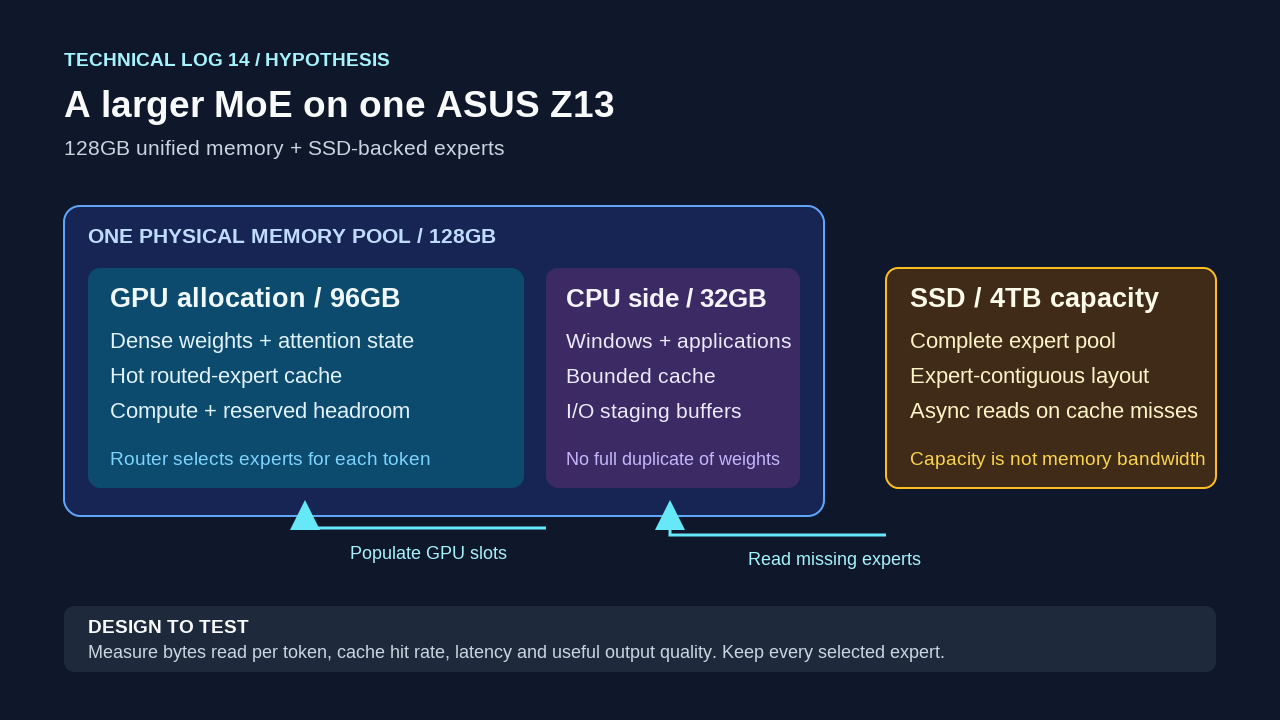
Keep fixed computation and hot experts on the GPU, a bounded cache and I/O buffers on the CPU side, and the complete expert pool on SSD. Both memory tiers remain within the same physical pool.
At each MoE layer the router selects expert IDs. Cache hits compute directly. Misses trigger reads into available slots before executing the selected experts. Eviction creates room for missing weights; it does not remove experts from the model's calculation.
A conceptual starting budget assigns 12GiB of the GPU partition to fixed weights and state, 64GiB to experts, 8GiB to compute buffers and 12GiB to reserve. The host partition assigns 16GiB to Windows and applications, 8GiB to a bounded cache, 4GiB to I/O buffers and 4GiB to reserve. These are illustrative allocations, not measured model requirements or ready-to-use engine flags. If permanent state exceeds its allowance, expert capacity must shrink. A backend requiring large duplicate host allocations may fail with the remaining system RAM.
Keep the 96GB premise for the first trial. Alternative BIOS splits belong in a later controlled experiment if host memory proves limiting.
Storage capacity and delivery speed
SSD-backed inference has published precedents. SSD-LLaMA reports three-tier expert delivery and a trillion-parameter case exceeding one token/s with an RTX 5090 and 32GB host RAM. Different GPU and SSD hardware prevent transferring that number to the Z13. Original research
A closer CPU reference is Colibri's GLM-5.2 experiment on a Ryzen AI Max+ 395 Framework desktop with 128GB memory: warm decode reaches approximately 1.8 tokens/s. Its CPU path and larger host-memory budget differ from this Windows GPU split. Original test records
At 1.8 tokens/s, 512 output tokens take approximately four minutes and 44 seconds, excluding prompt processing. Thousands of reasoning tokens can turn this into a much longer task.
For a simplified decode model, let effective SSD bandwidth be B GiB/s and newly read missed weights be R GiB/token. The I/O ceiling is approximately B / R tokens/s. Compute, synchronization and dequantization add constraints. Multi-token speculative verification needs a different accounting model.
More terabytes permit larger artifacts; fewer new bytes per token can improve latency. Cache capacity does not directly determine hit rate. Routing concentration, language and changing tasks must be measured.
Improving expert delivery
Memory mapping creates addressability, not RAM-speed storage. Expert-aware contiguous reads, bounded slot pools and asynchronous delivery can avoid some page-fault overhead. Existing llama.cpp experiments also show that extra copies or excessive cache allocation can negate an I/O improvement. Streaming experiments and negative results
The proposed optimization sequence is contiguous expert layout, stable hot-expert placement, asynchronous double buffering, measured routing-based prefetch, reduced duplicate allocations, a two-SSD experiment, and finally MTP. Each requires end-to-end A/B measurement. More predicted tokens can enlarge the union of required experts and hurt a disk-limited system. Multi-disk design
Prefetch may guess incorrectly, but inference must still execute every selected expert. Expert skipping, substitution and additional precision reduction are separate quality tradeoffs.
Implementation and verification
Route A tests a lower-bit 320B model using a llama.cpp revision that supports GLM Flash, with verified Windows Vulkan or gfx1151 HIP support. The publisher currently points to a dedicated branch; an arbitrary installed build cannot be assumed compatible. Architecture support and build guide
Route B investigates Colibri's SSD expert delivery for a higher-quality or larger model. Its Windows and Linux Vulkan support is useful, but integrated-GPU acceleration remains model-dependent. If profiling shows missing optimizations, research can then target gfx1151 kernels, shared-memory budgets and asynchronous reads. Backend documentation
The experiment first checks allocation, available host memory, driver, engine revision and sustained SSD reads. Downloads select one quantization with complete shards and recorded hashes. Start with 4K or 8K context and one request; verify tokenizer, template and coherent output before optimizing.
Fixed prompts generate 256 tokens for at least three repetitions. Record model loading, prompt processing, time to first token, decode rate and full request duration. Cold and warm caches are separate. Fix thinking mode and count reasoning tokens separately from visible output.
The quality suite contains Chinese analysis, bug repair, cross-file changes, structured JSON, tool calls and handling insufficient information. Coding results require actual checks. Streaming additionally records bytes/token, hit rates, I/O waiting, utilization and thermal stability over 30 minutes. Cache-training prompts and held-out tasks must differ.
Preregistered hypotheses
| ID | Hypothesis | Falsifying result |
|---|---|---|
| H1 | A lower-bit 320B model runs correctly with the 96GB GPU allocation | OOM, excessive required allocation or incorrect output after architecture support is resolved |
| H2 | Streaming executes a weight pool larger than 128GB | Loader still requires full residency or expert computation is incorrect |
| H3 | Routing-aware caching reduces disk demand | Better hits fail to improve total latency or fail on held-out tasks |
| H4 | A larger model improves a real task category | No quality gain or more quantization errors |
| H5 | A slow high-quality mode is worth keeping | Waiting exceeds the predefined task budget without better success |
| H6 | Two SSDs or MTP improve end-to-end efficiency | Read amplification, synchronization or throttling cancels the gain |
The proposed product targets are at least 10 tokens/s for an interactive mode, and exploratory 1–3 tokens/s for a slow specialist within an agreed task-duration budget. These are chosen acceptance targets, not Z13 performance predictions. Multiple agents initially queue against one service; concurrency is tested only after a stable single request.
Current acceptance status
| Item | Today's result |
|---|---|
| Hardware and storage capacity | Observed; storage performance unmeasured |
| Candidate quantized file sizes | Checked |
| Hierarchy and I/O bounds | Proposed and explicitly hypothetical |
| Target AMD architecture support | Not installed or tested locally |
| Z13 inference speed and quality | No local inference measurements |
| File cleanup | Not needed for initial exploration; no files deleted |
Open questions are AMD backend correctness, host-memory pressure with the 96GB split, sustained storage bandwidth, and whether a strongly quantized larger model beats the baseline.
Tomorrow
Day 15 will record installation and the first experiments, updating H1 through H6 against actual evidence. Hardware availability, download failures or backend blockers will be documented as outcomes rather than replaced with invented benchmark numbers.
Today's figures describe designs and calculations. The next article will plot only what was measured and keep other-machine references separate.