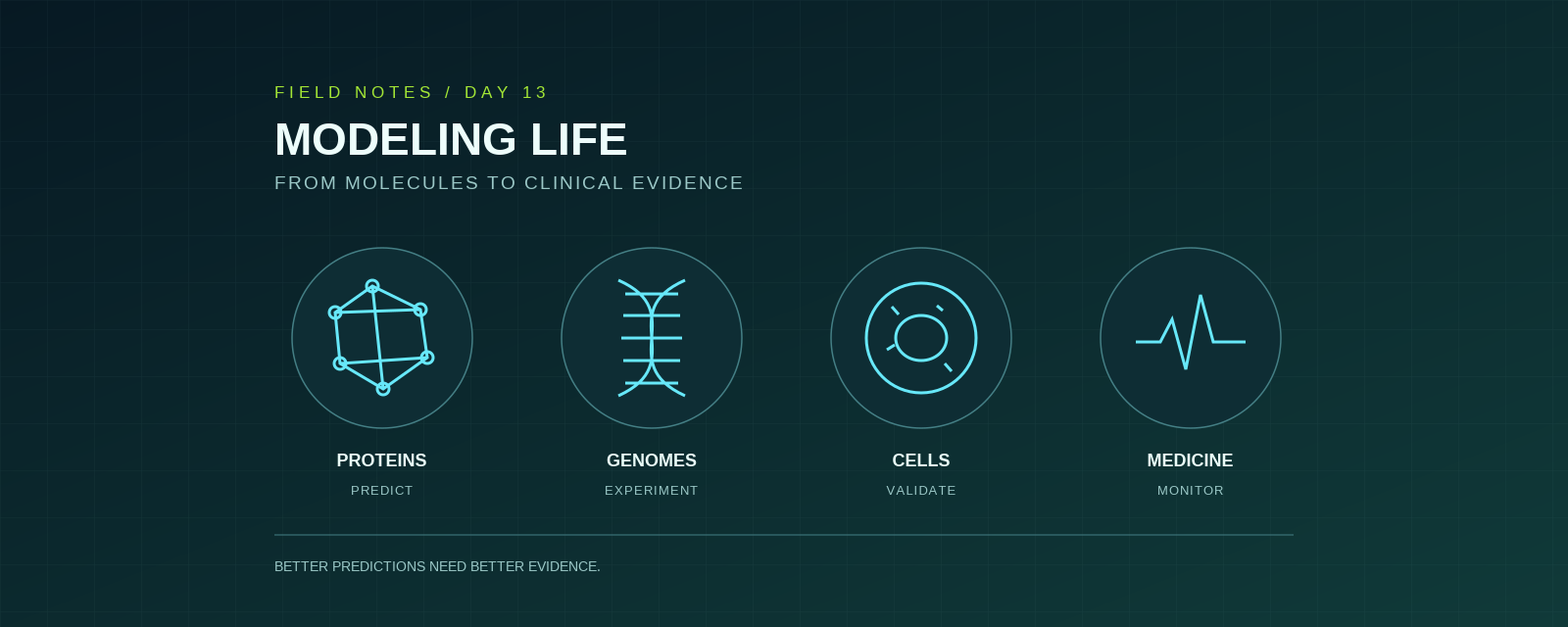
AI can help describe molecular structures, prioritize experiments, and support defined clinical tasks. The key question is which level of evidence each result actually reaches.
Today’s progress: a literature survey of biological and medical AI. This post reports research and analysis; no laboratory experiments or human trials were conducted.
Day 12 discussed longevity and care. Today we follow that question upstream: how does AI contribute to understanding life, and what separates a promising prediction from better health?
Sources were checked on October 11, 2026. These are selected examples rather than a complete product inventory. Clinical descriptions refer to the cited studies, teaching examples are labeled, and future directions are presented as analysis.
The problem I encountered
Biomedical headlines often place accurate predictions, cell experiments, clinical signals, and marketing authorization on the same scale. Each answers a different question.
Biological research asks how a system works. Medicine additionally asks who benefits from an intervention, how much they benefit, and what harm it can cause. A good prediction may justify the next experiment; a treatment needs a much longer evidence chain.
Predicting molecular geometry
Predicting regulation and cellular responses
Proposing and testing candidates
Supporting defined medical tasks
A method any reader can use
Ask three questions: What goes in, what comes out, and what demonstrates usefulness? Readers can use this to assess news; students can structure literature reviews; engineers can turn unanswered questions into acceptance criteria.
| Reported result | What it supports | What remains to check |
|---|---|---|
| Accurate structure prediction | Useful molecular geometry | Binding and biological function |
| Activity in cells | An effect under tested conditions | Toxicity and exposure in an organism |
| A small clinical signal | Further investigation | Precision and durability |
| Strong imaging performance | Recognition on tested data | Other hospitals and populations |
| Device marketing authorization | A regulated intended use | Conditions of use and monitoring |
Proteins from prediction to design
Proteins are amino-acid chains whose structure influences their function. The 2024 Chemistry Nobel Prize recognized David Baker’s computational protein design and Demis Hassabis and John Jumper’s structure prediction work. Source: Nobel Prize announcement
AlphaFold 3 extended structure prediction to complexes involving proteins, DNA, RNA, and small molecules, using a diffusion-based architecture to generate atomic coordinates. Source: original paper
What remains after the three-dimensional picture
A predicted binding pose, binding strength, and therapeutic benefit require separate measurements. A useful candidate must also function at appropriate concentrations, avoid unwanted interactions, and reach the relevant tissue.
My interpretation is that structure AI helps narrow the search. It provides reasons to choose one experiment over another; experimental results determine whether that choice was useful.
Genomics and the consequences of variation
DNA includes regulatory regions as well as protein-coding sequences. A variant can therefore matter even when it does not change a protein sequence.
The 2026 AlphaGenome paper describes predictions of regulatory readouts, including expression and splicing, from long DNA sequences. Comparing predictions before and after a sequence change can help prioritize variants for investigation. Source: original paper
Regulation is one step in a longer chain
A predicted splicing change raises further questions: does it occur in a relevant tissue, can it be reproduced experimentally, and does it fit the clinical presentation? This is an illustrative research question, not a personal genetic interpretation.
A predicted regulatory effect is not an individual disease probability. Clinical interpretation requires additional genetic and clinical evidence.
Virtual cells and the benchmarking debate
Single-cell sequencing measures individual cellular states. scGPT, published in 2024, used more than 33 million cells for pretraining and explored annotation, integration, and perturbation-response tasks. Source: scGPT paper
Here, “virtual cell” refers to the goal of predicting measurable cellular responses to interventions. It should not be assumed to reproduce every metabolic, spatial, and temporal aspect of a cell.
Why model rankings can change
A 2025 independent benchmark found that tested deep-learning models did not outperform simple baselines in its perturbation-prediction settings. Source: Nature Methods benchmark
A study published October 1, 2026 examined 14 datasets and 18 metrics. It reported that some common metrics were insufficiently sensitive to improvements, and that deep-learning models could outperform uninformative baselines under calibrated metrics. Source: Nature Biotechnology study
My interpretation is that task definition and measurement matter. Reconstructing expression, identifying affected genes, and recognizing interactions are different objectives. Neither paper establishes universal success or universal failure.
Engineers should retain simple baselines and test unseen perturbations, batches, and cellular backgrounds. The goal is transferable signal rather than familiarity with a dataset.
Drug discovery has several gates
AI can contribute to target selection, molecular generation, property prediction, or experimental prioritization. An “AI-designed drug” headline should specify which steps used AI.
ADMET covers absorption, distribution, metabolism, excretion, and toxicity. Activity in a test tube is only one requirement: a candidate must reach the right place at a suitable exposure and have an acceptable safety profile.
Connect mechanism to intervention
Compare function and feasibility
Measure activity, exposure, and toxicity
Evaluate dose, safety, and efficacy
Define use and monitor outcomes
What rentosertib demonstrates
A 2025 phase 2a study evaluated rentosertib, developed with generative-AI involvement in target discovery and molecular design. The randomized, double-blind, placebo-controlled study treated 71 patients with idiopathic pulmonary fibrosis for 12 weeks.
The primary endpoint concerned adverse events. A secondary lung-function endpoint showed a promising signal at the highest dose, while liver toxicity and diarrhea were among observed concerns. The sponsor was the developer, and some authors were employees. Larger, longer studies were needed. Source: clinical study
My analysis is that the workflow produced a candidate worth clinical investigation. One trial cannot establish long-term benefit or an improved industry-wide success rate. Answering those questions requires comparable programs, costs, and failed candidates as well as successes.
Medical imaging belongs inside a workflow
The FDA’s AI-enabled device list includes imaging tools authorized through applicable US pathways. The agency notes that the list is not comprehensive. Each product must be interpreted within its intended use. Source: FDA device list
Clinical value depends on what happens after a prompt: are missed cases reduced, unnecessary investigations increased, or workloads improved? Recognition performance alone cannot answer all three.
Why ninety-five percent can still generate many false alarms
This is a fictional teaching example, not a product evaluation. Assume 10,000 people, 1% disease prevalence, 95% sensitivity, and 95% specificity.
| Actual status | Positive result | Negative result |
|---|---|---|
| 100 people with disease | 95 true positives | 5 false negatives |
| 9,900 without disease | 495 false positives | 9,405 true negatives |
Of 590 positive results, 95 are true: positive predictive value is approximately 16.1%, calculated as 95 / (95 + 495). This is different from sensitivity and specificity.
Scores must be interpreted with the population. A triage aid and a tool that directly determines disease have different downstream consequences.
Technical details and continuing validation
These are proposed engineering practices, not claims that every product already satisfies them.
| Failure mode | Why it matters | Better evaluation |
|---|---|---|
| Images from one patient cross splits | Patient recognition can inflate scores | Split by patient |
| Similar molecules cross splits | Chemical similarity can inflate scores | Scaffold or time-based validation |
| A new hospital uses different equipment | Input distributions shift | External, device-stratified evaluation |
| One average hides subgroups | Failures can be obscured | Report subgroup uncertainty |
| An update inherits old scores | Behavior may change | Versioning and repeat evaluation |
| Only model metrics are measured | Workflow costs are missed | Track errors and downstream outcomes |
Prospective validation defines rules before collecting future cases. Establishing better patient outcomes additionally requires an appropriate comparison and follow-up.
WHO guidance for large multimodal models emphasizes defined tasks, stakeholder participation, and post-deployment auditing and impact assessment. Source: WHO guidance
Further analysis and possible next steps
These are inferences from the examples above, without a promised timeline or established clinical benefit.
Connecting structure to cellular response
One opportunity is to connect structural predictions with experiments that measure cellular effects. Outputs from several models should not simply be multiplied into a success probability; their assumptions and training conditions may differ.
Letting experiments teach the model
Active learning selects experiments expected to reduce uncertainty, then updates predictions from the results. Failed experiments and controls must be preserved to avoid learning only from favorable outcomes.
Specify predictions and conditions
Balance information, cost, and feasibility
Keep failures, controls, and batches
Inspect errors and choose the next test
A practical personal AI project
For a private AI cluster, I would start with a traceable literature assistant. Each record should preserve a DOI or source URL, date, study design, population, primary endpoint, limitations, conflicts of interest, verification date, and the original passage supporting a claim.
Retrieval and interpretation are different tasks. An acceptance check could ask whether a study proves longer lifespan. If it only measures cellular markers, the assistant should identify that endpoint and link to the methods and results. Its purpose is to make evidence easier to inspect.
Acceptance status
| Check | Result | Scope |
|---|---|---|
| Direct sources for selected examples | Papers or official pages | Not a market census |
| Different benchmarking perspectives | 2025 and 2026 studies included | Preserve their settings |
| Clinical design described | Sample, duration, and primary endpoint | No definitive efficacy claim |
| Screening arithmetic reproducible | Matrix and formula supplied | Fictional assumptions |
| Analysis distinguished from findings | Future directions labeled | No timeline promises |
Unresolved questions
The central unknown is whether prediction improvements transfer into new experiments and patient benefits. Cross-context cellular prediction, long-term drug safety, and clinical workflow outcomes need additional evidence.
Positive stories also provide an incomplete denominator. Evaluating overall efficiency requires failures, costs, and comparable conditions.
What to take away
- Is the output a structure, function, cellular state, or patient outcome?
- Is the comparator meaningful?
- Were unseen molecules, conditions, or hospitals tested?
- Is the number a primary, secondary, or exploratory result?
- How are errors and uncertainty handled?
- Whose work improved, and where is the supporting evidence?
A deeper look at the bottlenecks
The examples above cover structures, genes, cells, and clinical work. Together they raise a deeper question: can a model that predicts observed biology also predict what happens when we change it? The following analysis considers causality, search, decisions, and total research costs.
Predicting a state versus predicting an intervention
Imagine a gene that is highly active in diseased cells. It might drive the disease, respond to it, or share an upstream cause with it. A model can use that signal to recognize disease without distinguishing these explanations.
Suppressing the gene could therefore help, disrupt a compensatory response, or leave the real cause untouched. This is a hypothetical mechanism example, not a claim about a particular gene.
A Nature Genetics perspective discusses opportunities and challenges in combining single-cell measurements with perturbation screens to study causal gene effects. Source: causal machine learning for single-cell genomics
In my view, meaningful virtual-cell progress means falsifiable predictions about untested interventions. Specify the gene, cellular context, dose, time, readouts, and predicted direction before running new experiments. Reconstructing familiar cellular states and guiding new experiments require different capabilities.
Observational atlases, genetic perturbations, drug dose responses, and time series supply different information. More observations do not automatically establish transfer to an unfamiliar intervention.
Large searches can amplify scoring errors
A generator proposes molecules; a scoring model ranks them. Searching for extreme scores can select both useful candidates and candidates exploiting the scorer’s blind spots.
Consider a thought experiment: a score contains genuine activity signal and prediction error. Searching a vast candidate pool may also select unusually optimistic errors. More generated molecules need not produce proportionally more useful ones.
I would check distance from familiar chemical space, compare assessments using different data or methods, and test candidates selected for diversity and uncertainty as well as high scores. Models sharing data and biases do not provide independent confirmation merely by agreeing.
Candidate count measures search scale. Independently confirmed useful candidates under a fixed experimental budget are closer to research value.
Clinical AI must improve a meaningful decision
The same imaging score can prioritize work, request review, or trigger further testing. Each use has different costs and thresholds. Evaluation should compare the AI-supported workflow with the existing workflow.
Better offline performance may be undermined by excessive alerts, unclear interfaces, or overreliance. A modest improvement at a consequential decision point can also matter considerably.
The FDA, Health Canada, and MHRA transparency principles emphasize human-AI team performance and how devices fit into workflows, including communication of intended use, limitations, data characteristics, and monitoring. Source: transparency principles
My proposed evaluation chain is: who receives the output, which action changes, how outcomes are checked, and when a person takes over or use stops. This makes it possible to choose endpoints that match the purpose.
A faster step is not a faster research pipeline
Here is a fictional cost example. A project costs 100 units: 10 for computational screening and 90 for experiments and other work. Cutting screening costs tenfold produces a total of 1 + 90 = 91, a 9% reduction.
Earlier rejection of unhelpful candidates could save expensive downstream work. Merely producing more candidates could instead worsen an experimental bottleneck. Evaluation should track confirmed results, total costs, elapsed time, and failure reasons under comparable conditions.
Answer questions under unseen conditions
Gain more information within a fixed budget
Confirm function, safety, and conditions
Measure costs, time, and patient results
| Level | An appealing number | A more informative outcome |
|---|---|---|
| Molecular generation | Candidate count | Useful candidates confirmed under a fixed budget |
| Virtual cells | Reconstruction scores | Reproducible predictions for new interventions and contexts |
| Clinical tools | Recognition scores | Benefits and costs of the human-AI workflow |
| Drug development | Time saved in one stage | End-to-end costs, success rates, and efficacy evidence |
The development I most want to see is earlier recognition of mistaken directions, so scarce experimental and clinical resources address questions that reduce uncertainty. Recording predictions, validations, and failures is necessary to establish whether the research system actually improves.
Further reading
The linked original sources above cover the Nobel-recognized protein work, AlphaFold 3, AlphaGenome, scGPT, both perturbation benchmarks, the rentosertib trial, the FDA device list, and WHO governance guidance. Read their methods, limitations, and conflicts of interest alongside the abstracts.
For the deeper analysis, also read the single-cell causal machine learning perspective and the medical-device transparency principles.