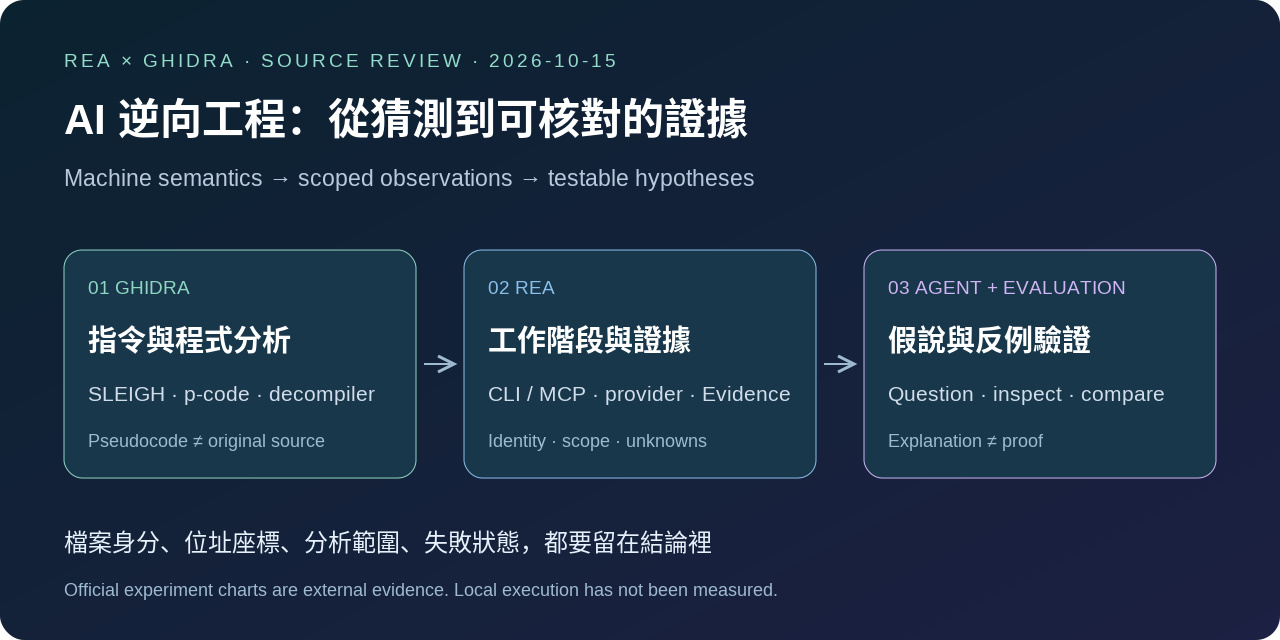
REA's name invites an ambitious expectation: hand an application to an AI and recover its source, design and product behavior. Reading REA and Ghidra suggests a more valuable change: agents can investigate through tools whose observations have identities, scopes and explicit failure states.
REA coordinates investigations; Ghidra supplies native analysis; the model proposes hypotheses and chooses follow-up questions. Confusing those layers makes plausible explanations look stronger than their evidence.
This is a documentation and source review, not a local REA/Ghidra benchmark. Checked on October 15, 2026: REA source 1438422dfedf1de29368b595e09a04f1fc10750d, Ghidra development source 918acd744d17e3b95fbde44ec6ab3e59b6dbd45f. npm reported REA 6.5.0; Ghidra's release page lists 12.1.4. Published packages, development branches and historical experiment runtimes remain separate. REA snapshot, Ghidra snapshot, Ghidra release.
The article has three parts: Ghidra as a complete workbench, REA as an agent investigation layer, then choosing and combining them by deliverable. Each project’s uses and limits are examined independently first.
Where each project fits
Ghidra is NSA's extensible reverse-engineering framework, with disassembly, decompilation, graphs and scripting across multiple architectures and formats. REA exposes investigation workflows through CLI/MCP and can use Ghidra or other providers. Its static JavaScript and .NET paths need not start a native decompiler. Ghidra README, REA README.
| Layer | Main contribution | Useful question | Insufficient alone |
|---|---|---|---|
| Ghidra | Decoding, Program analysis, decompilation and references | What instructions and static relationships are present? | Original intent or every runtime path |
| REA | Contracts, sessions, retained observations and workflows | How can an agent obtain and revisit analysis consistently? | Unobserved behavior or correct model interpretations |
| LLM/agent | Hypotheses, tool choice and explanation | What should I inspect next? | Proof or complete source recovery |
| Human evaluation | Questions, counterexamples and acceptance | Is this sufficient for an engineering decision? | Coverage of every version and input |
My interpretation: the combination is valuable when the model reasons over analysis rather than inventing an analysis engine. It should narrow unsupported guessing while keeping uncertainty visible.
Part I — Ghidra as an evolving analysis workbench
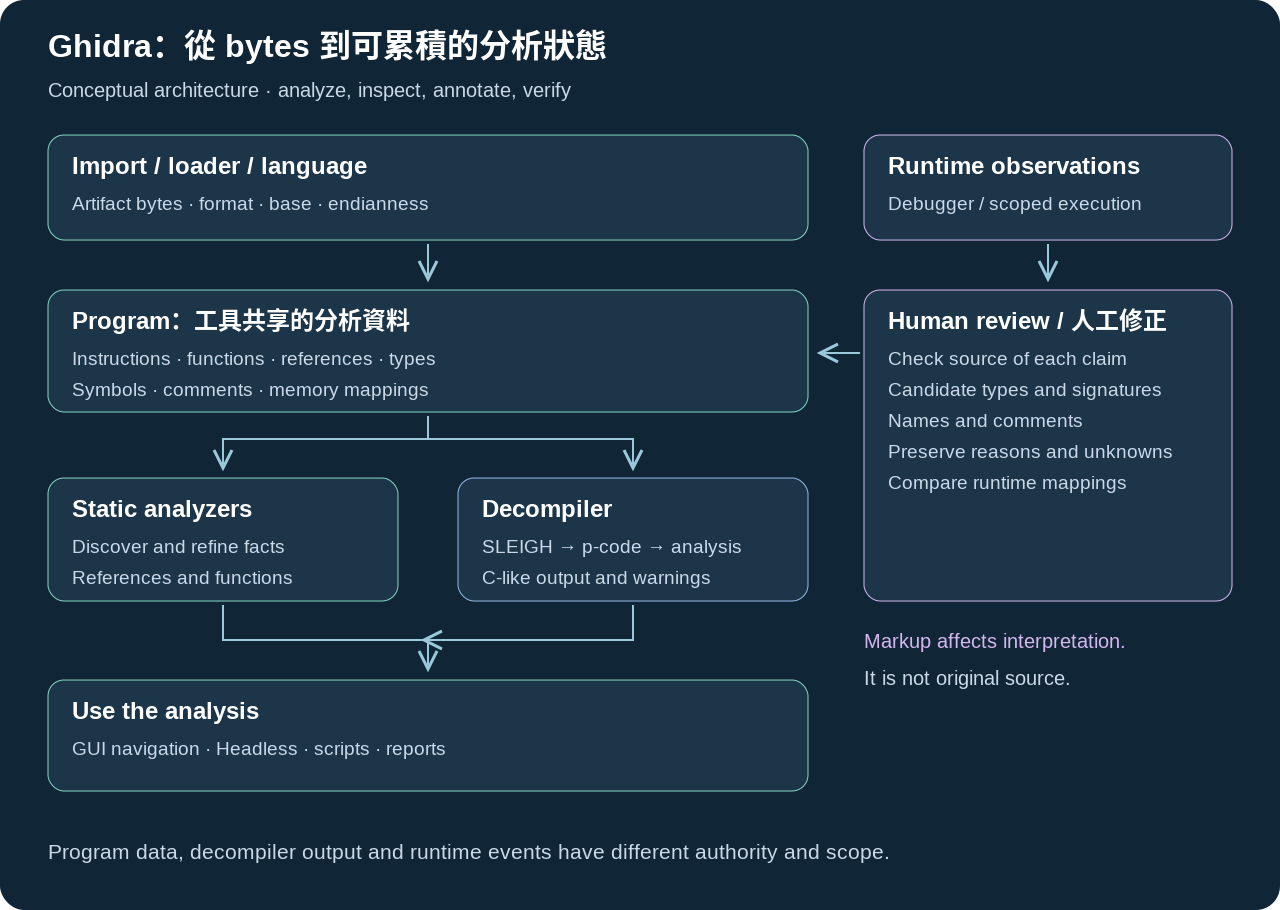
Considered on its own, Ghidra centers on a Program analysis database. Importing an executable starts the work; functions, symbols, types, references and comments accumulate as reusable knowledge. Listing, Decompiler and symbol views inspect different aspects of that state. Official introduction.
My interpretation: its enduring value is editable, transferable analysis. A fresh model explanation is not a replacement for this state. Model prose becomes useful when it remains connected to the Program and original bytes.
| Working object | Contents | Purpose |
|---|---|---|
| Original artifact | Compiled file bytes | Identity and reanalysis starting point |
| Imported Program | Memory mapping and analysis data | Shared object for analysis tools |
| Human markup | Names, structures, signatures and comments | Preserve justified knowledge |
| Project/sharing | Programs and collaboration data | Long-term organization and handoff |
| Report | Selected facts and limits | Share findings without repeating all navigation |
This is my working decomposition, not five separate products. An unchanged executable is different from unchanged analysis state: annotations and settings may change decompiler output without changing original file bytes.
Ghidra’s analysis core: SLEIGH and p-code
SLEIGH describes instruction encoding and semantics; p-code supplies a common intermediate representation. Data-flow and control-flow transformations support higher-level reconstruction. Official SLEIGH documentation.
Separate five questions: which bytes map into which regions; which instructions and entries can be decoded; what values and control transfers those instructions describe; how definitions, uses and branches relate; and how the result should be displayed through types, names and structured code.
A p-code varnode identifies data in an address space. Operations such as loads, stores and integer addition describe semantics rather than original variable names. Raw instruction p-code and transformed high p-code are different analysis stages. P-code reference.
My inference: common IR explains how analysis can be reused across CPUs. It also explains why readable pseudocode still needs instruction-level checking. A wrong loader, function extent or type can propagate into a convincing higher-level explanation.
The following is an original thought experiment, not a measured decompilation:
unsigned mask_bucket(unsigned x) { return x & 7u; }
unsigned modulo_bucket(unsigned x) { return x % 8u; }
These unsigned expressions produce the same values and may compile to the same operation under suitable optimization. Seeing a mask does not recover which source expression was written, or whether its purpose was bucketing, indexing or flags. Signed inputs require a fresh check of negative-value semantics.
My acceptance test would check width, signedness and input/output rules. A model's proposed name, such as hash_bucket, is a hypothesis, not new evidence about the author's intent.
Human intervention: types and signatures change the analysis
Function information, types and flow overrides affect decompilation; an analyst's incorrect annotations can therefore affect the result. Decompiler annotations.
Here is an original hypothetical example, not a Ghidra experiment. Suppose a self-owned format has candidate fields at offsets 0, 4 and 8:
/* Illustrative; verify sizes, alignment and endianness separately. */
struct PacketHeader {
    unsigned int magic;
    unsigned int payload_length;
    unsigned int flags;
};
Applying a candidate type may make offset accesses easier to read. That does not prove the original structure. I would check widths, layout, actual loads/stores, other uses and caller objects before accepting the names.
Likewise, a wrong external prototype can distort parameter and return-value interpretation. Record whether a correction came from symbols, headers, another use or a provisional hypothesis; never stop merely because output now resembles the expected source.
My assessment: markup is revisable knowledge. Agent-generated names and types can help, provided their justification remains inspectable and unsupported assumptions can be reversed.
Six useful Ghidra scenarios
These are proposed scenarios, not completed local cases, for self-owned or authorized software.
| Scenario | Question | Starting observations | Deliverable | Remaining need |
|---|---|---|---|---|
| Legacy maintenance | How is a file format parsed without source? | Strings, imports, xrefs and parsers | Field candidates, flow and test specification | Legal samples, boundary inputs and versions |
| SDK/DLL upgrade | Did an unchanged API acquire a different internal path? | Exports, functions, types and versions | Observed changes and regression candidates | Contracts and runtime tests |
| Firmware research | What architecture and message processing does a component use? | Loader, base, endianness, entries and constants | Reliable coordinates and candidate flow | Extraction and peripheral context |
| Defensive malware study | Which static indicators merit investigation? | Imports, referenced strings and data flow | Sourced hypotheses and unknowns | Isolated dynamic observation |
| Preservation/interoperability | Can a small algorithm be reconstructed? | Instructions, signedness, overflow and constants | Behavior specification and tests | Original oracle and authorized scope |
| Compiler education | How does optimization transform source? | Listings/p-code across builds | Reproducible transformation observations | Source, flags and fixed toolchain |
The shared value is a locatable analysis object. A selected function, structure or version change is a better investigation unit than an unbounded request to understand everything.
Example A: inheriting a source-less data reader
I would confirm import and architecture, identify format-related strings/imports and narrow references to candidate readers. Then inspect field offsets, length checks and error branches, separating observed instructions from proposed field meaning.
The deliverable would be a test specification, not just C-like output: accepted inputs, error behavior and unresolved branches. Legitimate original outputs can support differential reconstruction tests. This describes a method, not a completed recovery.
Example B: handing off weeks of research
Screenshots omit markup, navigation and justification. I would transfer artifact identity, analysis state, accepted/candidate types, naming evidence and unresolved functions.
Project/collaboration capabilities support cumulative work, but running a collaboration server is not required for analysis. A reproducible individual project is a sensible starting point before introducing team infrastructure.
Batch analysis: Headless and scripts
analyzeHeadless imports files or processes existing Programs with analysis and pre/post scripts. Repetitive inventories and consistent exports can be deterministic pipelines before adding an agent. Headless guide.
This unexecuted planning example assumes an installed Ghidra and prepared directories/self-owned fixture:
& "$env:GHIDRA_INSTALL_DIR\support\analyzeHeadless.bat" `
  "C:\rea-lab\projects" "fixture-review" `
  -import "C:\rea-lab\fixtures\sample.exe" `
  -readOnly -analysisTimeoutPerFile 120 -max-cpu 2
The limits are illustrative policies, not measured optimal settings. Read-only concerns saving Program changes; it does not sandbox arbitrary scripts or prevent all host writes. Running a batch, obtaining output and completing the intended analysis are separate acceptance conditions.
PyGhidra supplies CPython 3 integration. It is one automation option; REA's Java bridge does not consequently require Python. PyGhidra module.
My rule: scripts for fixed rules, investigation for unknown questions. Asking a model to reason over every export in an unchanged daily inventory introduces unnecessary cost and variation.
Version Tracking and BSim serve different questions
Version Tracking generates inter-Program matches through correlators, then supports review and markup handling. It is useful for transferring trusted old-version knowledge into a new version, not automatically proving behavioral equivalence. Version Tracking workflow.
BSim finds similar functions using features derived from decompiler data-flow descriptions rather than only machine-code bytes. Similarity alone cannot establish equivalence, authorship or absence of vulnerabilities. BSim overview.
| Question | Start with | Follow-up |
|---|---|---|
| Where should old names transfer? | Version Tracking matches | Validate correspondence and select markup |
| Which samples contain candidate similar code? | BSim search | Inspect functions, provenance and differences |
| Are these builds equal on specified inputs? | Fixed oracle/differential tests | Use static analysis to explain results |
| Does a change affect all consumers? | Xrefs/call relationships | Investigate unresolved edges and use cases |
My interpretation: Version Tracking supports correspondence and knowledge transfer; BSim supports candidate retrieval. Treating retrieval as a verdict is automation bias.
Debugger: filling particular runtime gaps
Ghidra Debugger observes execution and relates dynamic addresses to static Programs. Ghidra having that capability does not mean REA's Ghidra provider exposes the full debugger. Official debugger tutorial.
For a self-owned callback fixture, static analysis may leave an indirect target unresolved. A runtime observation adds an event for that input; it does not establish the target for every possible input. ASLR, modules and mappings must align before attaching runtime addresses to Program entries.
I would label static relationships, scenario-specific events and cross-scenario unknowns separately. Dynamic study of unknown samples needs appropriate isolation, and static reading must not silently become target execution.
Costs and failure boundaries
These are historical upstream SDK measurements, not local or fresh runs. The first provider query includes import/auto-analysis waiting; the whole workflow includes that query. Original checkpoint.
My inference: building analysis state and reusing it deserve separate measurement. Their proportion affects practical experience; one small artifact's first wait is not a universal per-function cost.
| Failure class | Symptom | My diagnostic direction |
|---|---|---|
| Wrong import/coordinates | Implausible entries or mappings | Check format, language, base and endianness |
| Insufficient information | Missing symbols/types or unresolved calls | Inspect uses and preserve unknowns |
| Optimization/obfuscation/packing | Only stub or difficult high-level structure | Narrow the question and distinguish carrier from logic |
| Missing dependencies | Import name without implementation | Obtain authorized matching library/environment facts |
| Time/resource limits | Partial analysis, timeout or failure | Preserve scope/logs instead of equating output with completion |
This is my diagnostic classification, not an automatic repair promise. Ghidra enables inspection and correction; uncertainty remains part of the problem.
Part II — REA as a cross-tool investigation layer
REA asks a different architectural question: how can an agent connect observations when one feature spans JavaScript, IPC, managed code, native libraries and runtime evidence?
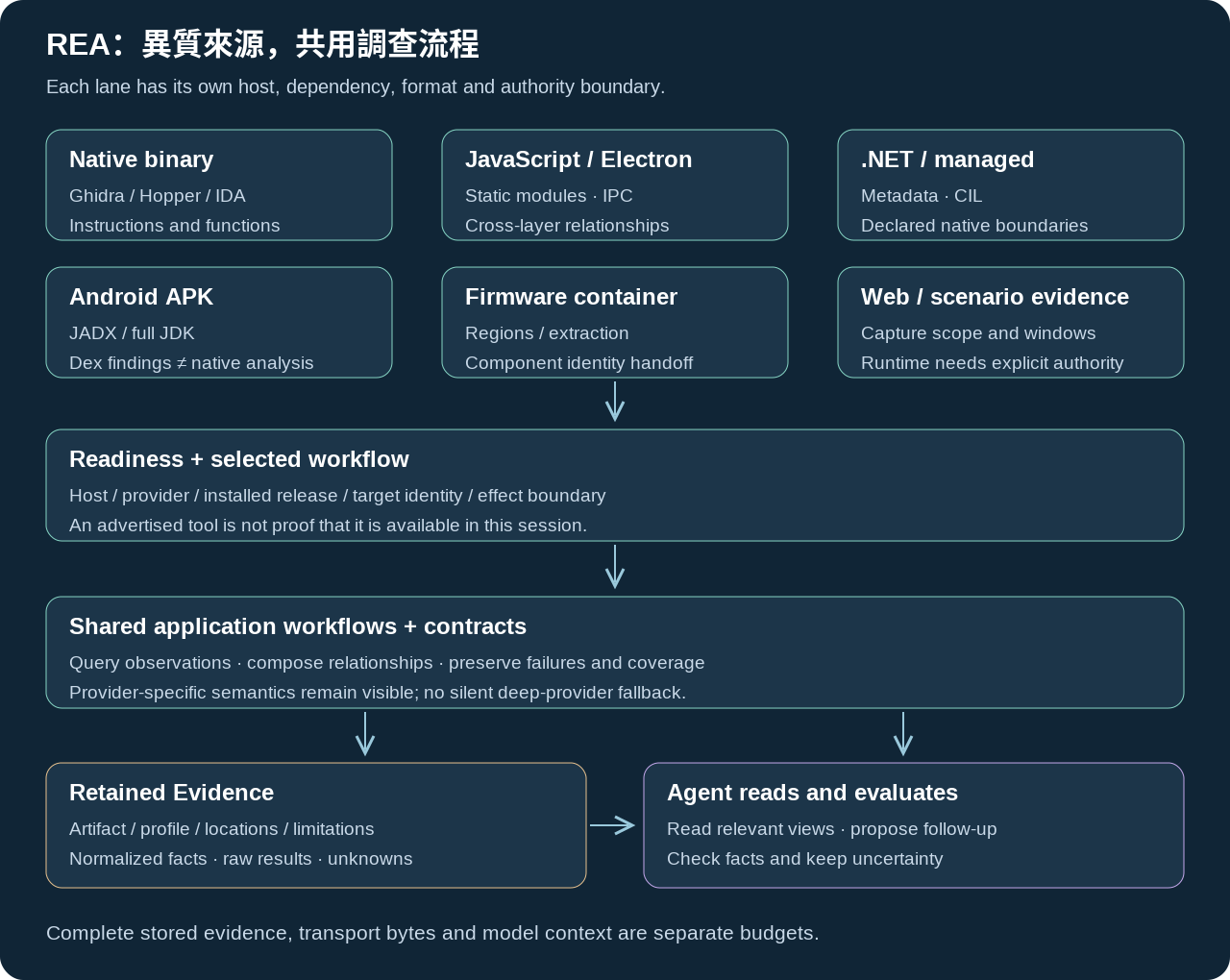
Composition/lifecycle, workflows, pure domain data, contracts and provider adapters are separated. This makes adding observation sources possible without rewriting the entire investigation behind every entry point. Architecture source.
Cross-tool does not mean uniform support. Each workflow retains host, format, dependency, version and authority constraints; a catalog entry does not prove current-session availability.
REA's capability map
| Target | Typical observations | Useful question | Boundary/dependency |
|---|---|---|---|
| Native binary | Instructions, functions, references, pseudocode | How does a selected algorithm/call relationship work? | Provider and host semantics vary |
| JavaScript/Electron | Modules, imports, IPC and graphs | How does renderer behavior reach main through preload? | Static relationships are not all runtime paths |
| .NET PE/CLI | Metadata, CIL and member/native boundaries | Which members changed and what native calls are declared? | Execution-free; not original C# recovery |
| Android APK | Manifest, classes, decompiled methods | Which components and Dex paths relate to a feature? | Headless JADX/full JDK; native code is separate |
| Firmware container | Regions, extracted artifacts and provenance | Which components merit native analysis? | Linux Binwalk/Unblob and external extractors |
| Website/saved traffic | DOM/scripts, captured events and HAR/SAZ | Which observed frontend/request facts support a flow? | Capture scope/time, not backend source |
| Process scenario | Terminal, exit and selected filesystem state | How do original/reconstruction runs differ? | Compatible PTY host; not an OS sandbox |
This is a conceptual index, not a complete support matrix. Sources: JS, .NET, Android, firmware, browser, captures, process.
A: Electron feature tracing
JS workflows query retained application graphs and bind native handoffs to matching artifact digests. When evidence suffices, tracing need not execute the app again or implicitly start another native provider. Cross-layer contracts.
My example question: why does an export button in a self-owned Electron app produce this format? Identify module candidates, follow preload exposure, IPC and the main handler, then verify any native addon's identity before a handoff.
The deliverable is a located relationship chain with missing modules, dynamic imports and unresolved calls preserved. It avoids reading an entire minified bundle at once, but a reachable static graph does not prove identical execution in every state.
B: .NET version and native-boundary investigation
The managed provider reads metadata/CIL, compares members/builds and inspects native declarations without executing the assembly. Build-local identities such as metadata tokens need correct cross-build mapping. Managed contracts.
For a self-owned C# plugin upgrade, I would identify deployment form, compare relevant signatures/bodies and distinguish P/Invoke declarations from exports in the supplied native artifact. Successful runtime binding belongs to a separately defined scenario.
This is more precise than sending every executable to Ghidra. Reading CIL does not recover the original solution, comments or source layout.
C: Website observations and API clues
CDP observation and offline HAR/SAZ evidence have different scopes. Browser guide, saved traffic.
For a search in a self-owned website, define inputs, actions and observation windows, then connect scripts and captured requests. Uncaptured bodies, backend logic, background jobs and other users' states remain outside that conclusion.
Passive observation is not general remote control or proof of every API contract. It can inform troubleshooting and interoperability specifications without pretending to recover a complete backend design.
D: Firmware and APK handoffs
Extracting regions/components still leaves loader, architecture and native analysis choices. JADX's APK/Dex results do not mean JNI libraries have been analyzed too. Firmware workflow, Android boundaries.
My handoff would retain container/component hashes, relative locations, settings and per-component status. That prevents a same-named library from another release becoming the source of a function claim.
REA's usage flow: readiness before investigation
This unexecuted planning example assumes a compatible installation and self-owned fixture:
rea doctor --json
rea providers --json
rea inspect "C:\rea-lab\fixtures\sample.exe" --provider ghidra --json
rea search "C:\rea-lab\fixtures\sample.exe" entry --kind procedures --provider ghidra --json
entry is an illustrative search, not an assumed function name. Select an actual returned name/address before inspection. MCP should likewise discover current availability and use its real schema. Native workflow/selectors.
I would give an agent this proposed task, not assume every model obeys it:
Investigate only the selected function in this fixed artifact.
Explain its inputs, returned value and observed callers.
Attach Evidence references and locations to claims.
Preserve unresolved calls and unavailable facets.
Start statically; propose a concrete scenario before target execution.
Acceptance must inspect calls and answers rather than the completeness of the instructions.
Coordination costs and responsibilities
| Cost source | Why | My management plan |
|---|---|---|
| Provider startup/analysis | External engines import/analyze artifacts | Measure initial and subsequent queries separately |
| Results/repeated context | Complete records and repeated reads can be large | Retain evidence, select facets, measure client input |
| Cross-layer identity | Containers, components and profiles differ | Verify digest, location and version at handoffs |
| Tool choice/recovery | Agents can misread valid contracts | Preserve invalid, failed and repeated calls |
| Execution/data authority | Reading, execution and transmission differ | Define scope and authority per workflow |
This is my cost model, not measured percentages. REA may reduce navigation and organization effort; elapsed time, tokens and quality still need matched questions and acceptance criteria.
Process Capture runs with user authority and is not a sandbox; new native Windows PTY capture is currently unsupported. Native Windows controls elsewhere do not imply parity for every dynamic workflow. Process Capture limits.
REA's entry points, session and bridge
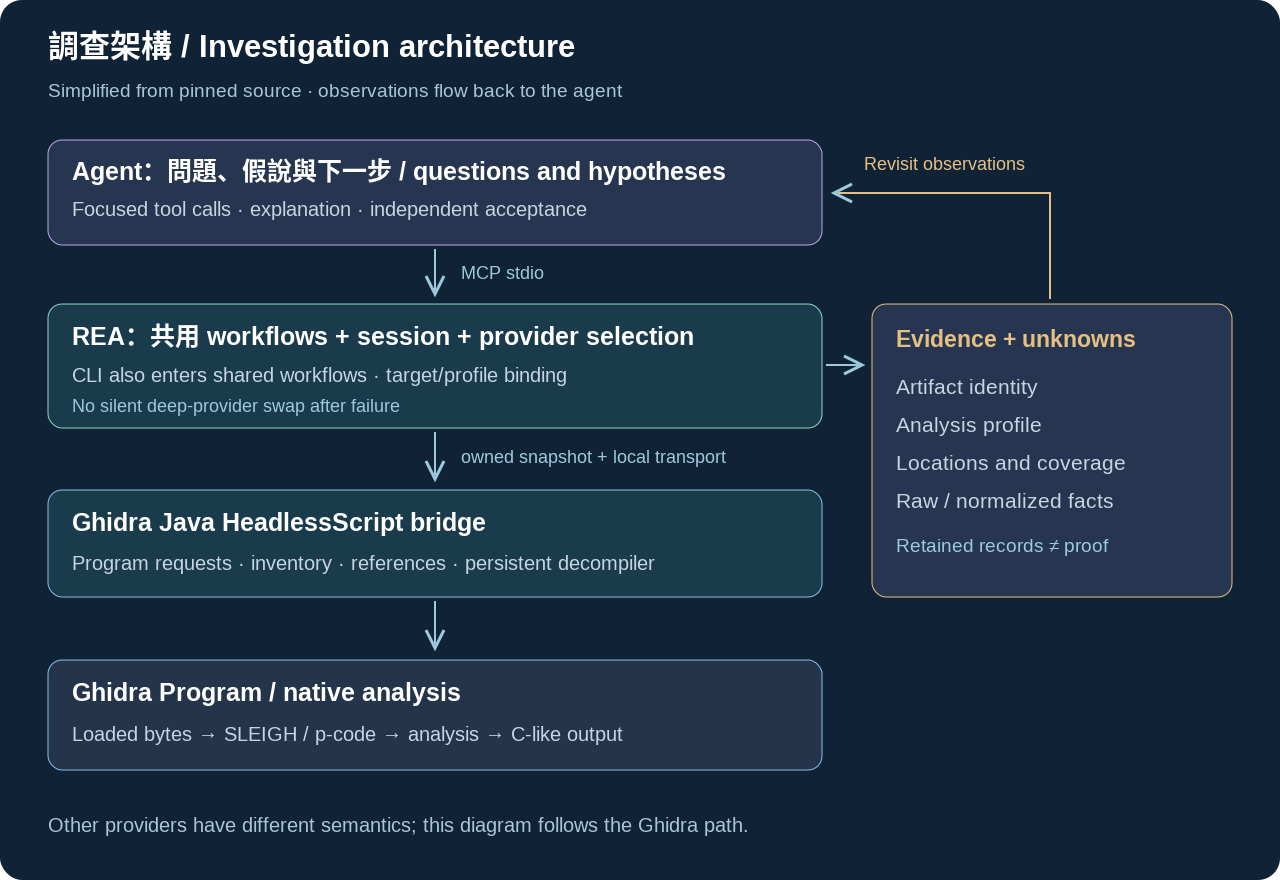
CLI and MCP feed shared application workflows, which compose providers, sessions and records. The Ghidra integration uses a Java HeadlessScript rather than model-driven GUI clicking. REA architecture.
| Component | Source location | Engineering role |
|---|---|---|
| CLI/MCP | src/cli.ts, src/main.ts, src/server/ | Interface adaptation over shared workflows |
| Composition/selection | src/composition/, provider registry | Explicit engine selection |
| Session | SessionProviderRouter, BinarySession | Bind target to deep provider |
| Ghidra adapter | src/ghidra/ | Discovery, snapshot, startup and lifecycle |
| Java bridge | ReaGhidraBridge.java | Read Program facts and decompiler output |
| Records | EvidenceLedger and related modules | Preserve observations and unresolved questions |
The target's deep-provider binding is not silently replaced after runtime failure. This matters when interpreting a single investigation: different engines' names, boundaries and results must not become an invisible composite truth. Session router.
The bridge maintains a DecompInterface; the adapter serializes Program requests through FIFO. Local transports include Unix sockets and authenticated loopback TCP on Windows. Neither implies a publicly exposed remote service or unrestricted Ghidra API concurrency. Bridge implementation, transport.
Ghidra's own persistent DecompInterface supports repeated function decompilation for one Program. That offers a useful lifecycle baseline, but first import, auto-analysis and later queries still need separate measurements. Ghidra interface.
Evidence is more useful than a polished explanation
REA distinguishes normalized results, provider representations, Evidence identity and analysis profile, and retains records in a session bundle. Result contract.
The ledger handles duplicate records and identity conflicts separately and validates bundles before state changes. Unresolved questions have records and revisions too. Record integrity does not prove that an analyzer or an interpretation is correct. EvidenceLedger.
This is my proposed report format, not a claimed universal REA output schema:
| Category | Example | Check |
|---|---|---|
| Observation | A masking constant appears at a selected address | Bytes, architecture, address and Evidence reference |
| Derivation | Unsigned output is within 0–7 | Width, data flow and other branches |
| Hypothesis | It may implement an eight-slot ring index | Callers and uses of the result |
| Unknown | Whether the source used % 8 | Admit the binary may not distinguish it |
The Ghidra analysis profile commits semantics and configuration identity. Matching artifact bytes alone do not make results from different settings or bridge semantics interchangeable. Profile implementation.
My interpretation: unresolved questions are a productive work queue. Recording an unresolved indirect call and a next inspection is better than supplying an unsupported target name.
Four ways observations get mistaken for proof
A missing string is not a missing feature. Ghidra searches defined string Data, which can omit undefined or packed content. Preserve scope and follow known bytes/references rather than turning an empty response into a universal negative. Provider semantics.
A missing static path is not runtime impossibility. Native call observations distinguish resolved, ambiguous and unresolved outcomes; indirect references do not establish every runtime target. My rule is to retain uncertainty when an expansion remains unresolved. Native investigation guide.
A value-flow graph is not complete business understanding. REA bounds high-p-code/def-use collection and reports truncation; composed tracing does not resolve all aliasing, effects or runtime semantics. A value reaching a file write does not by itself establish “backup,” and a buffer reaching a network call does not establish “password.” Dossier contract.
Different pseudocode is not automatic behavioral difference. My comparison would align artifact, profile and available facets, then inspect bytes, structure and reproducible behavior. Changed evidence identifies a question; it does not unconditionally prove semantic equivalence or difference.
Address precision needs a coordinate system
A hexadecimal number can refer to a file offset, loaded address, address space or procedure entry. REA preserves mappings and source identity rather than treating those coordinates as interchangeable. Mapping contract.
This is a hypothetical linear byte mapping, not a sampled target:
file_offset   = 0x200
mapping.start = 0x140001000
F             = 0x250
address       = mapping.start + (F - file_offset)
              = 0x140001050
The expression applies only within that mapping. It is not “image base plus any file offset.” Overlays, overlaps, unbacked regions and other spaces require an explicit selection. Precision without coordinates can make an incorrect answer more persuasive.
Upstream experiments: useful facts, bounded conclusions
The historical native entry-view experiment used Linux/Ghidra 12.1.4 and REA runtime 10400fdb…, not our local computer or this reviewed main revision. It compares a complete dossier with four retained-facet replies. Upstream checkpoint.
The PE facets are larger; the DOS facets are smaller. This does not establish universal token savings, and observing a packed DOS entry does not recover the whole editor.
The separate client-context investigation distinguishes raw replies, projected client output and model usage. It motivates observing the actual client boundary, not promising model costs. Context experiment.
My inference: retaining complete evidence while selecting relevant views may improve information selection. Repeated envelopes, context and recovery calls can offset that benefit; measure it per task.
Part III — Choosing direct Ghidra or REA
These are my recommendations, not official support promises or numerical rankings. Begin with a deliverable, not star counts or tool counts.
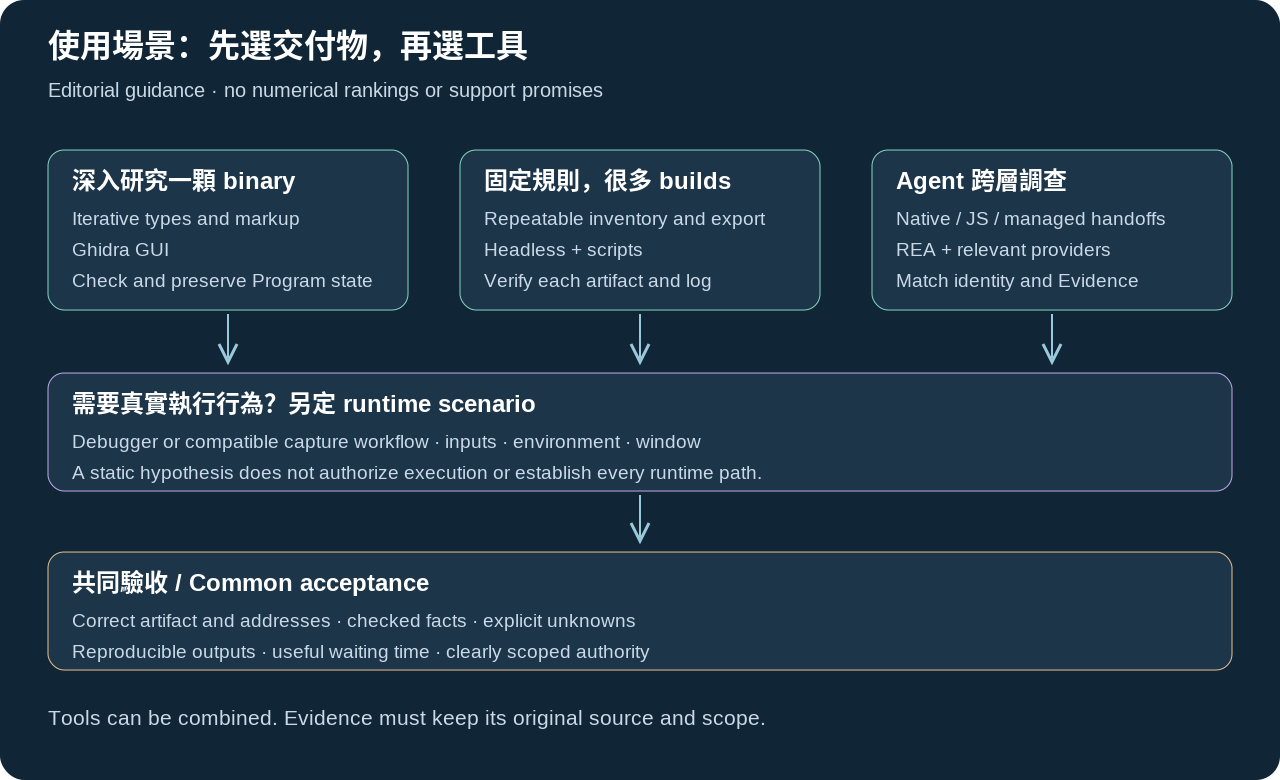
| Need | Start with | Reason | Acceptance |
|---|---|---|---|
| Deep, iterative binary research with markup | Ghidra GUI | Direct control of Program/navigation | Traceable decisions and transferable state |
| Fixed rules across self-owned builds | Headless/scripts | Deterministic work need not use a model | Logs, completeness, hashes and consistent outputs |
| Bounded native questions for an agent | REA + Ghidra | Contracts and Evidence join the conversation | Correct facts, locations, unknowns and costs |
| Features spanning JS/managed/native | REA cross-layer workflows | Multiple observations and identity handoffs | Correct provenance without version mixing |
| Actual behavior for specified inputs | Explicit debugger/capture scenario | Static relations cannot substitute for runtime | Inputs, window, environment and scope |
An end-to-end combination
Suppose a self-owned desktop app uses a source-less native converter whose output changes after an upgrade. I would use REA to trace frontend-to-module relationships and verify addon identity, then Ghidra to inspect relevant types, branches and output generation.
If needed markup exceeds the adapter's exposed operations, work directly in Ghidra and preserve that analysis state separately. Do not assume arbitrary GUI projects synchronize through REA. Finish with authorized fixed-input regression tests and have the agent organize confirmed facts, candidate causes and unknowns.
The deliverable is checkable change analysis and tests, not unrestricted replication of another product. This scenario is hypothetical and adds no local benchmark results.
Connecting a local model is a separate evaluation problem
REA analysis and model inference are different workloads. More model GPU cache does not automatically accelerate JVM import/analysis. Context, tool schemas and multi-turn state need their own budget. These are design inferences, not measured local results.
I would start with a narrow question: identify uses of a selected return value, cite evidence and retain unresolved relationships. Discover available tools, read selected inventories/instructions and obtain a dossier only when needed. Dumping an entire tool catalog and string inventory at the beginning is a poor default for limited context.
Result encoding and budgets are handled by the tool-result implementation; CLI operations expose Evidence workflows. A reply fitting the transport is not proof it fits the model context. Tool-result code, CLI/Evidence guide.
| Measurement I propose | Boundary | Prevents |
|---|---|---|
| First analysis | Session open to useful result | Blaming model inference for all import latency |
| Later queries | Same-session request/reply | Comparing against process restart silently |
| Model usage | Actual per-round input/output/cache | Converting JSON bytes into billed tokens |
| Tool behavior | Correct, failed and repeated calls | Judging only prose quality |
| Fact correctness | Fixed oracle requirements | Treating citations as proof of correctness |
| Uncertainty | Required unresolved facts retained | Rewarding confident fabrication |
| System resources | Model, JVM, Node and child processes | Reporting one RSS as the whole workload |
This extends our earlier local-agent setup work: a working connection and adequate context are the beginning; analysis semantics and acceptance come next.
Execution and data boundaries belong in the architecture
REA describes local analysis while noting that model providers apply their own data policies to tool results received by agents. Local analysis does not make the entire conversation offline. REA FAQ.
My authority model separates reading artifacts, annotating analysis databases, executing targets and transmitting results. An ephemeral database edit is also different from modifying executable bytes. Those distinctions should remain visible through a workflow.
Target strings, pseudocode and even error output may contain instruction-like content. REA marks target-derived results as untrusted; that provenance signal is useful to hosts but does not guarantee a model will obey. Target-content contract.
A fixture string requesting a helper download should be reported as target data, never become authority to execute a new command. This can be scored with a known oracle rather than assumed from a polite system prompt.
Windows and the Z13: capability before capacity
Windows Ghidra P0 is an experimental read-only adapter boundary. It requires Windows x64, fixed local NTFS target/temp volumes, compatible Node, installed Ghidra 12.1.x and a full JDK. Native controls govern filesystem and owned-process admission. Windows guide.
| Area | Check separately |
|---|---|
| Native Windows PE | Host/target admission and installed release capabilities |
| Managed .NET | Separate static provider, not forced native analysis |
| Other formats/architectures | Linux/macOS support does not imply Windows parity |
| GUI and persistent projects | Ghidra capabilities are not automatically adapter operations |
| exFAT/network/reparse paths | Admission constraints cannot be fixed with more RAM |
There is a version distinction: development Ghidra README points to JDK 25, while REA's 12.1.x guide describes JDK 21+. Follow the selected distribution's own guide alongside REA's validated versions and diagnostics. Development README, installation/release boundaries.
I would record Node, REA, Ghidra and JDK versions and provenance, then run the installed environment's rea doctor --json and rea providers --json. Only after compatibility passes would I inspect a self-built harmless fixture. This article installed nothing, changed no agent settings and loaded no target binary.
A test that would actually establish useful capability
REA distinguishes fake seams, CLI/MCP boundaries, real toolchain lanes and agent verification. Those establish different levels of confidence. Testing documentation.
My proposed corpus has three self-owned fixtures. Source stays with the evaluator rather than the investigation agent:
| Fixture | Agent task | Oracle |
|---|---|---|
| Unsigned mask/branch | Explain widths, ranges and branches | Boundary inputs and original instructions |
| Function-pointer dispatch | Separate resolved paths and unknown targets | Known branches and required uncertainty |
| Different optimization/symbol settings | Compare observations and retained behavior | Artifact hashes, source and compiler commands |
Not yet executed: freeze toolchain, model and prompt; verify import and instruction facts in Ghidra; compare CLI/MCP normalized observations; run the same agent question three times; score each fact and unknown; measure startup, repeated queries, context and whole-process resources separately.
Wrong addresses, fabricated targets, lost uncertainty or references to a different artifact are failures even if the explanation reads well. Correctly admitting that an original variable name cannot be recovered is a capability, not a grading defect.
My assessment
Ghidra is a durable analysis foundation. Inspectable instructions, references and reconstructed semantics remain useful when the model changes.
REA adds an agent-oriented coordination layer. Identity, sessions, capability discovery, failure handling, Evidence and unknowns are more consequential than another decompile button. Provider differences, output sizes and actual agent behavior remain integration costs.
My hypothesis is that AI reverse engineering becomes dependable first on bounded investigations: selected data flows, function relationships, known-version comparisons and testable reconstruction. MCP connectivity does not establish complete autonomous recovery of arbitrary software.
I would use the projects together and replace “recover the source” with a testable objective: for this fixed artifact, question and input scope, produce an analysis that counterexamples can challenge. That makes both the saved effort and the remaining human responsibility visible.